
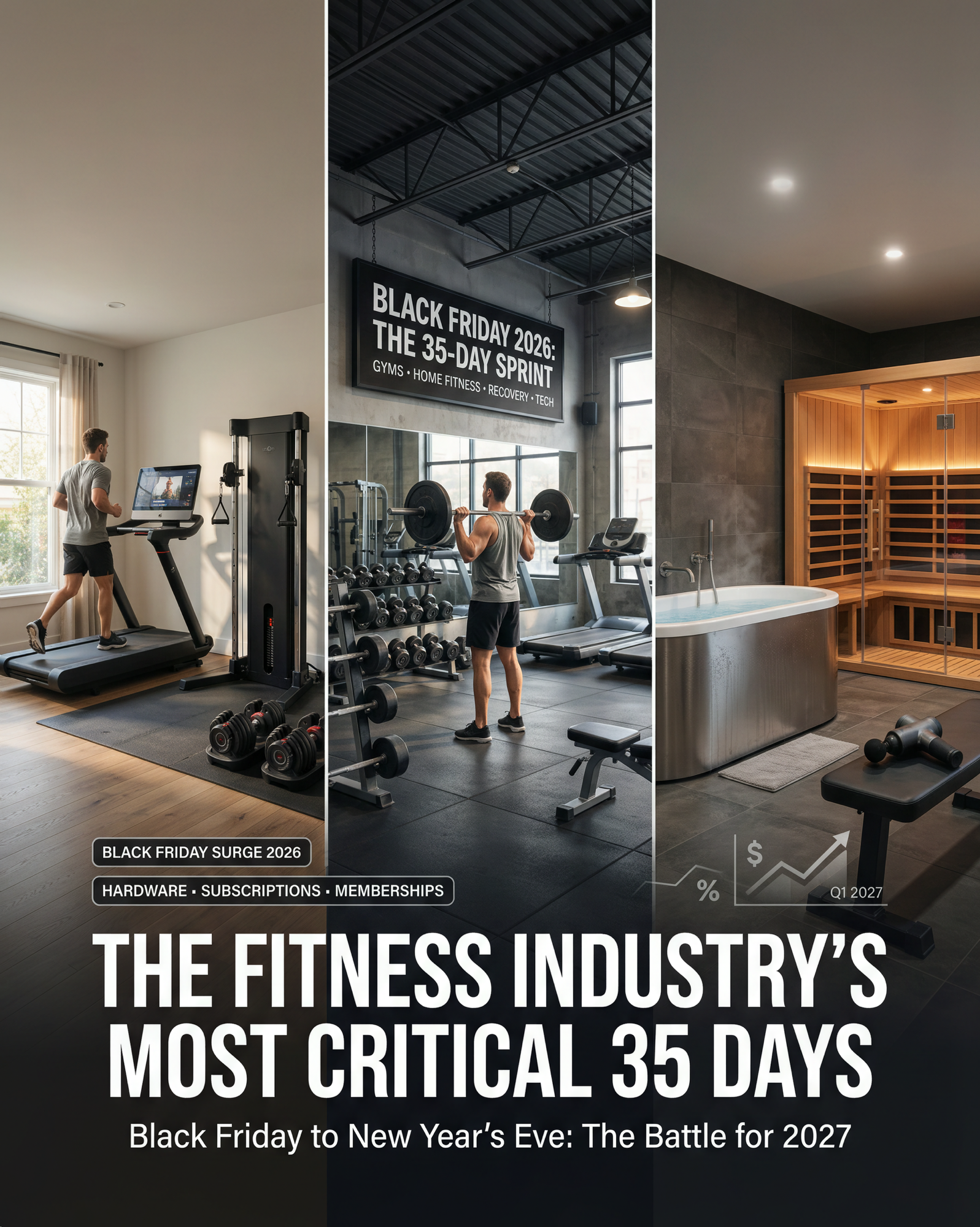
For most retail sectors, Black Friday is the grand finale of the year. For the fitness industry—spanning brick-and-mortar gyms, boutique studios, connected home gyms, and recovery gear makers—Black Friday 2026 is the opening bell of a high-stakes, 35-day survival and acquisition sprint.

Between November 27 and December 31, 2026, the global fitness ecosystem navigates a stark contradiction: physical gym floor traffic typically drops as holiday travel and social commitments disrupt routines, yet consumer purchasing intent for wellness, gifting, and self-improvement hits its annual inflection point. How brands, studios, and equipment manufacturers execute during this five-week stretch determines their cash reserves, inventory health, and recurring revenue trajectory for the entire first half of 2027.
1. Why the Fitness Industry Needs Black Friday 2026
After navigating post-pandemic normalization, macroeconomic tightening, and Q3 2026 earnings pressure across discretionary consumer goods, fitness operators can no longer rely passively on organic January walk-ins. Black Friday 2026 serves four critical structural functions:
- Clearing Overstocked Hardware & Protecting Cash Flow: Smart home gym and recovery hardware brands—such as Peloton, BowFlex, NordicTrack, Speediance, and Plunge—enter Q4 carrying heavy balance-sheet inventory. Steep Black Friday markdowns (ranging from 25% to 40% off) convert stagnant warehouse stock into immediate liquidity before year-end accounting close.
- The “Razor-and-Blade” Subscription Lock-In: Connected fitness manufacturers willingly sacrifice upfront hardware margin—often selling bikes, rowers, and smart strength trainers near break-even—because each unit sold unlocks a multi-year digital membership stream carrying gross margins above 70%. Acquiring a subscriber in late November at a discounted customer acquisition cost (CAC) yields 12+ months of high-margin recurring billing.
- Rescuing Brick-and-Mortar Gyms From the December Slump: Commercial gyms and boutique studios face a predictable year-end attendance dip and elevated churn between Thanksgiving and Christmas. Black Friday cash injections—driven by paid-in-full annual memberships, discounted class packs, and gift cards—bridge the Q4 operational cash gap when regular floor traffic slows down.
- Capturing Early-Decision Wellness Shoppers: As colder winter weather pushes outdoor athletes indoors, demand surges for home strength gear, apparel, and recovery tools (cold plunges, infrared saunas, percussion massagers). Research from OfferingTree notes that Black Friday discounts generally need to hit at least the 20% threshold—or pair full-price packages with high-value tangible bonuses (77% of consumers report a free gift increases purchase likelihood)—to break through holiday noise.
2. Segment-by-Segment Breakdown: How Each Sector Plays the Window
Industry SegmentPrimary Black Friday 2026 LeverCore Strategic Objective Connected Home Gyms & Smart StrengthDeep hardware discounts ($400–$1,300+ off) paired with multi-month app trialsPull Q1 hardware demand forward; lock in recurring monthly software subscriptions before competitors capture the household budget. Recovery & Biohacking GearHigh-dollar markdowns ($2,000–$3,500 off saunas/plunges) & bundled accessoriesCompress luxury price barriers for affluent gift-givers and home-wellness upgraders during peak winter indoor training. Commercial Gyms & Health Clubs$0 enrollment fees, locked-in 2026 rates, and “Commit Now, Start in January” pre-salesPre-sell Q1 membership capacity early to lower January marketing costs and stabilize Q4 cash flow. Boutique Studios & Independent CoachesPaid-in-full annual passes (~30% off), BOGO gift cards, and retail grab bagsSecure upfront cash reserves and turn holiday gift card buyers into new January studio faces.
3. What the 35 Days Between Black Friday and Dec 31 Mean for the Overall Industry
The five-week corridor from November 27 through December 31 is not merely a retail shopping window—it is the operational staging ground for the “New Year, New Me” Q1 surge, which still accounts for roughly 30% to 40% of annual new member and equipment acquisition across the fitness sector.
A. Pulling Forward “Resolution” Demand (Pre-Empting January)
Wait-and-see strategies are fatal in modern fitness. If a consumer buys a Peloton Tread, a NordicTrack rower, or a set of adjustable dumbbells on Black Friday or Cyber Monday, that consumer is off the market for a commercial gym membership in January. Conversely, gyms that run “Commit Now, Start Later” campaigns in December lock in members before big-box competitors flood digital ad auctions in January—when cost-per-click (CPC) rates across fitness keywords spike dramatically.
B. The Logistics & Fulfillment Bottleneck
For at-home gym equipment and heavy recovery gear (such as 300-pound cold plunges or home saunas), the window between November 27 and mid-December represents the absolute cutoff for white-glove freight delivery before January 1. Equipment delivered and assembled in December allows users to build habits immediately on January 1, dramatically reducing early-year return rates.
C. The Gift Card Multiplier Effect
According to National Retail Federation data cited in industry analyses by OfferingTree and Mindbody, nearly half (47%) of holiday shoppers want to receive gift cards. When gyms, studios, and sporting goods retailers sell discounted or BOGO gift cards between Black Friday and Christmas Eve, they book immediate unearned revenue in Q4 while guaranteeing foot traffic and redemptions in January and February.
D. Retention & “The January Cliff” Prevention
As fitness creator platform Playbook highlights in its 2026 holiday commerce research, discount-acquired members renew at noticeably lower rates than full-price buyers unless onboarded immediately. Consequently, smart operators use December not just to sell, but to run low-barrier accountability challenges (“12 Days of Fitness” or “Holiday Hustle” programs) that keep November buyers engaged through the holidays so they don’t churn before Q1 begins.
4. Ready-to-Publish Social / Blog Post Version
Why Black Friday 2026 Is Make-or-Break for the Fitness Industry 🏋️♂️📉📈
Most people think January 1 is the biggest day of the year for fitness. Behind the scenes, the real battle is won—or lost—between Black Friday and December 31.
This year, connected fitness giants, home-gym makers, and recovery brands are rolling out some of the steepest holiday markdowns we’ve seen—up to $1,300 off smart cardio, 30%+ off home strength systems, and thousands off cold plunges and saunas. Meanwhile, local gyms and boutique studios are pushing paid-in-full annual passes and BOGO gift cards.
Why does this 35-day window matter so much?
- Hardware Brands Need Recurring Revenue: Connected fitness companies trade upfront hardware margin on Black Friday to lock in high-margin monthly app subscriptions heading into 2027.
- Gyms Need to Beat the December Slump: Holiday travel empties gym floors in December. Black Friday cash injections keep independent studios profitable before the January rush.
- Pre-Empting the Resolution Rush: Every home gym delivered in December is one less person shopping for a gym membership on January 2. Conversely, every gym that sells a “Start in January” pass in December avoids skyrocketing Q1 ad costs.
- The Gift Card Pipeline: Nearly half of holiday shoppers want gift cards—turning December retail sales into guaranteed January foot traffic.
In fitness, Q4 isn’t the end of the year—it’s the launchpad for Q1.
Sources & Further Reading
- Mindbody Business: 7 Tips to Help Fitness Businesses Prepare for Black Friday and Small Business Saturday
- OfferingTree: Black Friday 2026 for Studios: Offers That Actually Sell
- Playbook: Black Friday Guide for Fitness Creators (2026)
- Your Limitless Studio: Black Friday 2026: The Ultimate Marketing Guide for Fitness Studios
- Future Fit for Business: Low Gym Attendance at Year-End? Here’s How to Respond Strategically
- Business Insider / GlobeNewswire: Speediance Black Friday Sale Brings Up to 33% Off Smart Home Gyms (Nov 2026)
The Golden Window: Why the 35 Days From Black Friday 2026 to New Year’s Eve Decide the Fitness Industry’s Fate
For most retail sectors, Black Friday is the grand finale of the year. For the fitness industry—spanning brick-and-mortar gyms, boutique studios, connected home gyms, and recovery gear makers—Black Friday 2026 is the opening bell of a high-stakes, 35-day survival and acquisition sprint.
Between November 27 and December 31, 2026, the global fitness ecosystem navigates a stark contradiction: physical gym floor traffic typically drops as holiday travel and social commitments disrupt routines, yet consumer purchasing intent for wellness, gifting, and self-improvement hits its annual inflection point. How brands, studios, and equipment manufacturers execute during this five-week stretch determines their cash reserves, inventory health, and recurring revenue trajectory for the entire first half of 2027.
1. Why the Fitness Industry Needs Black Friday 2026
After navigating post-pandemic normalization, macroeconomic tightening, and Q3 2026 earnings pressure across discretionary consumer goods, fitness operators can no longer rely passively on organic January walk-ins. Black Friday 2026 serves four critical structural functions:
- Clearing Overstocked Hardware & Protecting Cash Flow: Smart home gym and recovery hardware brands—such as Peloton, BowFlex, NordicTrack, Speediance, and Plunge—enter Q4 carrying heavy balance-sheet inventory. Steep Black Friday markdowns (ranging from 25% to 40% off) convert stagnant warehouse stock into immediate liquidity before year-end accounting close.
- The “Razor-and-Blade” Subscription Lock-In: Connected fitness manufacturers willingly sacrifice upfront hardware margin—often selling bikes, rowers, and smart strength trainers near break-even—because each unit sold unlocks a multi-year digital membership stream carrying gross margins above 70%. Acquiring a subscriber in late November at a discounted customer acquisition cost (CAC) yields 12+ months of high-margin recurring billing.
- Rescuing Brick-and-Mortar Gyms From the December Slump: Commercial gyms and boutique studios face a predictable year-end attendance dip and elevated churn between Thanksgiving and Christmas. Black Friday cash injections—driven by paid-in-full annual memberships, discounted class packs, and gift cards—bridge the Q4 operational cash gap when regular floor traffic slows down.
- Capturing Early-Decision Wellness Shoppers: As colder winter weather pushes outdoor athletes indoors, demand surges for home strength gear, apparel, and recovery tools (cold plunges, infrared saunas, percussion massagers). Research from OfferingTree notes that Black Friday discounts generally need to hit at least the 20% threshold—or pair full-price packages with high-value tangible bonuses (77% of consumers report a free gift increases purchase likelihood)—to break through holiday noise.
2. Segment-by-Segment Breakdown: How Each Sector Plays the Window
Industry SegmentPrimary Black Friday 2026 LeverCore Strategic Objective Connected Home Gyms & Smart StrengthDeep hardware discounts ($400–$1,300+ off) paired with multi-month app trialsPull Q1 hardware demand forward; lock in recurring monthly software subscriptions before competitors capture the household budget. Recovery & Biohacking GearHigh-dollar markdowns ($2,000–$3,500 off saunas/plunges) & bundled accessoriesCompress luxury price barriers for affluent gift-givers and home-wellness upgraders during peak winter indoor training. Commercial Gyms & Health Clubs$0 enrollment fees, locked-in 2026 rates, and “Commit Now, Start in January” pre-salesPre-sell Q1 membership capacity early to lower January marketing costs and stabilize Q4 cash flow. Boutique Studios & Independent CoachesPaid-in-full annual passes (~30% off), BOGO gift cards, and retail grab bagsSecure upfront cash reserves and turn holiday gift card buyers into new January studio faces.
3. What the 35 Days Between Black Friday and Dec 31 Mean for the Overall Industry
The five-week corridor from November 27 through December 31 is not merely a retail shopping window—it is the operational staging ground for the “New Year, New Me” Q1 surge, which still accounts for roughly 30% to 40% of annual new member and equipment acquisition across the fitness sector.
A. Pulling Forward “Resolution” Demand (Pre-Empting January)
Wait-and-see strategies are fatal in modern fitness. If a consumer buys a Peloton Tread, a NordicTrack rower, or a set of adjustable dumbbells on Black Friday or Cyber Monday, that consumer is off the market for a commercial gym membership in January. Conversely, gyms that run “Commit Now, Start Later” campaigns in December lock in members before big-box competitors flood digital ad auctions in January—when cost-per-click (CPC) rates across fitness keywords spike dramatically.
B. The Logistics & Fulfillment Bottleneck
For at-home gym equipment and heavy recovery gear (such as 300-pound cold plunges or home saunas), the window between November 27 and mid-December represents the absolute cutoff for white-glove freight delivery before January 1. Equipment delivered and assembled in December allows users to build habits immediately on January 1, dramatically reducing early-year return rates.
C. The Gift Card Multiplier Effect
According to National Retail Federation data cited in industry analyses by OfferingTree and Mindbody, nearly half (47%) of holiday shoppers want to receive gift cards. When gyms, studios, and sporting goods retailers sell discounted or BOGO gift cards between Black Friday and Christmas Eve, they book immediate unearned revenue in Q4 while guaranteeing foot traffic and redemptions in January and February.
D. Retention & “The January Cliff” Prevention
As fitness creator platform Playbook highlights in its 2026 holiday commerce research, discount-acquired members renew at noticeably lower rates than full-price buyers unless onboarded immediately. Consequently, smart operators use December not just to sell, but to run low-barrier accountability challenges (“12 Days of Fitness” or “Holiday Hustle” programs) that keep November buyers engaged through the holidays so they don’t churn before Q1 begins.
Why Black Friday 2026 Is Make-or-Break for the Fitness Industry 🏋️♂️📉📈
Most people think January 1 is the biggest day of the year for fitness. Behind the scenes, the real battle is won—or lost—between Black Friday and December 31.
This year, connected fitness giants, home-gym makers, and recovery brands are rolling out some of the steepest holiday markdowns we’ve seen—up to $1,300 off smart cardio, 30%+ off home strength systems, and thousands off cold plunges and saunas. Meanwhile, local gyms and boutique studios are pushing paid-in-full annual passes and BOGO gift cards.
Why does this 35-day window matter so much?
- Hardware Brands Need Recurring Revenue: Connected fitness companies trade upfront hardware margin on Black Friday to lock in high-margin monthly app subscriptions heading into 2027.
- Gyms Need to Beat the December Slump: Holiday travel empties gym floors in December. Black Friday cash injections keep independent studios profitable before the January rush.
- Pre-Empting the Resolution Rush: Every home gym delivered in December is one less person shopping for a gym membership on January 2. Conversely, every gym that sells a “Start in January” pass in December avoids skyrocketing Q1 ad costs.
- The Gift Card Pipeline: Nearly half of holiday shoppers want gift cards—turning December retail sales into guaranteed January foot traffic.
In fitness, Q4 isn’t the end of the year—it’s the launchpad for Q1.
Sources & Further Reading
- Mindbody Business: 7 Tips to Help Fitness Businesses Prepare for Black Friday and Small Business Saturday
- OfferingTree: Black Friday 2026 for Studios: Offers That Actually Sell
- Playbook: Black Friday Guide for Fitness Creators (2026)
- Your Limitless Studio: Black Friday 2026: The Ultimate Marketing Guide for Fitness Studios
- Future Fit for Business: Low Gym Attendance at Year-End? Here’s How to Respond Strategically
- Business Insider / GlobeNewswire: Speediance Black Friday Sale Brings Up to 33% Off Smart Home Gyms (Nov 2026)
Leave a Reply