
Recently, a Men’s Health post circulating on X claimed to have the “simple advice” and the exact workout mistake to avoid if you want to be super fit in your 50s, featuring trainer Bryan Krahn. While the underlying message of moving safely is valid, we need to be highly skeptical of the fitness industry’s packaging. The idea that there is a “special” workout or a single, magical quick fix to outsmart aging is a marketing trap.

There is no ideal workout. If you are hunting for the ultimate, secret routine that will effortlessly melt away a dad bod and rebuild your 25-year-old joints, you are wasting your time. What truly dictates how well you age isn’t a shiny new routine—it’s consistency.
Here is what the science and decades of strength training data actually tell us about aging better:
Ditch the “Special” Routine for Push, Pull, Legs (PPL) You don’t need an exotic, reinvented wheel. The foundation of longevity in lifting is a well-structured Push, Pull, and Legs (PPL) split. Splitting your routine this way ensures you hit all major muscle groups symmetrically, allows adequate recovery for aging joints, and prevents overuse injuries. Organizing your training around fundamental movement patterns (pushing, pulling, and squatting/hinging) is far more effective for older adults than isolation-heavy routines or random, high-intensity circuit classes.
Periodization is Non-Negotiable Going 100% intensity every time you step into the gym in your 50s is a one-way ticket to the orthopedist. Your body needs periodization—the systematic planning of varying your training volume and intensity over time. Research published by the National Institutes of Health (NIH) repeatedly demonstrates that older adults must balance heavier, lower-rep strength phases with lighter, higher-volume phases to stimulate muscle hypertrophy without wrecking tendons and ligaments.
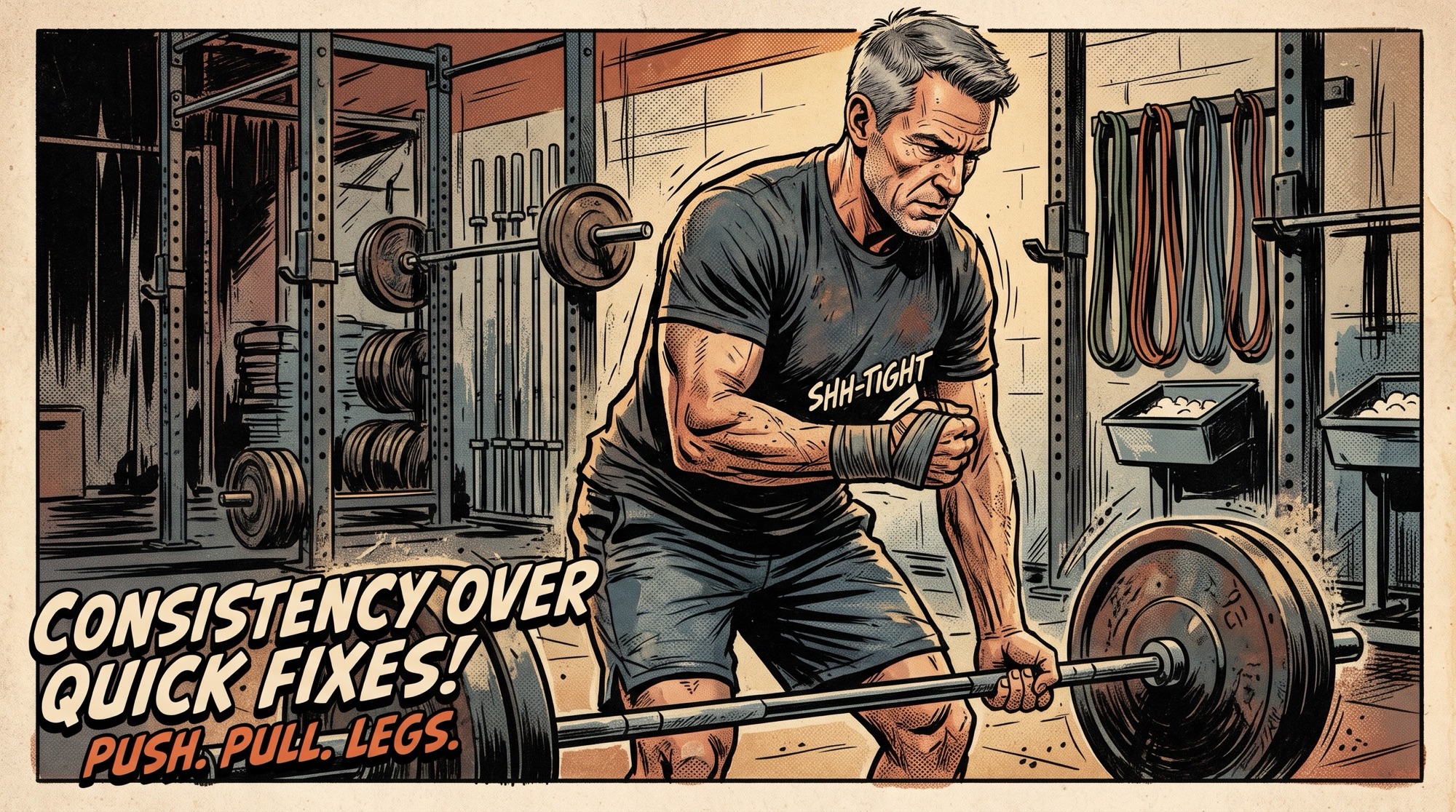
Consistency Outperforms Quick Fixes Aging naturally attenuates the hypertrophic response, meaning you cannot just blast your muscles for a four-week bootcamp and expect a miracle. The National Institute on Aging (NIA) highlights that to build healthier bodies, steady, weekly strength training is mandatory. Showing up three to four days a week for years will always beat a trendy, short-term program.
Do not get distracted by clickbait promising the “one mistake” you need to fix. Get on a basic Push, Pull, and Legs split, periodize your weights to manage physical fatigue, and commit to showing up consistently for the long haul.
Sources & Further Reading:
- National Institute on Aging (NIA): “How can strength training build healthier bodies as we age?” (https://www.nia.nih.gov/news/how-can-strength-training-build-healthier-bodies-we-age)
- National Institutes of Health (NIH) / PubMed: “Effect of age on muscle hypertrophy induced by resistance training” (https://pubmed.ncbi.nlm.nih.gov/8914498/)
- Bryan Krahn’s Over 50 Muscle: (https://over50muscle.com/)
Leave a Reply