
Emideltide Keeps Getting a ‘No’ for Compounding. What’s the Problem?
Why the government’s renewed interest in peptides excludes this one.
The regulatory landscape for compounded peptides has shifted dramatically in 2026. After years of tight restrictions, federal health officials opened the door for several popular wellness and recovery peptides—yet Emideltide, widely known as Delta Sleep-Inducing Peptide (DSIP), keeps getting left out in the cold.
In July 2026, the FDA’s Pharmacy Compounding Advisory Committee (PCAC) reviewed seven peptide families for potential inclusion on the Section 503A Bulks List: BPC-157, KPV, TB-500, MOTS-c, Epitalon, Semax, and Emideltide. The panel voted in favor of recommending six of those seven. Then, on October 28, 2026, the Department of Health and Human Services (HHS) issued an interim policy declining to take enforcement action against pharmacies compounding those six recommended peptides under specific conditions while formal rulemaking moves forward.
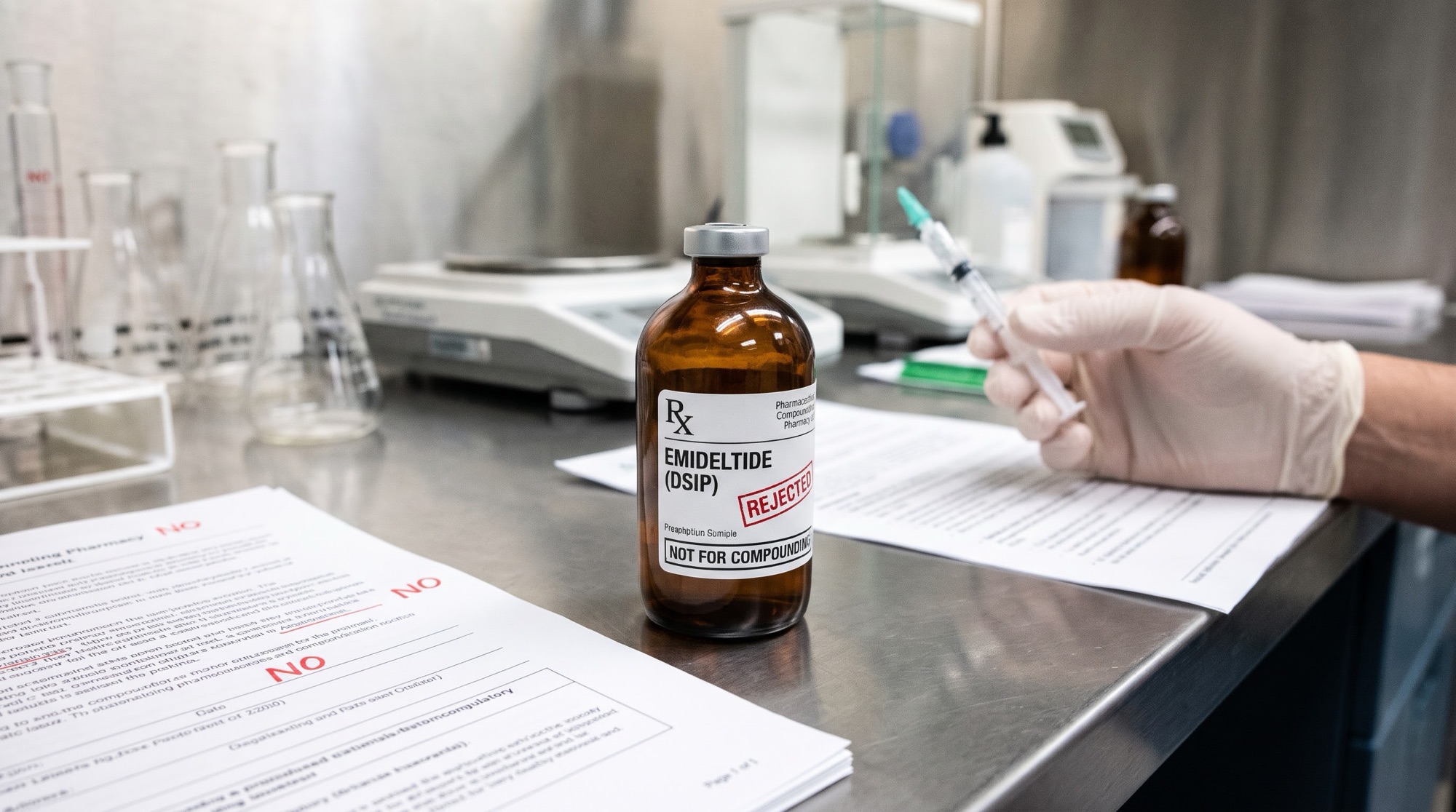
Emideltide (DSIP) was the sole rejection at the July committee meeting—and it remains excluded from the HHS interim policy. Even when regulators are showing renewed flexibility toward peptides, why does this nine-amino-acid sleep peptide keep hitting a brick wall?

4 Reasons Regulators Keep Saying “No” to Emideltide
- 1. Chemical Identity and Solubility Headaches FDA reviewers flagged major issues with how Emideltide is characterized. There is no official USP or National Formulary monograph for either its free base or acetate forms, and multiple salts and derivatives circulate commercially under the generic “DSIP” label. Even more concerning for an injectable product, Emideltide has poor water solubility—FDA staff noted it is unclear how a proposed 1,000 µg/mL injectable could even be formulated without a co-solvent, and nominations lacked critical bacterial endotoxin testing for subcutaneous administration.
- 2. Impurity and Immune Reaction Risks Because synthetic peptides can carry process-related impurities and tend to aggregate, the FDA warned that compounded Emideltide may pose a risk of immunogenicity (triggering unwanted immune responses) depending on the route of administration. The agency found no adequate safety data supporting subcutaneous injection in humans.
- 3. Fifty Years of Murky Science Despite being isolated from rabbit cerebral blood back in 1977, DSIP remains a biological puzzle. Scientists still have not isolated a dedicated DSIP gene or receptor. Human clinical studies are small, decades old, relied on intravenous infusions rather than under-the-skin injections, and produced inconsistent results for sleep architecture.
- 4. Proven, FDA-Approved Alternatives Already Exist When evaluating a bulk substance for compounding, regulators weigh clinical need against safety risks. The three conditions reviewed for Emideltide—chronic insomnia, narcolepsy, and opioid withdrawal—are serious medical conditions that already have well-established, FDA-approved medications and evidence-based therapies. Panel members noted little justification for exposing patients to an uncharacterized injectable when proven treatments are available.
The Bottom Line for Patients and Providers
While BPC-157, TB-500, Epitalon, KPV, MOTS-c, and Semax gained regulatory momentum through the 2026 PCAC recommendations and the October HHS interim policy, Emideltide did not make the cut. Without an FDA-approved product, a USP monograph, or placement on the 503A Bulks List, Emideltide remains off-limits for legal 503A pharmacy compounding—leaving products sold online strictly in the unverified “research chemical” gray market.
Sources & Further Reading:
- FDA Briefing Document: Pharmacy Compounding Advisory Committee Evaluation of Emideltide
- McDermott Will & Emery: HHS Issues Interim Policy on Peptide Compounding
- Restorative Compounding Pharmacy: DSIP (Emideltide) Sleep Research & FDA Vote
- Grey Peptides: Why the FDA Committee Rejected the Sleep Peptide
Leave a Reply