
BODi Q3 2026 Earnings: Inside the Subscriber Collapse and the Costly Fall of Connected Fitness
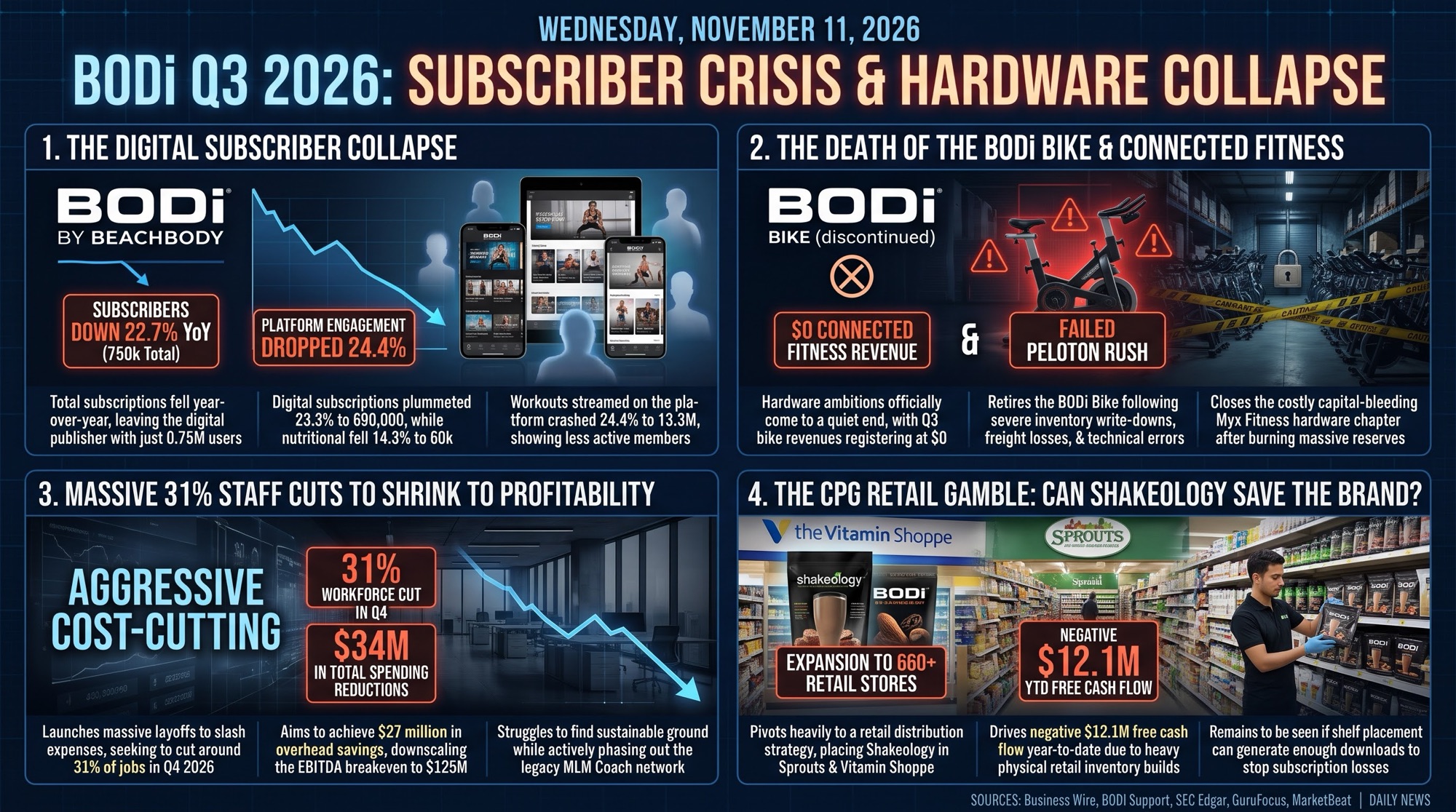
The Verdict: The Beachbody Company’s (BODi) Q3 2026 financial report illustrates the severe consequences of a failed hardware gambit and a broken top-of-funnel customer engine. While management celebrated a 12th consecutive quarter of positive Adjusted EBITDA ($6.4 million) and trimmed the company’s breakeven operational threshold to $125 million, total subscriptions tumbled 22.7% year-over-year.

Behind these numbers lies the painful aftermath of Beachbody’s ill-fated attempt to chase Peloton into connected fitness—an expensive hardware misadventure that burned massive amounts of capital and accelerated subscriber churn.
1. The Subscriber & Retention Reality: A Leaky Funnel
The Q3 metrics confirm that BODi is still unable to replace the customers it is losing:
- Digital Attrition: Digital subscriptions fell 23.3% year-over-year to 690,000 (down from 900,000 in Q3 2025).
- Nutritional Subscriptions Drop: Nutritional recurring subscriptions dropped 14.3% to 60,000 (down from 70,000).
- Platform Engagement Plunge: Total workout streams dropped 24.4% to 13.3 million (compared to 17.6 million in Q3 2025), showing that remaining members are using the digital platform significantly less.
- Retention Degradation: While the company reported a headline average digital retention rate of 95.4%, this represented a 150 basis-point drop from 96.9% in the prior year. Management conceded on the earnings call that overall subscriber attrition continues to outpace new member acquisition.
With deferred subscription revenue shrinking and guidance projecting Q4 revenue to contract further to $38M–$42M, BODi’s customer base is actively diminishing.
2. The Connected Fitness Disaster: From SPAC Darling to Discontinuation
To understand how BODi found itself cutting 31% of its workforce and shedding hundreds of thousands of subscribers, one must look at its disastrous entry into indoor cycling.
- The 2021 SPAC Frenzy: At the height of the home-fitness pandemic boom, Beachbody merged with Forest Road Acquisition Corp (a SPAC) and simultaneously acquired Myx Fitness in a deal valuing the combined enterprise at $2.9 billion. The premise was that Beachbody’s massive fitness library would turn the Myx stationary bike into a low-cost “Peloton killer.”
- Hardware Inventory & Capital Bleed: The thesis unraveled almost immediately. Unlike software, connected fitness hardware requires expensive supply chains, warehousing, freight logistics, and in-home white-glove technicians. As gyms reopened and consumer demand for $1,000+ connected bikes dried up, BODi was left with millions in unsellable bike inventory, write-downs, and mounting warranty liabilities.
- Technical Debt & Software Glitches: Users were plagued by tablet freezing, Wi-Fi 6 incompatibilities on V1 hardware, and software bugs that bricked tablets if left un-updated, leading to widespread consumer backlash and compounding subscription cancellations.
- The Final Surrender: Connected fitness unit deliveries dwindled to virtually zero, forcing BODi to officially discontinue and retire the BODi Bike entirely. In the Q3 2026 earnings filing, Connected Fitness revenue was reported at $0.00, marking the complete, quiet death of its hardware ambitions.
3. Strategic Analysis: Can Retail Rescue the Brand?
The combination of abandoning hardware, phasing out its multi-level marketing (MLM) network, and slashing 31% of staff has permanently changed BODi’s business structure. It is no longer an aspiring tech hardware titan or a direct-sales powerhouse; it is retreating to become a lean digital publisher and consumer packaged goods (CPG) nutrition brand.
The critical issue is that BODi used hardware and MLM “coaches” to lock users into high-margin recurring digital subscriptions. With the BODi Bike discontinued and the coach network dismantled, BODi must acquire digital subscribers through standard direct-to-consumer digital marketing—where ad customer acquisition costs (CAC) are notoriously punishing.
To offset this, management is pushing nutritional products like Shakeology into physical retailers like The Vitamin Shoppe (481 stores) and Sprouts (181 stores). However, retail product rollouts tie up valuable capital—evidenced by the negative $12.1 million in free cash flow year-to-date due to retail inventory builds. Unless shelf placement translates into renewed app downloads and digital platform sign-ups, BODi risks managing a shrinking, aging catalog with an ever-diminishing subscriber core.
Industry Sources & Regulatory Filings:
- Business Wire: Beachbody (BODi) Reports Third Quarter 2026 Financial Results
- BODi Support: BODi Bike Permanent Purchase Discontinuation & Support
- GuruFocus: BODi Q3 2026 Earnings Call Transcript & Analysis
- SEC EDGAR: Form 8-K / Item 9.01 Financial Statements (The Beachbody Company)
- MarketBeat: BODi Multi-Channel Growth Plan & Restructuring Review
Leave a Reply