
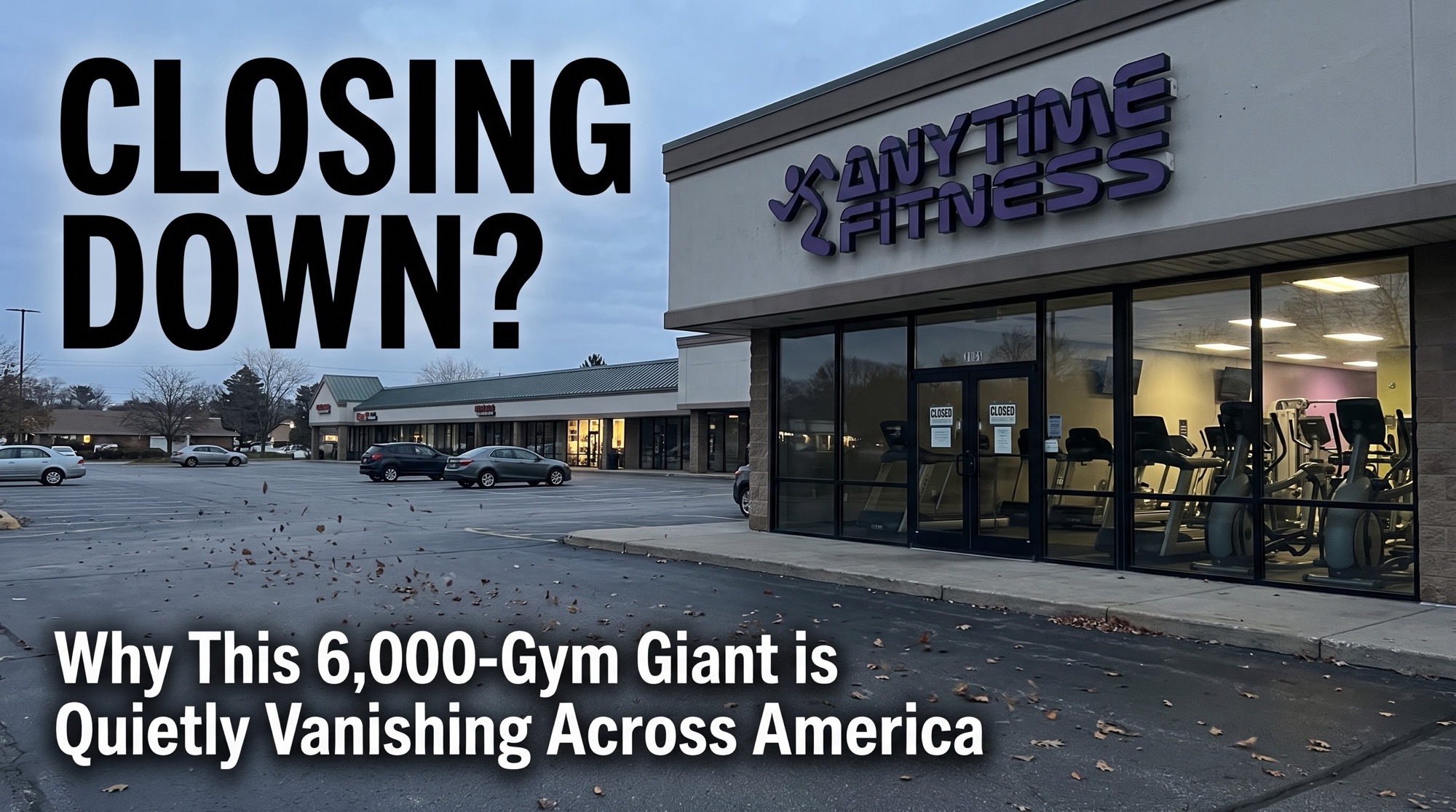
While Anytime Fitness celebrates cross-border milestones and a footprint surpassing 6,000 global clubs, its domestic footprint is undergoing a quiet, structural contraction. The franchise model that revolutionized 24-hour convenience is running up against domestic market saturation, high unit-level turnover, and intensifying margin pressure across its U.S. base.

The Mathematics of Domestic Attrition
On paper, the parent company’s growth narrative appears robust: in February 2026, Anytime Fitness revealed it had opened over 365 gyms worldwide throughout 2025. Yet disclosures within the brand’s 2026 Franchise Disclosure Document (FDD) show that domestic gains are being erased by system exits.
Between January 2023 and December 2025, U.S. franchised units fell from 2,318 to 2,271—a net decline of 47 locations. The gross churn behind that net drop tells the real operational story:
- New U.S. Openings (2023–2025): 146 locations
- U.S. Exits (Terminations, Non-Renewals, Ceased Operations): 193 locations
- Replacement Deficit: For every 10 new domestic locations opened, roughly 13 existing locations closed their doors.
Financial disclosures further highlight a widening gulf between top-tier performers and struggling units. Across the 1,683 franchised gyms evaluated in Item 19 of the 2026 FDD, the network reported an average annual gross revenue of $446,814. However, unit-level revenues ranged drastically from a peak of $2,048,737 down to just $90,337.
Because small-box franchise models operate with rigid, high-percentage fixed costs—commercial lease renewals, software fees, insurance, and system royalties—gyms operating in the bottom revenue quartile quickly run into cash burn, regardless of global brand equity.
The “Barbell Squeeze” and Commodity Convenience
The domestic decline is occurring even as consumer appetite for physical fitness reaches historical highs. The Health & Fitness Association (HFA) 2026 Global Report recorded landmark industry revenue growth, with more than 80 million Americans maintaining club memberships. Yet Anytime Fitness finds itself trapped in the middle of a polarized market:
- High-Volume, Low-Price (HVLP) Competitors: Brands like Planet Fitness dominate value-conscious consumers with large footprints, lower monthly dues, and higher promotional marketing spend.
- Premium & Boutique Studios: Specialized operators (including Pilates studios, strength conditioning clubs, and high-intensity franchises) capture higher-margin, discretionary fitness spending by offering personalized coaching and community experiences.
When Anytime Fitness launched in 2002, automated 24/7 keycard access was an industry-defining novelty. In 2026, 24/7 access is an expected baseline commodity. Charging mid-tier dues ($40 to $60+ per month) without the expansive equipment suites of big-box operators or the immersive coaching of boutique concepts leaves operators vulnerable to customer churn.
Parent Portfolio Hedging vs. Franchisee Risk
Under parent umbrella Purpose Brands (formed through the corporate union with Orangetheory), corporate leadership manages a diversified, multi-brand ecosystem generating over $4 billion across 44 countries. For the franchisor, a domestic closure in Illinois is readily offset on the balance sheet by master franchise expansions across Latin America, Europe, or Southeast Asia.
For the local business owner, however, enterprise-level resilience provides little solace. As franchise attorney Beverly Bradshaw explained to Inc. Magazine, “A multi-brand parent can spread risk, but an individual franchisee doesn’t have that luxury. They own a gym, and that gym has to make money”.
Independent franchisees face mounting territory friction, commercial rent hikes, and personal liability. When territories become oversaturated—or cannibalized by overlapping sister locations—operators who signed personal guarantees on equipment leases and Small Business Administration (SBA) loans bear the entire downside.
Confirmed 2026 U.S. Closures
The attrition highlighted in recent reporting from TheStreet and Inc. continues to materialize at the local storefront level:
- Guthrie, Oklahoma (1726 S. Division St.) — Permanently closed
- Freeport, Illinois (1862 S. West Ave.) — Closing
- Poinciana, Florida (1064 Cypress Pkwy.) — Closing
- Mount Vernon, Ohio (1417 Coshocton Ave.) — Closing
- Fairfax, Virginia (9529 Braddock Rd.) — Forced into relocation
Anytime Fitness’s international momentum proves the viability of the compact franchise model in emerging and underserved markets abroad. Domestically, however, the brand faces a crucial transition: it must either reinvent its mid-market value proposition to improve individual unit unit-economics or accept a permanently leaner U.S. presence.
Leave a Reply