
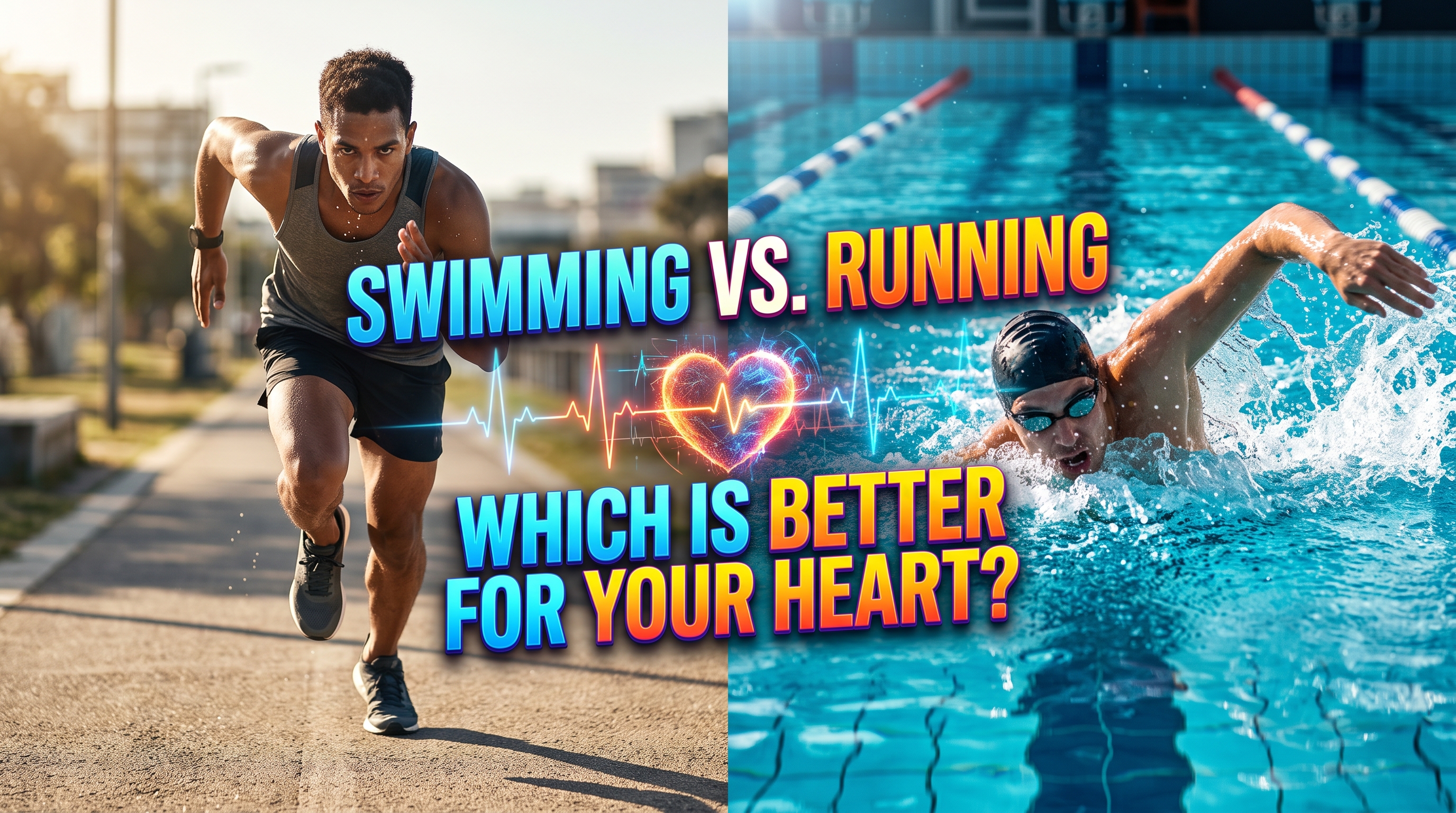
Neither running nor swimming holds an absolute, uncontested title as “strictly better” for cardiovascular health. Instead, decades of exercise cardiology demonstrate that both sports deliver elite cardioprotective adaptations, but they accomplish this through fundamentally different hemodynamic mechanisms, biomechanical demands, and physiological stress profiles.
Understanding which exercise is superior for an individual heart comes down to how each discipline loads the cardiac muscle, alters the vascular system, and supports long-term adherence.

Hemodynamics: How Posture and Immersion Shape Cardiac Work
The most distinct difference between running and swimming lies in how blood circulates back to the heart during exertion.
When running, the body remains upright against gravity. Venous blood must overcome hydrostatic pressure to travel from the lower limbs back up to the right atrium. To maintain cardiac output (stroke volume multiplied by heart rate), the heart relies heavily on increasing its rate of contraction. Running also produces eccentric left-ventricular remodeling driven by a combination of volume and pressure loads.
Swimming alters this dynamic through horizontal positioning and water immersion:
- Enhanced Venous Return (Preload): Lying horizontal in water neutralizes the vertical gravity column. At the same time, the hydrostatic pressure of water exerts external compression on peripheral blood vessels, shifting blood from the extremities into the central thoracic cavity.
- The Frank-Starling Mechanism: This shift floods the heart with venous return, stretching the myocardial fibers of the left ventricle before contraction. According to the Frank-Starling law of the heart, this increased stretch generates a more forceful contraction, resulting in a substantially higher stroke volume per beat.
- Lower Peak Heart Rate: Because stroke volume is higher in the pool, the heart does not need to beat as rapidly to sustain cardiac output. Combined with the cooling effect of water and the mild activation of the mammalian diving response (especially when the face is submerged), swimming typically produces a training heart rate that is 10 to 13 beats per minute lower than running at an equivalent perceived exertion.
Vascular Health, Blood Pressure, and $\text{VO}_2$ Max
Both modalities are potent interventions for keeping arteries compliant and managing blood pressure, but their clinical readouts differ slightly.
┌──────────────────────────────┬──────────────────────────────┬──────────────────────────────┐│ Metric │ Running │ Swimming │├──────────────────────────────┼──────────────────────────────┼──────────────────────────────┤│ Primary Hemodynamic Driver │ Heart rate & pressure-load │ Stroke volume & preload-load ││ Central Arterial Compliance │ Significant improvement │ Equal improvement ││ $\text{VO}_2$ Max Ceiling │ Slightly higher potential │ Very high potential ││ Blood Pressure Reduction │ Clinically proven (3–7 mmHg) │ Clinically proven (4–7 mmHg) ││ Muscular Work Distribution │ Lower-body dominant │ Upper- & lower-body balanced ││ Joint Impact │ High (2.5–3x body weight) │ Near-zero (buoyancy) │└──────────────────────────────┴──────────────────────────────┴──────────────────────────────┘
- Arterial Stiffness: Clinical investigations led by the Cardiovascular Aging Research Laboratory at the University of Texas at Austin evaluated central artery elasticity across swimmers, runners, and sedentary controls. The researchers found that carotid artery compliance was significantly higher and carotid $\beta$-stiffness was significantly lower in both runners and swimmers compared to sedentary peers. Crucially, there was no measurable difference in central arterial elasticity between runners and swimmers, confirming that both sports protect against age-related vascular stiffening.
- Blood Pressure Reduction: Regular swimming and regular running both lower resting systolic and diastolic blood pressure by an average of 4 to 7 mmHg in hypertensive adults. Swimming does this partly by inducing vasodilation in resistance arterioles, while running achieves it through repetitive shear stress that stimulates endothelial nitric oxide synthase (eNOS).
- Aerobic Capacity ($\text{VO}_2$ Max): Running tends to hold a modest advantage in driving absolute $\text{VO}_2$ max scores on standard metabolic cart testing. Because running requires an individual to support and propel 100% of their body weight against gravity, it engages large volumes of anti-gravity musculature, demanding maximum oxygen consumption. Swimming can achieve comparable aerobic fitness, but because water supports body mass, achieving equivalent oxygen uptake demands disciplined pacing and technical efficiency.
Longevity and Cardiovascular Mortality Evidence
Epidemiological cohorts examining hard clinical endpoints—such as heart attack incidence and cardiovascular mortality—show clear survival advantages for practitioners of both sports.
In a landmark analysis from the Cooper Clinic Longitudinal Study (Chase et al., published in the International Journal of Aquatic Research and Education), researchers tracked 40,547 men aged 20 to 90 over an average follow-up of 32 years. After adjusting for age, body mass index, smoking, alcohol intake, and personal or family history of cardiovascular disease, swimmers had a 53% lower risk of all-cause mortality compared to sedentary individuals. Strikingly, swimmers also demonstrated roughly a 50% lower mortality risk than walkers and a 49% lower risk than runners within that specific cohort.
Running possesses an equally massive body of clinical validation. A landmark study published in the Journal of the American College of Cardiology (Lee et al., 2014) followed 55,137 adults over 15 years. The researchers found that runners had a 45% lower risk of cardiovascular mortality and a 30% lower risk of all-cause mortality compared to non-runners, earning an average life expectancy gain of three years.Remarkably, this cardiovascular protection remained consistent even at low doses: running as little as 5 to 10 minutes a day at speeds under 6 mph was sufficient to dramatically reduce cardiovascular risk.
Biomechanics and Long-Term Adherence
Cardiovascular adaptations require consistency over decades, making mechanical wear and tear a crucial clinical consideration.
Running is a high-impact, weight-bearing exercise. Each stride delivers a ground reaction force equivalent to 2.5 to 3 times an individual’s body weight. While this axial loading is beneficial for stimulating bone mineral density and preventing osteoporosis, it brings a relatively high incidence of overuse injuries—such as patellofemoral pain syndrome, Achilles tendinopathy, and plantar fasciitis. When joint pain halts training, cardiovascular conditioning rapidly regresses.
Swimming eliminates impact forces entirely. Water buoyancy offsets approximately 90% of body weight, allowing individuals with osteoarthritis, previous joint replacements, obesity, or lower-limb injuries to achieve vigorous cardiovascular workouts without structural damage. However, swimming introduces a barrier of technical skill: inefficient stroke mechanics can limit an untrained swimmer’s ability to maintain an aerobic heart rate without fatiguing prematurely.
The physiological verdict is not that one sport definitively outperforms the other, but that they produce equivalent cardiovascular protection via different mechanisms. Running provides an unmatched, low-barrier exercise for maximizing peak aerobic power ($\text{VO}_2$ max) and bone density in minimal time. Swimming provides superior stroke-volume optimization, upper-body aerobic conditioning, and joint-sparing longevity, making it resilient against orthopedic wear as the body ages. For an ideal cardiovascular regimen, combining both captures the high-output conditioning of running alongside the low-impact hemodynamics of the pool.
Sources
- Chase, N. L., Sui, X., & Blair, S. N. (2008). “Swimming and All-Cause Mortality Risk Compared With Running, Walking, and Sedentary Habits in Men.” International Journal of Aquatic Research and Education, 2(3), 213–223.
- Lee, D. C., Pate, R. R., Lavie, C. J., Sui, X., Church, T. S., & Blair, S. N. (2014). “Leisure-Time Running Reduces All-Cause and Cardiovascular Mortality Risk.” Journal of the American College of Cardiology, 64(5), 472–481.
- Nualnim, N., Barnes, J. N., Tarumi, T., Renzi, C. P., & Tanaka, H. (2011). “Comparison of Central Artery Elasticity in Swimmers, Runners, and the Sedentary.” The American Journal of Cardiology, 107(5), 783–787.
- Schnohr, P., O’Keefe, J. H., Marott, J. L., Lange, P., & Jensen, G. B. (2015). “Dose of Jogging and Long-Term Mortality: The Copenhagen City Heart Study.” Journal of the American College of Cardiology, 65(5), 411–419.
- Yoshizaki, A., Antonio, E. L., Dos Santos, L., et al. (2025). “Swimming is superior to running in inducing physiological cardiac hypertrophy and enhancing myocardial performance.” Pflugers Archiv: European Journal of Physiology / PMC, PMC12914034.
- Albarrati, A. M., et al. & Tanaka, H. (2025). “Effects of aquatic exercise on arterial stiffness and endothelial function in adults: A systematic review and meta-analysis.” PLOS ONE, 20(12), e0338929.
Leave a Reply