
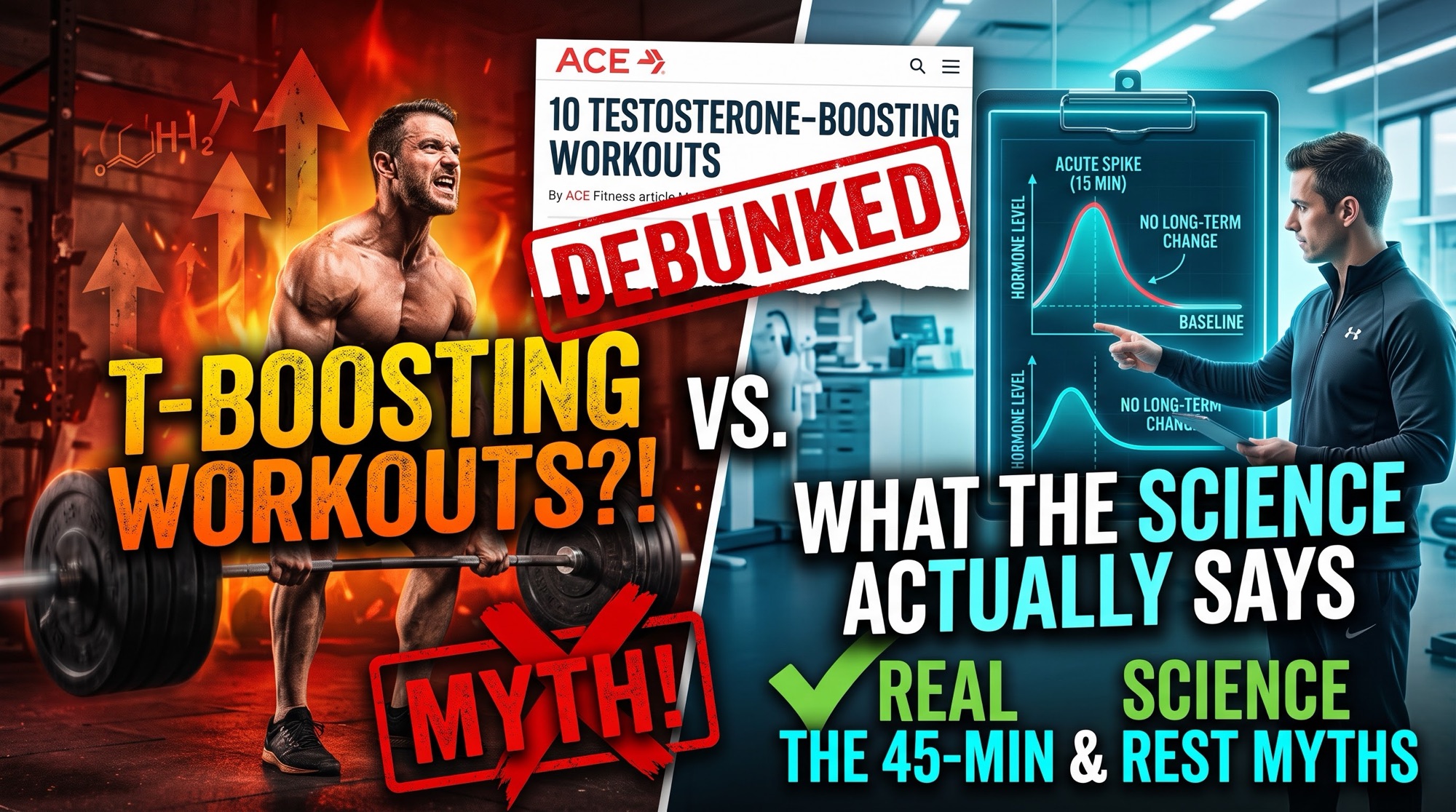
The article “10 Testosterone-Boosting Workouts” from the American Council on Exercise (ACE) reflects a widespread fitness industry narrative: that designing workouts around specific compound lifts, rest intervals, and rep schemes will meaningfully drive testosterone production and build muscle.
While the prescribed exercises (deadlifts, squats, rows, and presses) are effective for strength and hypertrophy, the underlying endocrinology and physiological claims made in the article are largely debunked or overstated by modern exercise science.

Claim 1: “The right exercise program can increase baseline testosterone production well into later years.”
- The Reality: Exercise does not reliably elevate baseline (resting) testosterone levels in healthy men.
- What the Science Shows: A systematic review and meta-analysis published in the Journal of Strength and Conditioning Research examined exercise interventions across inactive and healthy (eugonadal) men and concluded that exercise training does not significantly affect resting total or free testosterone concentrations.Resistance training improves insulin sensitivity, body composition, and neuromuscular performance, but it does not reprogram Leydig cells in the testes to permanently elevate resting serum testosterone. In individuals with obesity or metabolic syndrome, exercise can increase testosterone primarily secondary to visceral fat loss and reduced aromatase activity (which converts testosterone to estrogen), not via the lifting movements themselves.
Claim 2: Acute, post-workout testosterone spikes drive muscle hypertrophy.
- The Reality: Transient post-workout hormonal spikes have essentially no correlation with long-term muscle protein synthesis or hypertrophy.
- What the Science Shows: The article leans on the “Hormone Hypothesis”—the 1990s and early 2000s belief that manipulating rest intervals and compound lifts to spike systemic testosterone for 15–30 minutes directly drives muscle growth.Landmark studies by Dr. Stuart Phillips and colleagues at McMaster University thoroughly tested this hypothesis:
- In a study published in the Journal of Physiology, researchers had participants train an arm in a low-hormone state and the contralateral arm after a heavy leg workout that caused massive acute spikes in testosterone and growth hormone. Despite the large systemic hormonal surge, muscle protein synthesis (MPS) and muscle hypertrophy were virtually identical between both arms.
- A larger 12-week trial in the European Journal of Applied Physiology evaluated 56 young men undergoing heavy resistance training. The authors found no significant relationship between exercise-induced elevations in testosterone and gains in muscle mass or strength.
- Hypertrophy is primarily regulated locally at the muscle level via mechanical tension, intracellular signaling pathways (like mTORC1), and androgen receptor density—not by brief fluctuations in circulating serum testosterone within physiological limits.
Claim 3: Workouts must be under 45 minutes to prevent testosterone decline and cortisol spikes.
- The Reality: The “45-minute rule” is arbitrary and unsupported by performance and hypertrophy outcomes.
- What the Science Shows: The 45-minute limit originated from early acute endocrine studies showing that circulating cortisol begins to rise and testosterone may start to drift down during longer bouts of exertion. However:
- Cortisol is a normal metabolic and mobilizing hormone, not an inherently “muscle-destroying” signal during workouts. In fact, exercise-induced cortisol increases are often positively correlated with total work volume.
- Meta-analyses on resistance training volume, such as those published in the Journal of Sports Sciences, demonstrate that total weekly volume (sets per muscle group) is a primary driver of hypertrophy, regardless of whether workouts last 40 minutes or 70 minutes. Restricting training to 45 minutes can rush rest periods, compromising load and volume.
Claim 4: 1-minute rest intervals are “optimal for testosterone and growth.”
- The Reality: Short rest periods create an acute endocrine spike, but they impair the primary driver of muscle growth: volume load.
- What the Science Shows: While short rest periods (60 seconds) do cause a greater transient metabolic stress response and a brief spike in circulating hormones, they reduce total repetitions and load capacity on subsequent sets.A clinical study in the Journal of Strength and Conditioning Research compared 1-minute rest vs. 3-minute rest in resistance-trained men across 8 weeks. The 3-minute rest group achieved significantly greater muscle strength and hypertrophy because longer rest allowed for higher loads and greater total volume, even though short rest induces higher acute hormonal and metabolic stress.
Summary of What Actually Affects Testosterone
FactorInfluence on TestosteroneScientific Reality Workout Selection (Deadlifts, Cleans)High acute spike (15–30 mins)Returns to baseline quickly; no measurable impact on resting T or hypertrophy. Short Rest Intervals (60s)Increases acute fatigue/metabolic stressReduces load and volume capacity; inferior for strength and size compared to 2–3 min rest. Body Fat / Metabolic HealthMajor chronic driverExcess adiposity increases aromatase, converting testosterone to estradiol. Lean mass gain and fat loss normalize T. Sleep Quality & DurationMajor chronic driverRestricting sleep to 5 hours/night for just one week reduces daytime testosterone levels by 10–15% (JAMA, 2011). Adequate Caloric/Micronutrient IntakeMajor chronic driverSevere, prolonged caloric deficits or zinc/vitamin D deficiencies suppress the hypothalamic-pituitary-gonadal (HPG) axis.
The workout routines in the ACE article are solid compound-movement templates for building strength and general athletic conditioning, but calling them “testosterone-boosting workouts” misrepresents normal, short-lived hormonal fluctuations as a meaningful clinical or muscular outcome.
Leave a Reply