
Fitness Industry Daily Business Wrap-Up
Saturday, October 24, 2026
Here is a summary of the top fitness industry business developments, mass-participation racing expansions, member retention metrics, and workforce credentialing insights from the past 24 hours:

1. HYROX & Xenom Form Global Alliance Aiming for 2.2M+ Racers and Olympic Inclusion
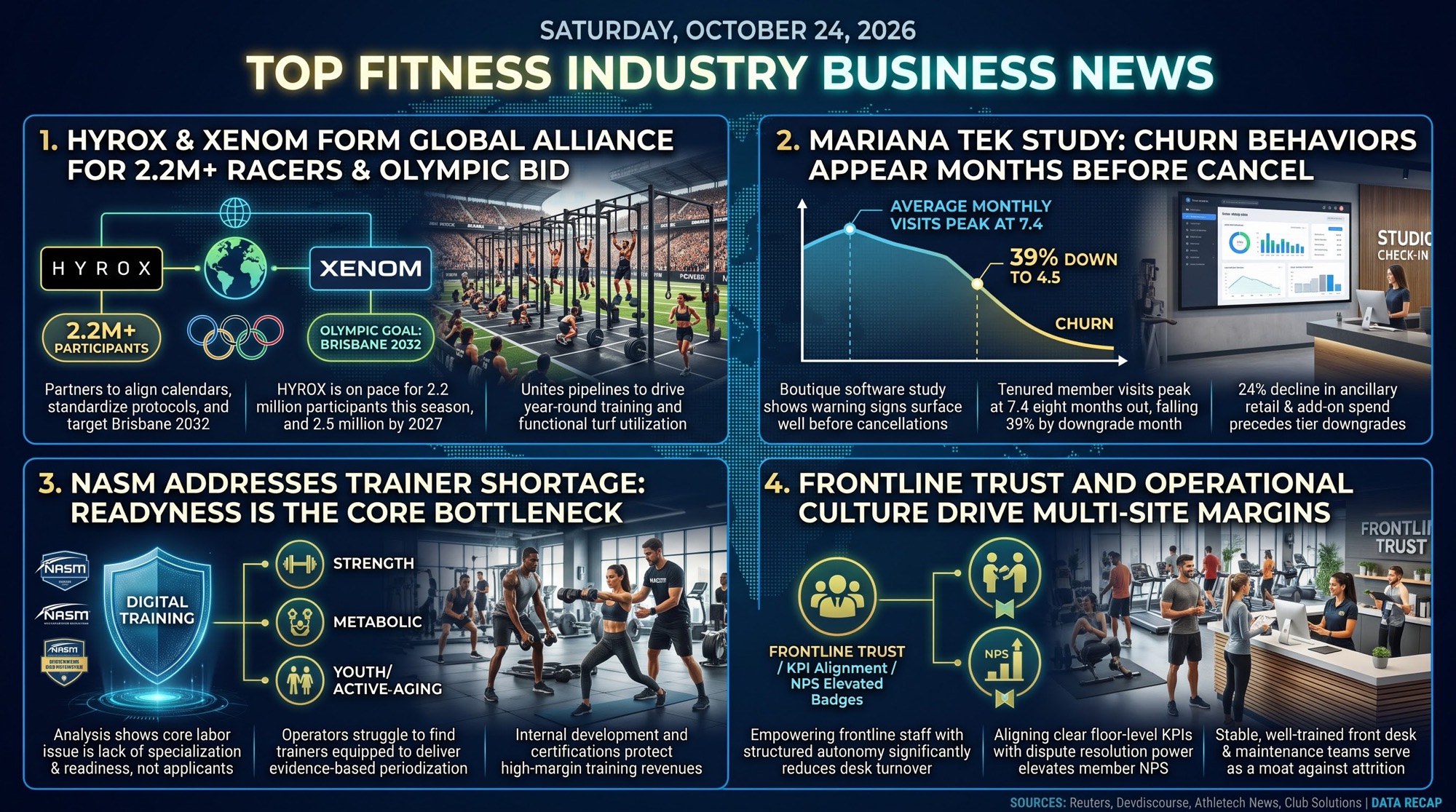
- What Happened: Global fitness racing series HYROX and competitor organization Xenom announced a strategic partnership to align competition calendars, standardize racing protocols, and target Olympic recognition by Brisbane 2032. In an interview with Reuters, HYROX co-founder Moritz Fürste revealed the brand is on pace for 2.2 million participants this running season, projecting 2.5 million by 2027 while accelerating expansion across Latin America. Concurrently, Xenom is scaling its 10-event hybrid fitness format across North America and Europe following events in Dallas and London.
- Business Impact: The collaboration marks an inflection point where functional fitness moves from fragmented gym programming into an institutionalized, mass-participation sport. By uniting athlete pipelines rather than engaging in regional turf wars, both entities provide commercial gym operators and affiliate facilities with a predictable, year-round athlete training cycle that drives sustained group class and functional turf utilization.
- Source: Reuters / Live Euronext | Devdiscourse
2. Mariana Tek Churn Study: Warning Signs Surface Months Before Cancellation
- What Happened: Boutique fitness software provider Mariana Tek released comprehensive member-lifecycle data showing that the behavioral indicators of member churn appear well in advance of a formal cancellation request. The study revealed that among members tenured for more than a year, average monthly visits peaked at 7.4 eight months prior to a tier downgrade, steadily declining 39% down to 4.5 visits by the month before the status change, accompanied by a 24% decline in ancillary retail and add-on spending.
- Business Impact: The findings reinforce why fitness operators must move beyond reactive cancellation saves toward automated, trajectory-based intervention workflows. With the FTC standardizing “Click-to-Cancel” rules across digital memberships, studios and commercial clubs can no longer rely on friction-based retention; they must deploy CRM triggers that flag declining check-in frequency months ahead of time to re-engage slipping members.
- Source: Athletech News
3. NASM Addresses Trainer Shortage: “Readiness, Not Headcount” Is the Core Bottleneck
- What Happened: A workforce analysis published in collaboration with the National Academy of Sports Medicine (NASM) emphasized that the fitness industry’s primary labor issue is not an absolute shortage of applicants, but a widening gap in practical readiness and specialization. With consumer demand shifting heavily toward longevity, progressive strength training, metabolic health, and youth/active-aging populations, operators are struggling to find trainers equipped to deliver structured, evidence-based periodization beyond basic entry-level floor sessions.
- Business Impact: High turnover among fitness staff continues to burden operators with onboarding costs and disrupted member relationships. Commercial chains and boutique franchises that invest in standardized internal development paths, accredited credentials, and continuing education can elevate average trainer compensation, increase member retention, and protect high-margin personal training revenues.
- Source: Athletech News
4. Frontline Trust and Operational Culture Drive Multi-Site Club Margins
- What Happened: Industry executive insights detailed operational strategies for managing distributed club workforces, focusing on empowering frontline staff with structured decision-making protocols and standardized communication channels. Club operators running multi-unit facilities reported that aligning clear floor-level Key Performance Indicators (KPIs) with autonomy in conflict resolution significantly reduced desk turnover and elevated Net Promoter Scores (NPS).
- Business Impact: As commercial health clubs absorb wage pressure and higher facility overhead, retaining skilled frontline staff serves as a defensive moat against member attrition. Facilities with stable, well-trained front desk and maintenance personnel consistently register lower member attrition and faster lead conversion than clubs relying on high-turnover, unguided floor coverage.
- Source: Club Solutions Magazine
Leave a Reply