
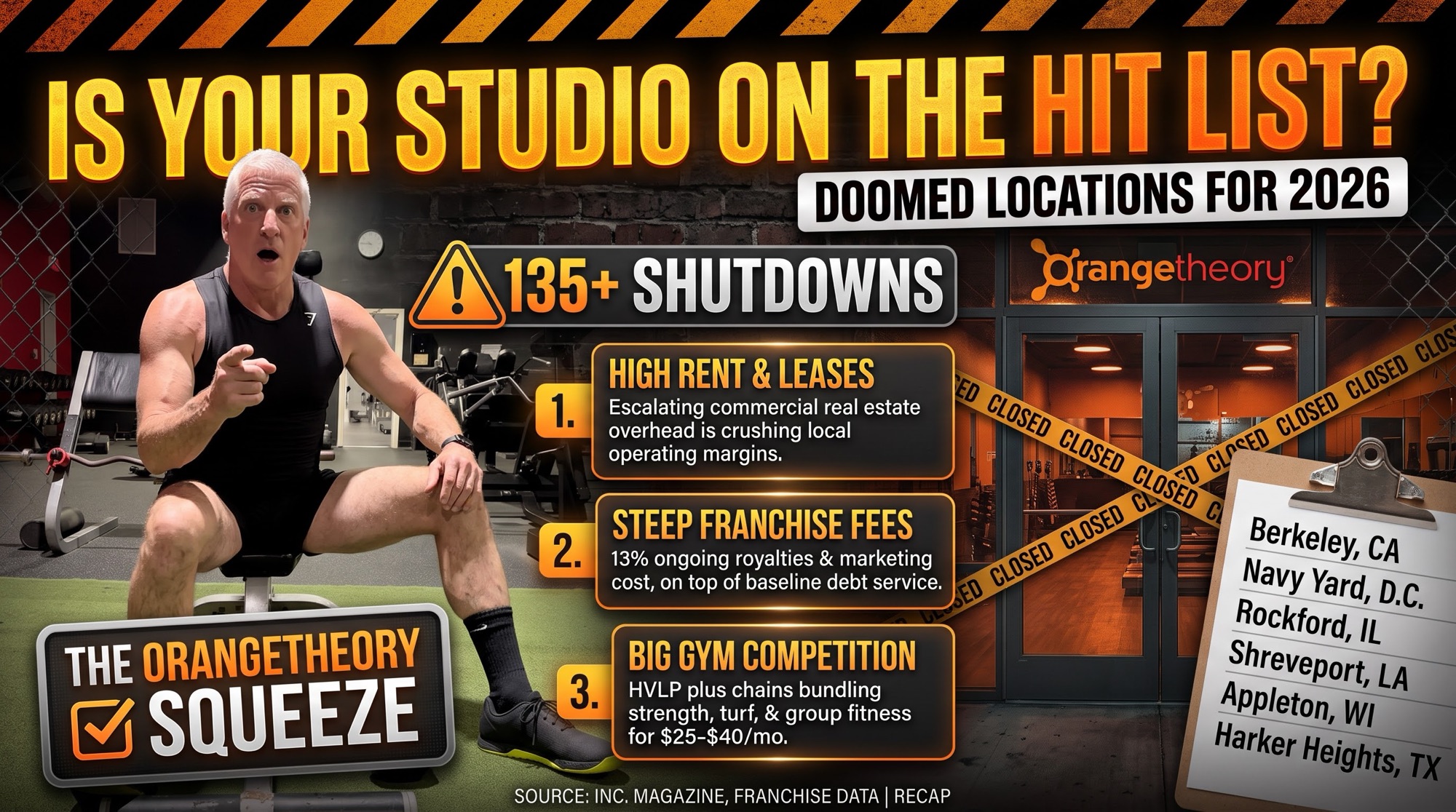
Orangetheory Fitness has closed roughly 135 U.S. studios in under three years, shrinking from approximately 1,333 domestic locations at the end of 2023 to 1,198 by mid-2026. The contraction has ignited industry-wide debate over whether the boutique fitness boom has finally hit a ceiling, or if aggressive early franchise expansion is colliding with a brutal macroeconomic environment.

Despite the wave of shuttered doors, franchise analysts and fitness industry operators emphasize that the boutique fitness model is not broken—rather, it is undergoing a structural right-sizing.
The Triple Squeeze on Franchisees
Franchisees operating single-modality HIIT studios are caught in an aggressive margin crunch driven by three converging pressures:
- Escalating Commercial Real Estate Overhead: Most Orangetheory studios occupy prime 3,000 to 4,500-square-foot suburban retail strips or dense urban corridors. As multi-year retail leases signed in the late 2010s come up for renewal, property landlords are demanding steep rent hikes, significantly raising break-even attendance thresholds.
- Fixed Royalties and Capital Requirements: According to franchise disclosure document (FDD) filings, initial studio investments range between $764,000 and $1.1 million. On top of baseline debt service and rising local labor costs, franchisees pay roughly 13% in ongoing royalties and systemwide brand advertising fees, which compresses operating margins when local membership counts dip below capacity.
- The “HVLP Plus” Encroachment: High-value, low-price (HVLP) and mid-tier chains—including Crunch, VASA, and Amped Fitness—have heavily restructured their floor plans. By bundling Olympic platforms, functional athletic turf, group classes, and contrast therapy into $25 to $40 per month memberships, large-format gyms are increasingly cannibalizing members who previously paid $150 to $200+ per month for standalone group HIIT.
Confirmed Studio Closures Across the Network
Recent investigative reporting by Inc. verified multiple Orangetheory closures across diverse regional markets:
- California: Berkeley (2475 Shattuck Ave) & Emeryville (5959 Shellmound St)
- Washington, D.C.: Navy Yard (82 I Street SE)
- Illinois: Rockford (6575 E. State St)
- Louisiana: Shreveport (1370 E. 70th St, Ste 1000)
- Wisconsin: Appleton (4301 W. Wisconsin Ave)
- Texas: Harker Heights (3045 Stillhouse Lake Rd, Ste 108)
Is the Boutique Fitness Model Broken?
The short answer is no, but the era of unchecked studio expansion is over.
Industry analysts point out that Orangetheory’s core brand equity, dedicated member community, and heart-rate telemetry platform remain exceptionally strong. The current wave of closures represents a transition from high-velocity unit growth to operational consolidation. Following the brand’s mega-merger with Self Esteem Brands (parent of Anytime Fitness) under Purpose Brands, leadership is focused on shedding unprofitable, over-saturated urban locations to re-anchor the network around a “smaller, highly profitable footprint”.
For franchise operators, survival in the post-2026 fitness landscape requires renegotiating legacy commercial leases, diversifying programming beyond pure HIIT (such as strength-focused and hybrid mobility formats), and defending local community retention against suburban big-box alternatives.
Sources & Reference Data
- Inc. Magazine: Orangetheory Fitness Is Closing Studios: See Updated List of Doomed Locations for 2026
- VetMyFranchise: Orangetheory Franchise Cost, Royalties, and Unit Economics Breakdown
- FDDIndex: Orangetheory Franchise Disclosure Reports & System Closures Data
- Health & Fitness Association (HFA): Industry Market Shifts & Consolidation Analysis
Leave a Reply