
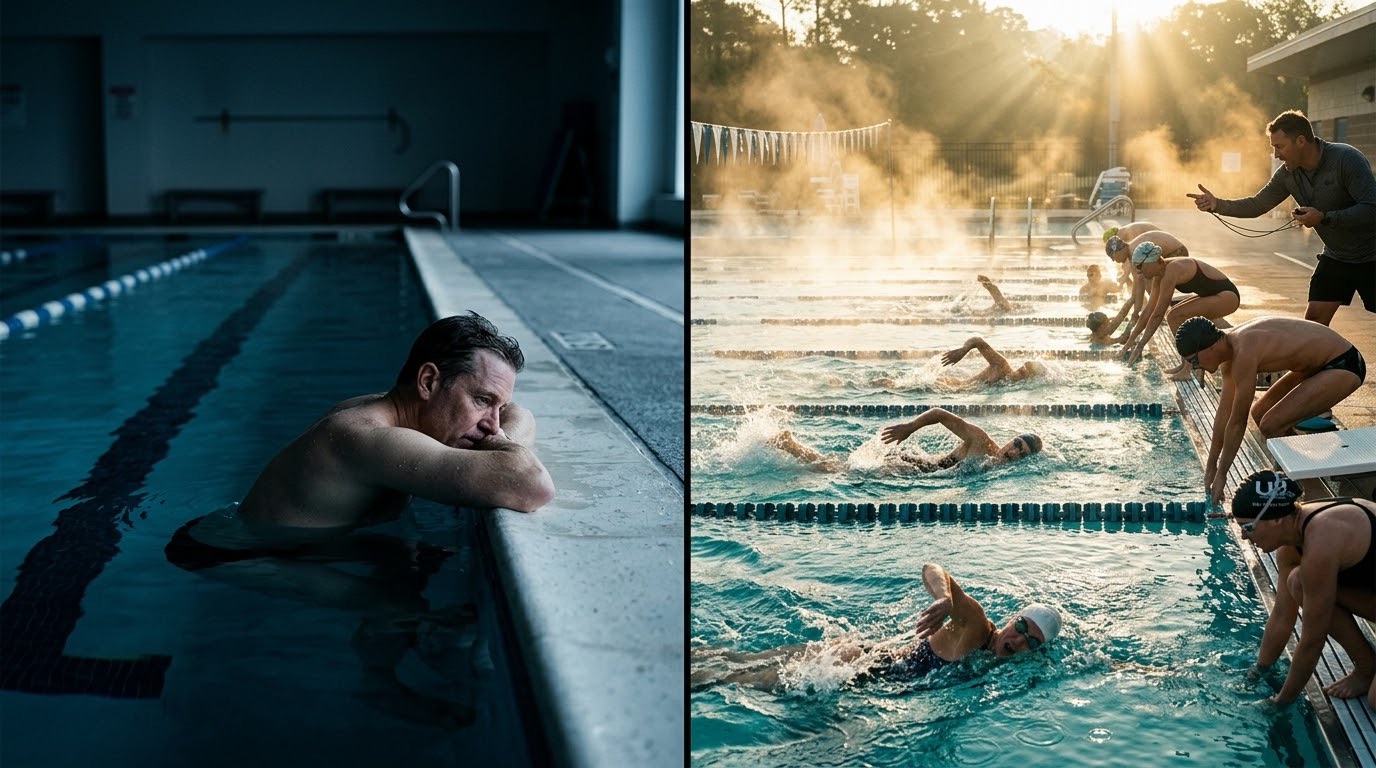
Solitary lap swimming offers a peaceful, meditative sensory break, but swimming with a U.S. Masters Swimming (USMS) club transforms the black line on the pool floor into an engine for peak performance, psychological resilience, and lifelong community.

Solo Laps vs. The Masters Workout: The Coaching Advantage
Swimming solo often falls victim to “junk yardage”—monotonous paces, unstructured sets, and uncorrected technique flaws that can aggravate shoulder impingement. Having a Masters coach on deck transforms the mental landscape of a workout:
- Cognitive Offloading: When training alone, you must track intervals, decide set progressions, and negotiate with your own fatigue. A coach handles programming, allowing you to focus entirely on execution.
- Objective Technical Feedback: Real-time micro-corrections (fixing an elbow drop, adjusting head position, or tightening streamline) eliminate the guesswork and self-doubt common in self-coached swimmers.
- Calibrated Stress & Safe Failure: A coach pushes you past self-imposed comfort zones with high-intensity sets and stroke variety that solo swimmers rarely program for themselves, building distress tolerance.
The Neurobiology of Teammates: Science Behind the Group Advantage
Training in a squad produces measurable psychological and physiological advantages backed by behavioral science:
- The Köhler Effect: Research on the Köhler effect in competitive swimmers demonstrates that people persist significantly longer and swim faster when training alongside lane mates. The fear of holding back the lane overrides perceived physical exhaustion.
- Synchrony and Endorphin Surges: An Oxford University study on collective aerobic movement found that synchronous physical exertion triggers elevated pain thresholds and a surge of beta-endorphins compared to solitary training. Pushing off the wall together primes the brain’s neurochemical reward system.
- Stress Reduction: Clinical research published by the Journal of the American Osteopathic Association revealed that group fitness participants experienced a 26% reduction in perceived stress and substantial gains in emotional quality of life. Solo exercisers working out for equal durations saw no statistically significant reduction in stress.
Long-Term Physical and Mental Trajectories
Solo swimming excels as a flexible, low-barrier habit, but Masters swimming produces superior durability over decades:
- Biological Age Reversal: Landmark research from Dr. Joel Stager at Indiana University’s Counsilman Center, highlighted in the USMS Beginner’s Guide, revealed that consistent Masters swimmers maintain biological markers—such as cardiovascular health, muscle mass, and lung capacity—that are up to 20 years younger than chronological age.
- Overuse Injury Prevention: Solo swimmers overwhelmingly defaults to continuous freestyle. Masters workouts enforce Individual Medley (fly, back, breast, free) intervals and kick sets, balancing shoulder musculature and preserving joint health.
- Cognitive Sharpness: Deciphering complex interval sets off a whiteboard and performing mental arithmetic against the pace clock provide dual-task cognitive demands that support neurological health well into old age.
US Masters Swimming as the Essential “Third Place”
Sociologist Ray Oldenburg defined the “Third Place” as a social anchor distinct from home (first place) and work (second place)—a realm that fosters conversation, equality, and regular gatherings. Masters swim teams function as one of modern life’s purest third places:
- The Great Leveler: In a swimsuit, silicone cap, and fogged goggles, corporate titles, wealth, and status evaporate. Lane assignments are based on pace, not pedigree.
- Unforced Camaraderie: Between 100-meter repeats and across lane lines, deck banter is spontaneous and low-stakes. As detailed in this U.S. Masters Swimming guide on community building, the shared struggle of cold 5:30 AM water creates profound relational bonds.
- A Grounding Ritual: The routine of showing up at the deck—often followed by a team coffee or breakfast—anchors identity outside professional productivity, combating modern social isolation.
Leave a Reply