
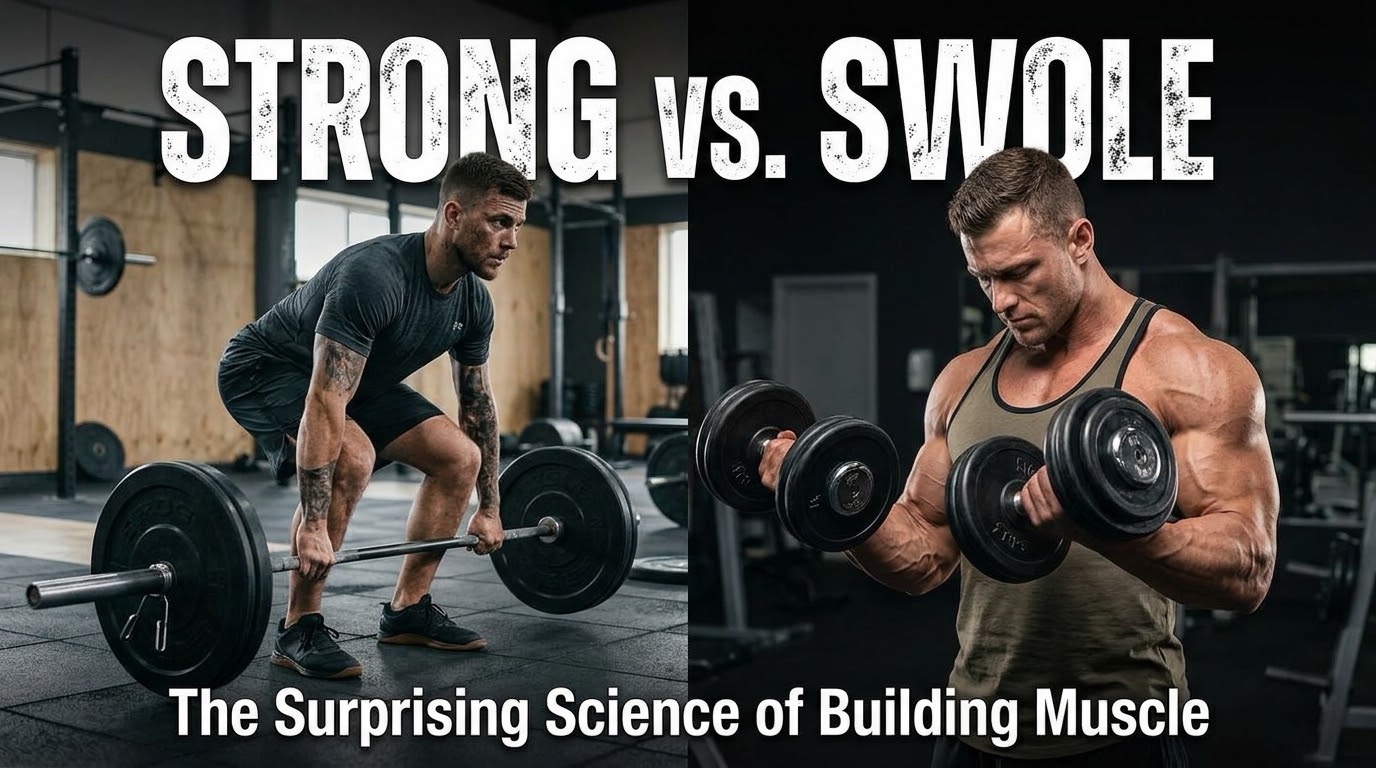
Strong vs. Swole: The Surprising Science Behind Building Muscle 💪🧠
For decades, the golden rule of the gym was “no pain, no gain.” Old-school bodybuilding advice told us that the only way to build muscle was to push every set to absolute failure, deliberately creating microtears in the muscle fibers so they could “tear and repair.”

But recent science shows us that everything we thought we knew about getting swole might be slightly off the mark.
Here is the real truth about building muscle, backed by modern sports science.
1. Muscle Damage is a Side Effect, Not the Goal
According to a recent piece in The Guardian, the idea that soreness is an indicator of an effective workout is a myth. Dr. Anne Brady, a kinesiology professor specializing in muscle quality, explains that the primary driver of muscle growth (hypertrophy) is actually mechanical tension.
When you lift a challenging weight, the physical tension stretches your muscle cell membranes. Specialized sensors called mechanoreceptors detect this stretch and activate the mTOR pathway, which tells your body to start muscle protein synthesis. The muscle damage and extreme soreness you feel? That’s just a side effect, and sometimes, too much damage can actually hinder your growth by ruining your recovery.
2. The “Burn” Isn’t Everything
You know that deep metabolic burn you get at the end of a high-rep set? That’s known as metabolic stress. While it acts as an excellent amplifier for muscle growth, it isn’t the main driver. As Dr. Brady points out, you could do biceps curls with a pencil in your hand until your arm burns, but you won’t grow any muscle because there isn’t enough mechanical tension.
3. Strong vs. Swole: Two Types of Growth
Did you know you can get significantly bigger without gaining much strength, or get incredibly strong without adding mass? There are two types of muscle hypertrophy:
- Myofibrillar Hypertrophy: An increase in the actual bundles of muscle filaments that contract. This results in dense, raw strength (think Olympic weightlifters or gymnasts).
- Sarcoplasmic Hypertrophy: An increase in the volume of fluid inside the muscle cell. This results in size without necessarily adding massive amounts of strength (think aesthetic bodybuilders).
Combining a heavy enough weight (high tension) with enough repetitions (metabolic stress) is the ultimate sweet spot for getting both strong and swole.
4. What Other Experts Say
The consensus on mechanical tension is spreading rapidly across the fitness world. A 10-week muscle-building review featured in Men’s Health completely backs this up, concluding that mechanical tension is the undisputed king of muscle growth. Interestingly, the review also found that short-term spikes in testosterone or “chasing the pump” do not meaningfully impact hypertrophy on their own.
Similarly, BarBend’s extensive guide to muscle hypertrophy notes that as long as you are actively focusing on progressive overload and applying real mechanical tension to the tissue, the exact rep-range matters far less than we used to think. Whether you do sets of 6, 12, or even 20, the key is taking your muscles near failure, rather than total failure.
The Bottom Line
You don’t need to destroy your body to build it up. Drop the ego, eliminate momentum, and focus on lifting with solid mechanical tension. Work near failure, slowly increase the weight over time (progressive overload), and don’t worry if you aren’t waking up painfully sore the next day. Your muscles are still growing!
Sources:
- The Guardian: Strong v swole: the surprising truth about building muscle
- Men’s Health UK: How Much Muscle You Can Expect to Gain in a 10-Week Training Review
- BarBend: The Big Guide to Muscle Hypertrophy
Leave a Reply