

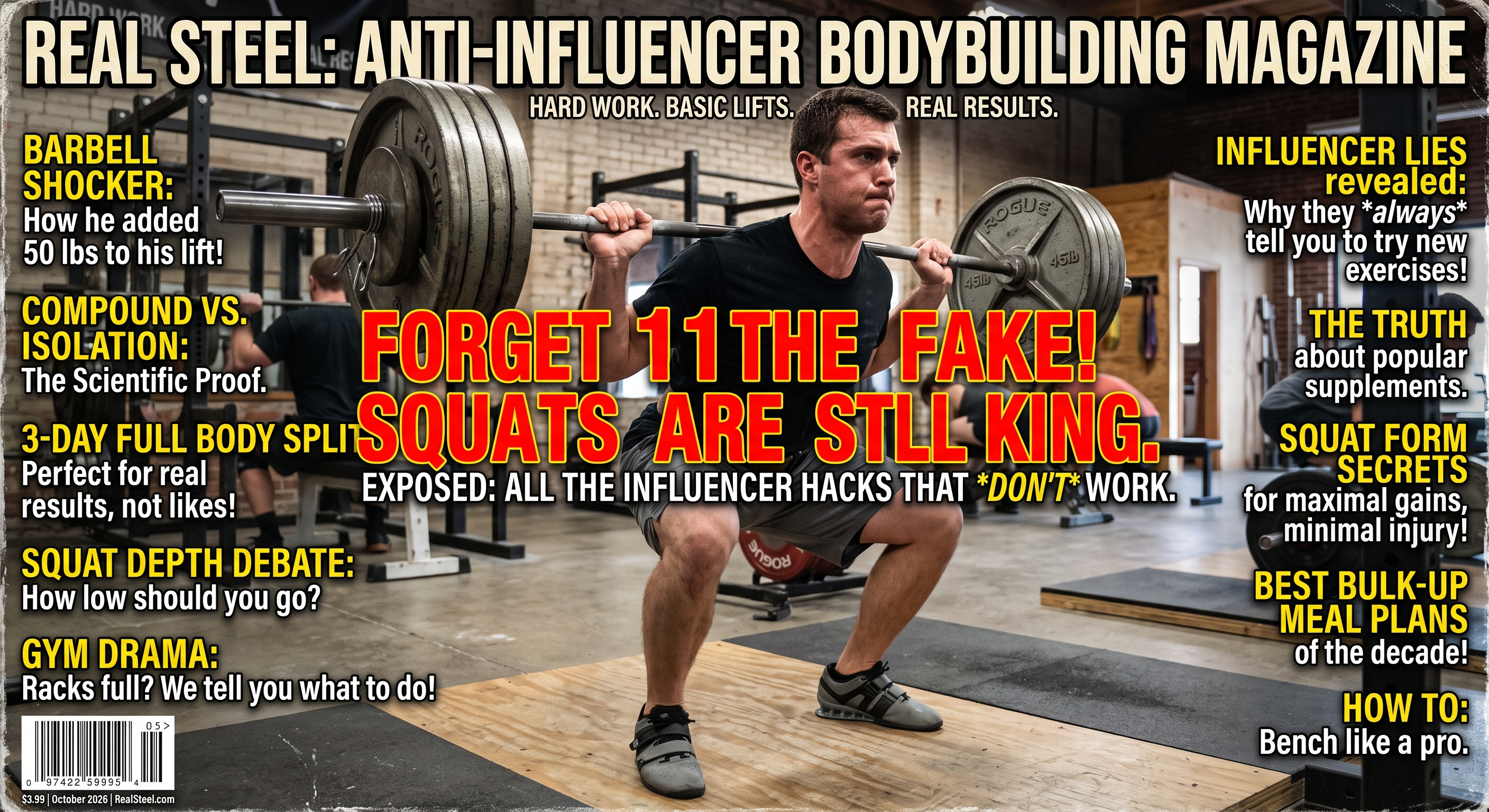
Fitness algorithms reward novelty because basic consistency cannot be monetized, but skeletal muscle responds exclusively to mechanical tension, progressive overload, and systematic recovery. Flashy TikTok workouts—balancing on stability balls, contorting through six-pulley cable setups, or changing exercises every workout—trade real mechanical stimulus for social media engagement.
Debunking Viral Fitness Myths
- Myth 1: “You must confuse the muscle.”Online creators claim you need to switch exercises every session so your muscles don’t adapt. Research explicitly refutes this: a study by Baz-Valle et al. (2019) compared lifters using a fixed exercise routine against those who randomized exercises session-to-session and found identical muscle hypertrophy. Constantly changing lifts merely induces neurological motor-learning fatigue and soreness rather than actual structural hypertrophy.
- Myth 2: “Targeting the lower bicep or inner chest.”Short-form videos frequently claim specific wrist tweaks or angled cable grips will grow impossible subdivisions of a muscle. Muscle fibers contract along the full length of their fascicles. While you can bias individual anatomical heads (like the clavicular head vs. sternal head of the pectoralis major), you cannot isolate the “inner” or “lower” insertion of a single muscle belly.
- Myth 3: “Soreness is the primary indicator of growth.”Circus-style variations maximize novelty, which causes extreme delayed-onset muscle soreness (DOMS) through excessive micro-tears in unaccustomed motor units. High levels of muscle damage actually impair protein synthesis and compromise recovery without stimulating additional growth.
Why Basic Compound Lifts Outperform Variations
Foundational multi-joint lifts—squats, presses, hinges, and rows—remain the most potent tools for building muscle mass:
- Greater Absolute Mechanical Tension:Mechanical tension is the primary physiological driver of muscular hypertrophy, as detailed by Schoenfeld (2010). Basic compound movements allow you to handle significantly heavier absolute loads through stable ranges of motion, maximizing high-threshold motor unit recruitment.
- True Progressive Overload: Gaining muscle requires exposing the target tissue to progressively greater workloads over months. It is simple to track a 5-pound increase or an extra rep on a barbell overhead press; it is nearly impossible to track meaningful overload on an unstable, multi-angle cable flye.
- Maximal Volume Efficiency: A systematic review by Gentil et al. (2013) found that multi-joint compound exercises stimulate prime and secondary movers so completely that adding single-joint isolation variations often provides no significant extra whole-muscle growth in beginners.
- Neuromuscular Mastery: Strength is a motor skill. Sticking to the same fundamental movement patterns develops neuromuscular efficiency, ensuring that subsequent performance gains reflect actual muscle tissue growth rather than your brain just learning how to coordinate a new movement.
The 3-Day Full-Body Split
A 3-day full-body routine hits every major muscle group 2 to 3 times per week, which a meta-analysis by Schoenfeld et al. (2016)
demonstrated produces superior hypertrophy compared to hitting a muscle only once per week.
Alternate between Workout A and Workout B on non-consecutive days (e.g., Monday, Wednesday, Friday):
Workout A
- Barbell Back Squat: 3 sets × 6–8 reps
- Barbell Flat Bench Press: 3 sets × 6–8 reps
- Barbell Bent-Over Row: 3 sets × 8–10 reps
- Romanian Deadlift (RDL): 3 sets × 8–10 reps
- Standing Overhead Dumbbell Press: 2 sets × 8–12 reps
Workout B
- Trap-Bar or Conventional Deadlift: 3 sets × 5 reps
- Standing Overhead Barbell Press: 3 sets × 6–8 reps
- Pull-Ups or Lat Pulldowns: 3 sets × 6–10 reps
- Dumbbell Bulgarian Split Squat: 2 sets × 8–10 reps per leg
- Incline Dumbbell Bench Press: 3 sets × 8–10 reps
Building muscle is fundamentally boring on camera: it is the systematic repetition of the same five to six movement patterns, executed with strict technique and heavier weights, sustained over years.
Leave a Reply