
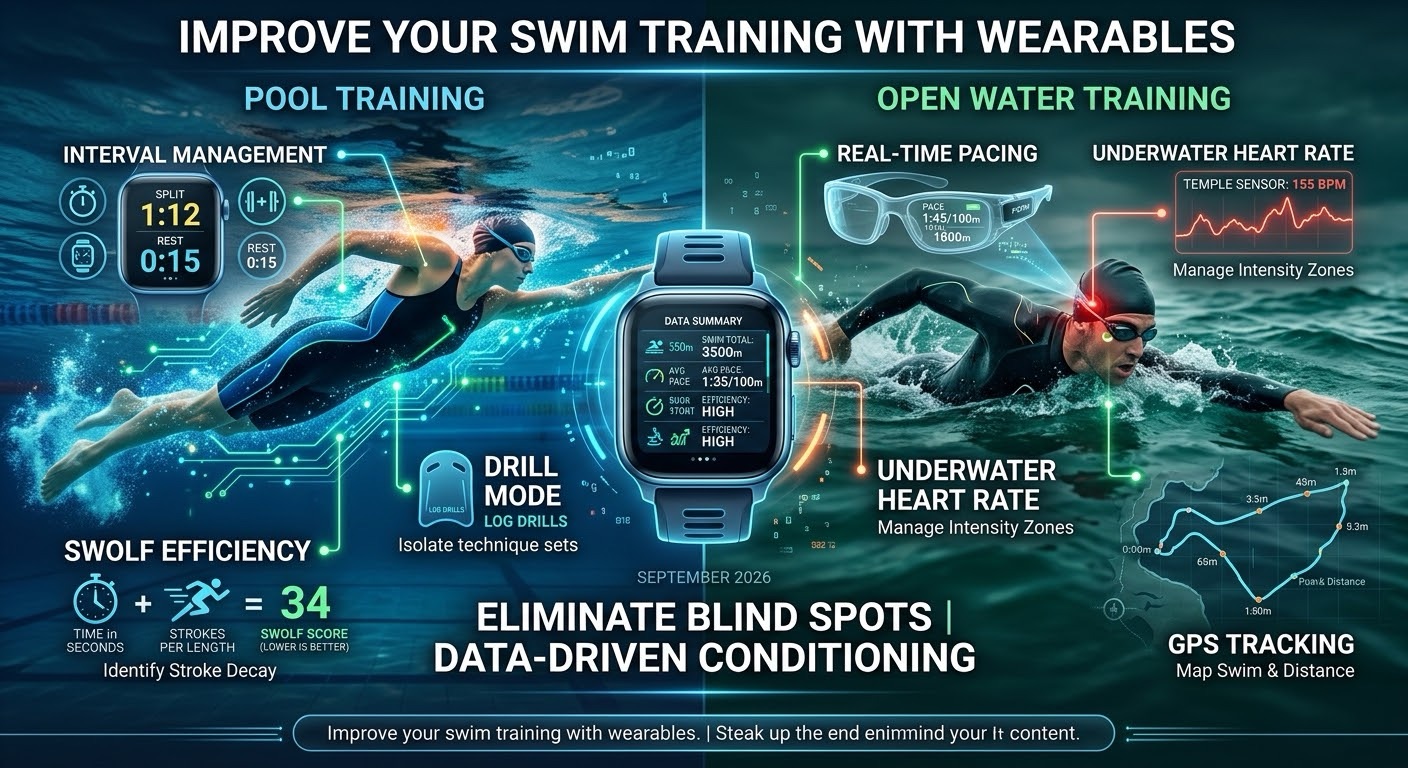
Modern swim wearables have shifted pool and open-water training from mental lap-counting and rough guesswork into precise, data-driven conditioning. By combining optical biometric sensors, high-frequency inertial measurement units (IMUs), and heads-up displays, connected devices eliminate common training blind spots and enforce structured pacing.

1. Automating Intervals and Rest Management
Tracking split times while managing physical fatigue often leads to sloppy interval pacing. Modern multisport watches streamline recovery and set control:
- Garmin’s dedicated swim tools feature auto-rest detection, which automatically pauses and resumes timers when a swimmer stops at the wall, alongside manual lap-button toggles for precise intervals under 10 seconds.
- Wearable timers accommodate both fixed-duration rest and send-off times (e.g., departing on a strict 2-minute cycle for repeat 100-meter efforts), removing the need to track the wall clock on deck.
- Haptic distance alerts vibrate on predefined lengths, freeing swimmers from counting laps during long aerobic blocks.
2. Measuring True Efficiency with SWOLF
Speed in swimming is dictated by managing drag and maximizing distance per stroke (DPS):
- Wearables calculate SWOLF (a portmanteau of “swimming” and “golf”) by adding the total time in seconds to the number of strokes taken per length.
- A lower SWOLF score signals higher mechanical efficiency; tracking score increases during a workout pinpoints the exact moment technical form deteriorates under fatigue, as detailed by SwimSwam’s breakdown of SWOLF efficiency.
- Devices across the Garmin, Apple Watch, and smart-goggle ecosystems log SWOLF trend lines to help athletes gauge whether stroke adjustments translate to actual hydrodynamic improvements.
3. Real-Time Pacing: Smartwatches vs. In-Lens AR
How performance metrics are displayed plays a critical role in preserving body position:
- Smartwatches such as Garmin multisport models rely on physical side buttons—which avoid touchscreen slipping in water—and tactile vibration cues at each turn to notify swimmers if they are ahead of or behind target split times.
- The Apple Watch platform provides high-brightness OLED displays alongside swim-focused analytics applications that evaluate stroke decay and interval splits, as analyzed in SwimWise’s swim hardware comparison.
- Augmented reality eyewear, such as FORM Smart Swim Goggles, projects live split times, stroke rate, and pacing directly into the lens, allowing swimmers to check metrics without turning their wrist or disrupting head alignment.
4. Isolating Technique with Dedicated Drill Modes
Standard stroke detection algorithms rely on regular arm revolutions across freestyle, backstroke, breaststroke, and butterfly:
- When practicing kick sets, sculling, or single-arm progressions, standard algorithms can misread movements or fail to record distance.
- Dedicated drill logging modes allow athletes to pause active stroke recognition, perform drill sets uninterrupted, and manually input the completed distance to preserve accurate training volume.
5. Underwater Heart Rate and Effort Regulation
Underwater intensity control has evolved beyond resting pulse checks at the pool edge:
- Integrated optical photoplethysmography (PPG) sensors in modern watches track continuous wrist-based heart rate in pool and open-water modes without requiring uncomfortable chest straps.
- Smart goggles leverage temple-mounted optical sensors to read cardiovascular strain directly from temporal blood vessels, bypassing wrist turbulence.
- Monitoring heart-rate zones in real time prevents swimmers from pushing into premature lactate accumulation during base endurance sets.
Referenced Sources
- Garmin: Improve Your Swim Training with Garmin
- SwimSwam: SWOLF for Swimming – What It Is and How It Can Help You Swim Efficiently
- Swim-Wise: Wearable Swim Hardware Comparison (Apple Watch vs. Garmin vs. FORM)
- FORM Swim: Open Water & Pool Swimming Tracker
Leave a Reply