
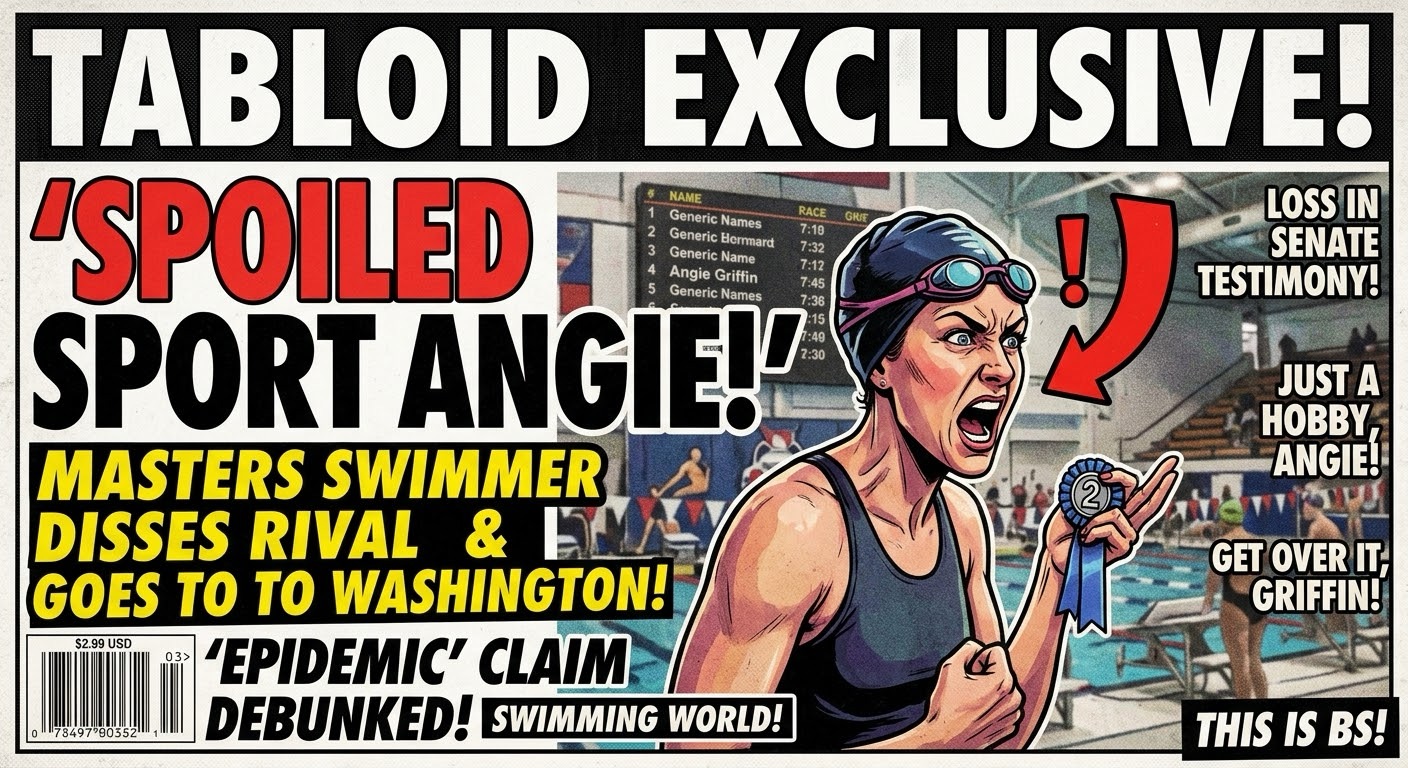
When competitive swimmer Angie Griffin testified before a Senate committee warning of an “epidemic” of trans women dominating women’s sports—pointing to her second-place finish at the U.S. Masters Swimming (USMS) Nationals in San Antonio—she did what has become standard practice in modern culture wars: take a single, isolated loss in an amateur adult league and frame it as an existential national crisis.

The claim of an “epidemic” falls apart under basic statistical reality.
The Numbers Tell a Very Different Story
To claim an institution is facing an epidemic, there must be evidence of widespread, systemic takeover. The actual data reveals the complete opposite:
- General Demographics: Comprehensive population research by the Williams Institute at the UCLA School of Law estimates that transgender adults make up roughly 0.8% of the U.S. adult population. Transgender women make up roughly one-third of that figure—about 0.27% of American adults. Among adults aged 35 to 64 (the exact demographic tier competing in Masters 45–49 divisions), only about 0.4% identify as trans at all.
- The Masters Pool: According to U.S. Masters Swimming, the organization serves around 60,000 to 70,000 adult members across more than 1,200 clubs nationwide. Only about 25% of those members ever participate in formal competitions. Across thousands of heats, age brackets, and regional meets every single year, the number of openly transgender women competing at national championships amounts to isolated, individual occurrences—often a single person at a multi-day event featuring hundreds of swimmers.
A fraction of a fraction of one percent is not an epidemic. It is a statistical rarity.
A Hobby Masquerading as High Stakes
The most thought-provoking aspect of this controversy is how completely divorced it is from the intended purpose of adult recreational sport.
Masters Swimming is not the Olympics. It is not NCAA Division I athletics. There are no collegiate scholarships, no multimillion-dollar Nike endorsement deals, and no livelihood hanging in the balance. As USMS itself emphasizes, the organization exists primarily to encourage lifelong health, fitness, community, and personal goal-setting among adults.
When someone wins a heat at a Masters meet, their reward is typically a ribbon, a medal, or a certificate. The participants are accountants, teachers, plumbers, and retirees who wake up at 5:00 AM to squeeze in yardage before their day jobs.
Yet Griffin and her backers treated a second-place finish in a 45–49 age bracket as grounds for a high-profile media tour and congressional testimony. Taking a community fitness league and turning it into a platform for partisan grievance looks less like an athlete standing on solemn principle and far more like classic poor sportsmanship.
Ego vs. Camaraderie
Competitive recreational sports demand an unspoken social contract: you train hard, you race hard, and when the horn sounds, you tap the wall, shake the hand of whoever touched ahead of you, and celebrate the fact that you’re still healthy enough to swim competitively as an adult.
When an athlete cannot handle touching second and instead escalates a local age-bracket race into a national moral panic, it threatens the very thing that makes adult leagues work: camaraderie and shared joy.
If someone’s personal identity and validation are so fragile that losing an amateur hobby race leads them to petition lawmakers and launch public grievance crusades, the problem isn’t the pool. The problem is an inability to keep adult play in perspective. Masters swimming is a hobby. If someone cannot handle losing with grace, they might want to reconsider why they got in the water in the first place.
Leave a Reply