
Can Creatine Actually Make You Smarter? What the Science Really Says 🧠⚡
When most people think of creatine monohydrate, they picture gym shakers, weight racks, and muscle hypertrophy. But over the last few years, creatine has exploded across social feeds as an unexpected “smart drug” or nootropic.

Does scooping creatine into your morning shake actually boost IQ, sharpen focus, or prevent mental fatigue? Here is what current clinical research and health reporting say about creatine and brain health.
1. Why the Brain Needs Creatine
Your brain represents roughly 2% of your total body weight, yet it burns roughly 20% of your body’s resting metabolic energy.
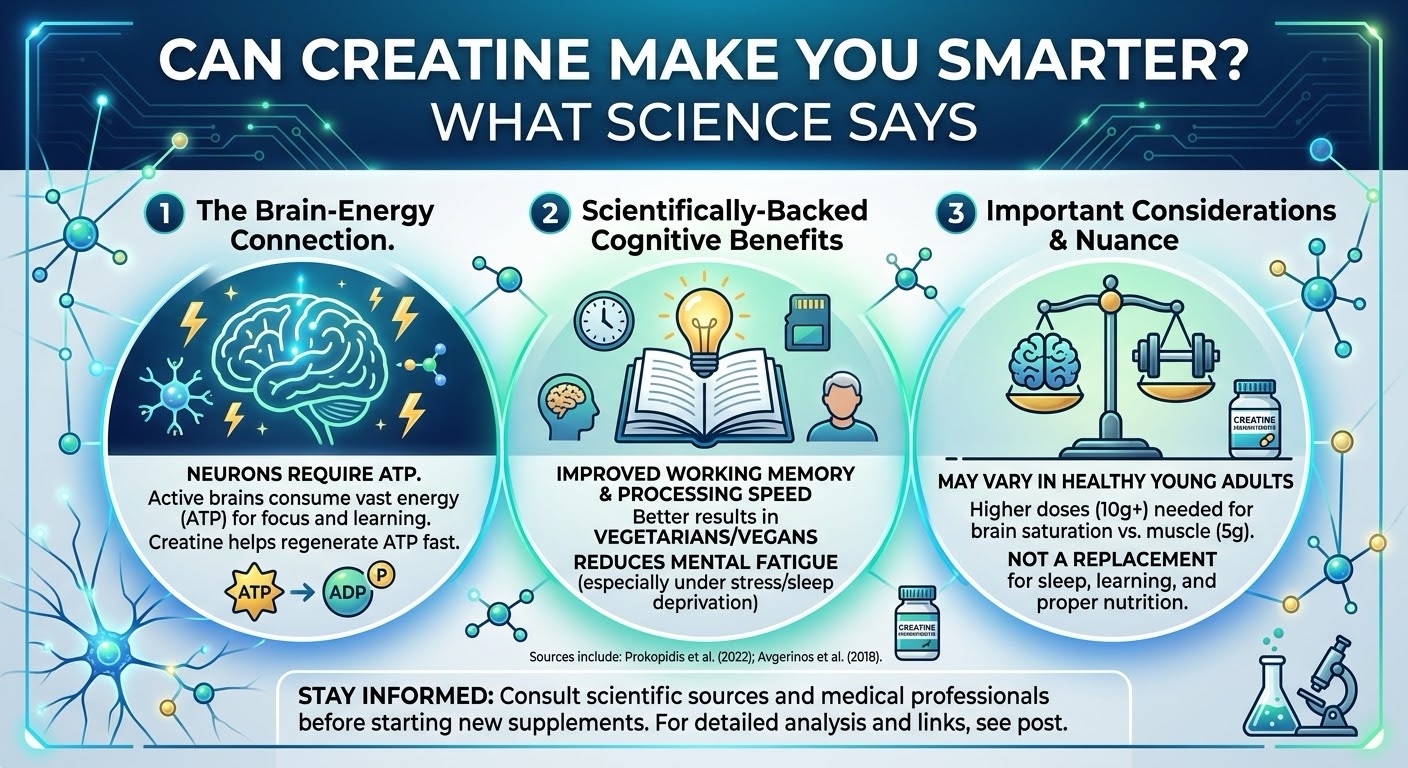
Just like working muscles, active neurons rely on rapid replenishment of adenosine triphosphate (ATP)—the cell’s primary energy currency. When energy demand spikes, phosphocreatine donates a phosphate molecule to regenerate ATP.
While skeletal muscle holds roughly 95% of the body’s creatine stores, the remaining supply supports tissues with high energy turnover, primarily the brain. When cognitive tasks become demanding or oxygen levels dip, brain phosphocreatine levels can deplete quickly.
2. Where the Science Shows Real Benefits
Recent systematic reviews and trials indicate that while creatine isn’t necessarily a “limitless pill” for everyone, it provides measurable benefits under specific conditions:
- Short-Term Memory & Working Memory: A comprehensive systematic review published in Nutrition Reviews found that creatine supplementation significantly improved memory performance compared to placebo, with especially pronounced effects in older adults aged 66–76 (Prokopidis et al., 2022).
- Vegetarians and Vegans: Because natural dietary creatine is found almost exclusively in meat and fish, individuals following plant-based diets typically have lower baseline tissue stores. Clinical trials reviewed by researchers found that vegetarians tend to show noticeably larger memory and cognitive gains following supplementation compared to omnivores (Avgerinos et al., 2018).
- Cognition Under Stress & Sleep Deprivation: Creatine appears most effective when the brain is metabolically strained—such as during severe sleep deprivation, hypoxia, or prolonged, exhaustive mental work. Under high fatigue, supplemental creatine helps maintain processing speed, working memory, and executive function.
3. The Nuance: Does It Boost Baseline IQ in Young, Healthy Adults?
If you are a well-rested, healthy omnivore in your twenties, creatine probably won’t turn you into Einstein overnight.
A 2024 meta-analysis in Frontiers in Nutrition analyzed randomized controlled trials and noted that while individual studies showed varying degrees of effect, creatine supplementation did not produce statistically significant shifts in baseline overall cognitive function or raw executive speed in healthy, un-stressed young adults (Xu et al., 2024).
As highlighted in health features on Men’s Health’s cognitive benefits coverage and Men’s Fitness UK, creatine acts more like a metabolic tailwind:
- It protects against the mental drop-off caused by exhaustion, sleep deficit, and aging.
- It does not replace proper sleep, balanced nutrition, or dedicated learning.
4. Dosing: Brain vs. Muscle Saturation
Reaching the brain is harder than saturating muscle tissue. The blood-brain barrier tightly regulates nutrient transport and expresses relatively low levels of the creatine transporter protein (SLC6A8).
- Muscle saturation: Typically achieved with 3–5 g per day.
- Brain saturation: Neuroscientists and sports nutrition researchers suggest that shifting brain creatine levels may require a higher or longer dosing protocol—often around 10 g per day or longer sustained periods of 5 g daily.
The Verdict
Creatine won’t magically increase raw intelligence, but it provides vital cellular energy buffer that protects cognitive capacity under stress, reduces mental fatigue, and sharpens memory in older adults or plant-based eaters.
References & Sources
- Men’s Health: Creatine Cognitive Benefits
- Men’s Fitness: Creatine Could Boost Your Brain
- MU Health Care: 6 Facts About Creatine and Brain Health
- Avgerinos, K. I., Spyrou, N., Bougioukas, K. I., & Kapogiannis, D. (2018). Effects of creatine supplementation on cognitive function of healthy individuals: A systematic review of randomized controlled trials. Experimental Gerontology, 108, 166–173. https://doi.org/10.1016/j.exger.2018.04.013
- Prokopidis, K., Giannos, P., Triantafyllidis, K. K., et al. (2022). Effects of creatine supplementation on memory in healthy individuals: a systematic review and meta-analysis of randomized controlled trials. Nutrition Reviews, 81(4), 416–427. https://doi.org/10.1093/nutrit/nuac064
- Xu, C., Bi, S., Zhang, W., & Luo, L. (2024). The effects of creatine supplementation on cognitive function in adults: a systematic review and meta-analysis. Frontiers in Nutrition, 11. https://doi.org/10.3389/fnut.2024.1424972
For an in-depth scientific breakdown of how dosing, brain uptake, and stress interact, watch Rhonda Patrick on Creatine Cognitive Benefits.
This discussion explains the biochemical mechanism of phosphocreatine in neurons and details why brain saturation requires different dosing strategies than muscle tissue.
#MentalPerformance
#CreatineMonohydrate
#MemoryImprovement
#CognitiveEnhancement
#BrainSupplements
Leave a Reply