
📣 Breakthrough for Masters Athletes: You Don’t Need Heavy Loads to Build Muscle After 50

For years, the dogma in the fitness world has been that building muscle (hypertrophy) and gaining strength requires heavy lifting—specifically, loads exceeding 70-80% of your one-rep max (1RM). A parallel belief has been that the post-exercise surge in systemic hormones like testosterone and growth hormone is the primary driver of these gains.
Newer research, much of it spearheaded by Dr. Stuart Phillips’ lab at McMaster University, turns both of these assumptions on their head, even for resistance-trained men over 50.
A groundbreaking study—originally conducted on young men but since confirmed as highly relevant for older, trained populations—demonstrates that neither the weight on the bar nor systemic hormones determine resistance training-mediated hypertrophy or strength gains.
The Key: Volitional Failure
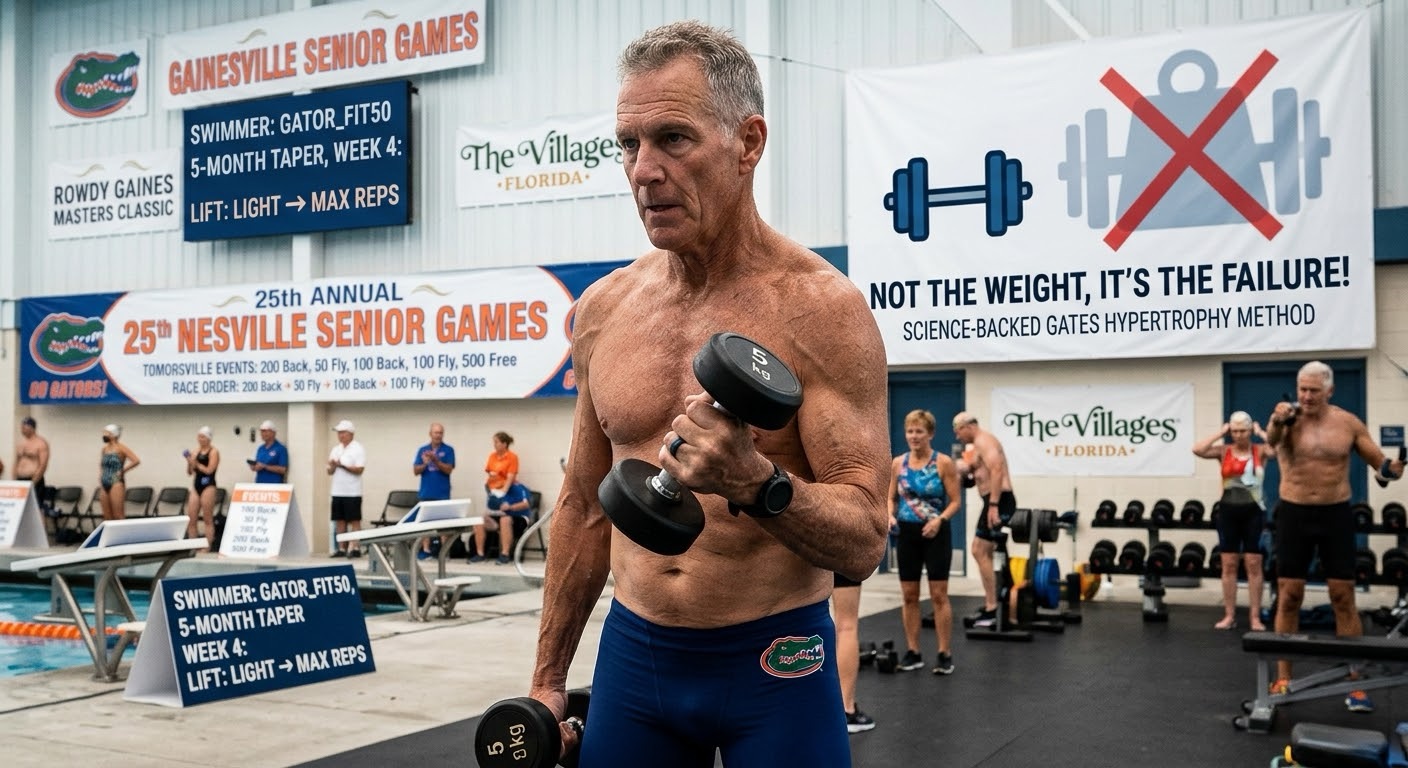
The pivotal factor isn’t the absolute load you lift; it’s the effort and fatigue within the set.
When exercises are performed to volitional failure (the point where you cannot complete another repetition with proper form), low-load training (e.g., 30-50% 1RM) produces similar muscle growth and significant strength improvements when compared to high-load training (e.g., 75-90% 1RM).
- For Hypertrophy: The metabolic stress generated by high-repetition sets to failure is just as effective at stimulating muscle protein synthesis and fiber growth as the mechanical tension of heavy weights.
- For Strength: While high-load training still has a slight edge for 1RM strength (partially due to neurological practice), low-load training still yields substantial, meaningful strength gains.
What About Hormones?
The study found no significant correlation between the acute, post-exercise spike in anabolic hormones and changes in muscle mass or strength. The hormonal surge appears to be a systemic response to exercise stress, rather than the primary cause of localized muscle growth. The true driver is the local, cellular mechanotransduction within the trained muscle itself.
Why This Matters for the Experienced Swimmer/Lifter Over 50
This is liberating news for aging athletes. As we age, our joints have accumulated more “mileage.” Lifting maximal weights consistently can increase the risk of injury and connective tissue strain, which can sideline you from both the gym and the pool.
By adopting this evidence-based approach, you can prioritize:
- Joint Longevity: Achieve championship-level hypertrophy and robust functional strength using lighter, more joint-friendly loads, as long as you match the intensity by training close to failure.
- Flexible Programming: This supports training variety. You can alternate between phases of traditional heavy strength building (e.g., during your STRENGTH phases) and phases using higher repetitions with lighter weights (e.g., during your ENDURANCE or TAPER phases) without fearing a loss of muscle mass.
The science is clear: The most critical component of your strength routine isn’t how much weight you are lifting, but how hard you are willing to work.
Sources:
- Primary Study: “Neither load nor systemic hormones determine resistance training-mediated hypertrophy or strength gains in resistance-trained young men” (Morton et al., 2016). Read the full study on PubMed.
- Further Context: “Resistance training load does not determine resistance training‐induced hypertrophy across upper and lower limbs in healthy young males” (Lees et al., 2025). Read on ResearchGate.
Leave a Reply