
Clickbait fitness articles targeted at adults over 50—such as those frequently featured in mainstream publications like Men’s Health—often commodify genuine scientific findings into sensationalized, actionable “quick fixes” or hyper-specific rules.
While the underlying premise—that strength training is essential for longevity—is backed by medical consensus, mainstream fitness media frequently distorts this reality to generate clicks and sell workout programs.

Why Fitness Clickbait Sets Adults Over 50 Up for Failure
1. Conflating “Muscle Mass for Longevity” with “Getting Shredded”
Clickbait articles routinely feature elite 50+ trainers or fitness influencers with single-digit body fat and extreme muscularity. They sell the idea that aging adults must pursue body transformation or high-intensity hypertrophy.
- Why it fails: Training to achieve an extreme physique requires severe caloric restriction, heavy mechanical loading, and high volume. For a typical 50+ adult, this significantly elevates joint stress and injury risk. Medical literature demonstrates that the longevity benefits of strength training come from functional muscular reserve, metabolic regulation, and bone density, not from having a 6-pack or extreme muscle hypertrophy.
2. Oversimplification and “One-Size-Fits-All” Prescriptions
Popular headlines promise “The 5 Moves You Must Do After 50” or sell standardized workout programs (e.g., “Max Muscle at 50”).
- Why it fails: Individual variance in joint health, past injuries, connective tissue degeneration, and recovery capacity accelerates significantly after age 50. Prescribing strict movement patterns (like standard barbell deadlifts or overhead presses) without individualized autoregulation or mobility assessments leads directly to tendinopathy, lower back flare-ups, and eventual abandonment of exercise.
3. Misrepresenting Exercise Volume and “More is Better”
Commercial articles often promote high-frequency, complex routines to keep content engaging and justify paid workout subscriptions.
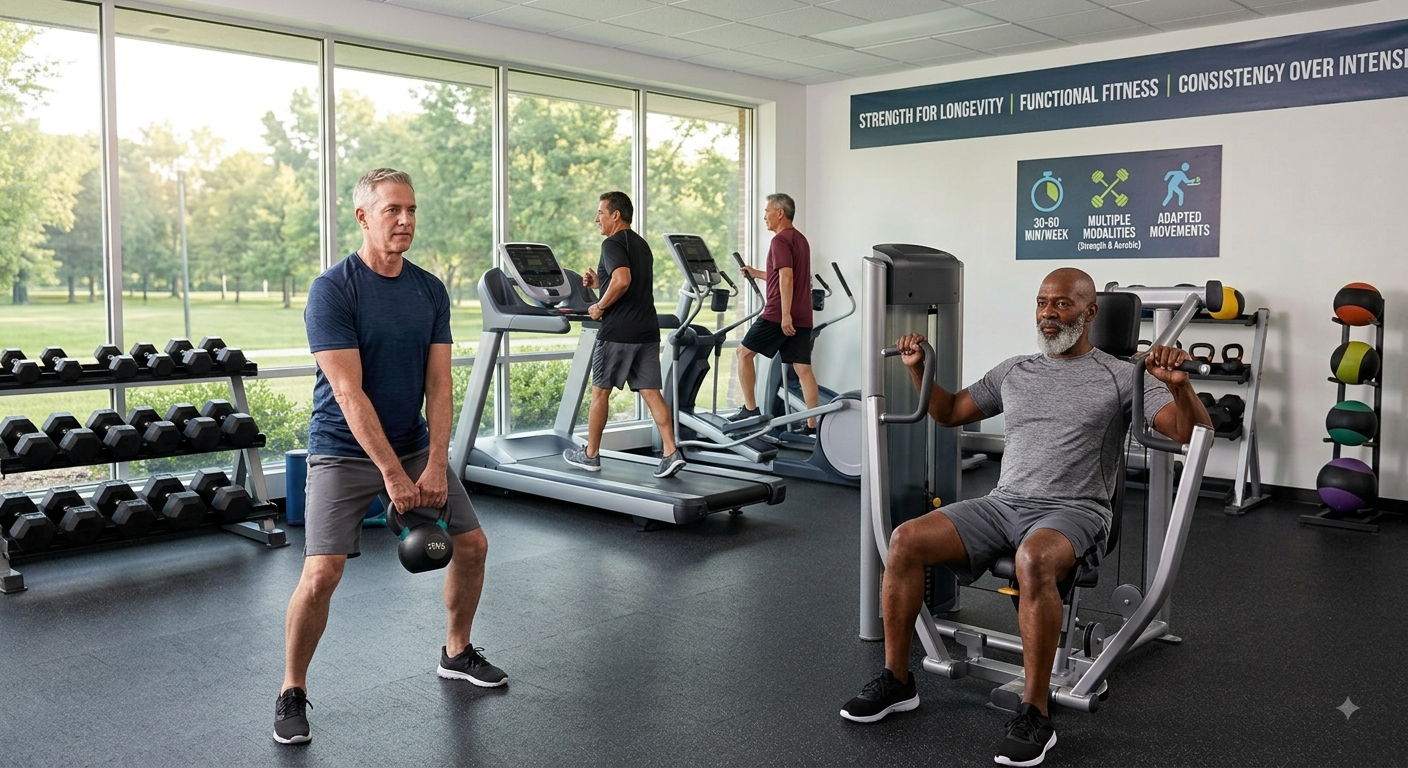
- Why it fails: Meta-analyses show that the mortality reduction curve for strength training actually flattens at modest doses (around 30 to 60 minutes per week). Excessive volume beyond this threshold yields diminishing returns for longevity and dramatically increases recovery demands, leading to chronic systemic fatigue.
4. Sensationalizing Scientific Research
Articles take epidemiological association studies (e.g., “people with higher grip strength live longer”) and translate them into clickbait claims (“do this exercise to add 10 years to your life”).
- Why it fails: It confuses correlation with causation. Grip strength and muscle mass are proxies for long-term health, physical activity, and low systemic inflammation—not a magic cure triggered overnight by a single workout protocol.
What the Research Actually Says (Sources & Evidence)
To build a sustainable strength protocol after age 50, the focus must shift from commercial aesthetic goals to evidence-based longevity outcomes:
- The Dose-Response Curve for Longevity is Small
- Evidence: A major meta-analysis published in the British Journal of Sports Medicine (Momma et al., 2022) evaluated muscle-strengthening activities and mortality.
- Finding: Maximum risk reduction for all-cause mortality, cardiovascular disease, and cancer occurred at 30 to 60 minutes per week of strength training (a 10–17% reduction in risk). Pushing far beyond this time commitment provided no additional mortality benefit.
- Grip Strength & Muscle Quality as Biological Indicators
- Evidence: The landmark Prospective Urban Rural Epidemiology (PURE) study published in The Lancet (Leong et al., 2015) evaluated over 140,000 adults.
- Finding: Muscle quality and functional strength (measured via grip strength) were stronger predictors of all-cause and cardiovascular mortality than systolic blood pressure. The goal over age 50 is preserving force capacity to prevent sarcopenia and frailty, not lifting for extreme hypertrophy.
- Combining Strength with Aerobic Training Yields the Best Outcomes
- Evidence: Research published in JAMA Internal Medicine (Zhao et al., 2020) analyzed physical activity guidelines in relation to mortality.
- Finding: Combining modest strength training with aerobic exercise reduced all-cause mortality risk by ~40%, compared to strength training alone. Media articles focusing exclusively on “building muscle” miss the vital synergy between cardiovascular fitness (VO2 max) and muscle strength.
The Realistic Blueprint for Strength After 50
Instead of chasing clickbait “max muscle” routines, evidence-based training for older adults prioritizes consistency, joint longevity, and functional independence:
- Frequency: 2 to 3 days per week (30–45 minutes per session).
- Movement Selection: Multi-joint compound patterns adapted to individual joint comfort (e.g., trap bar deadlifts instead of conventional deadlifts, dumbbell presses, leg presses, cable rows).
- Intensity: Moderate loading (RPE 7–8 out of 10), keeping 2–3 repetitions in reserve to minimize injury risk while maintaining sufficient stimulus to preserve muscle mass and bone mineral density.
Leave a Reply