
Why “Forgetting” Zone 2 and VO2 Max is Dangerous Fitness Advice: A Science-Backed Debunk
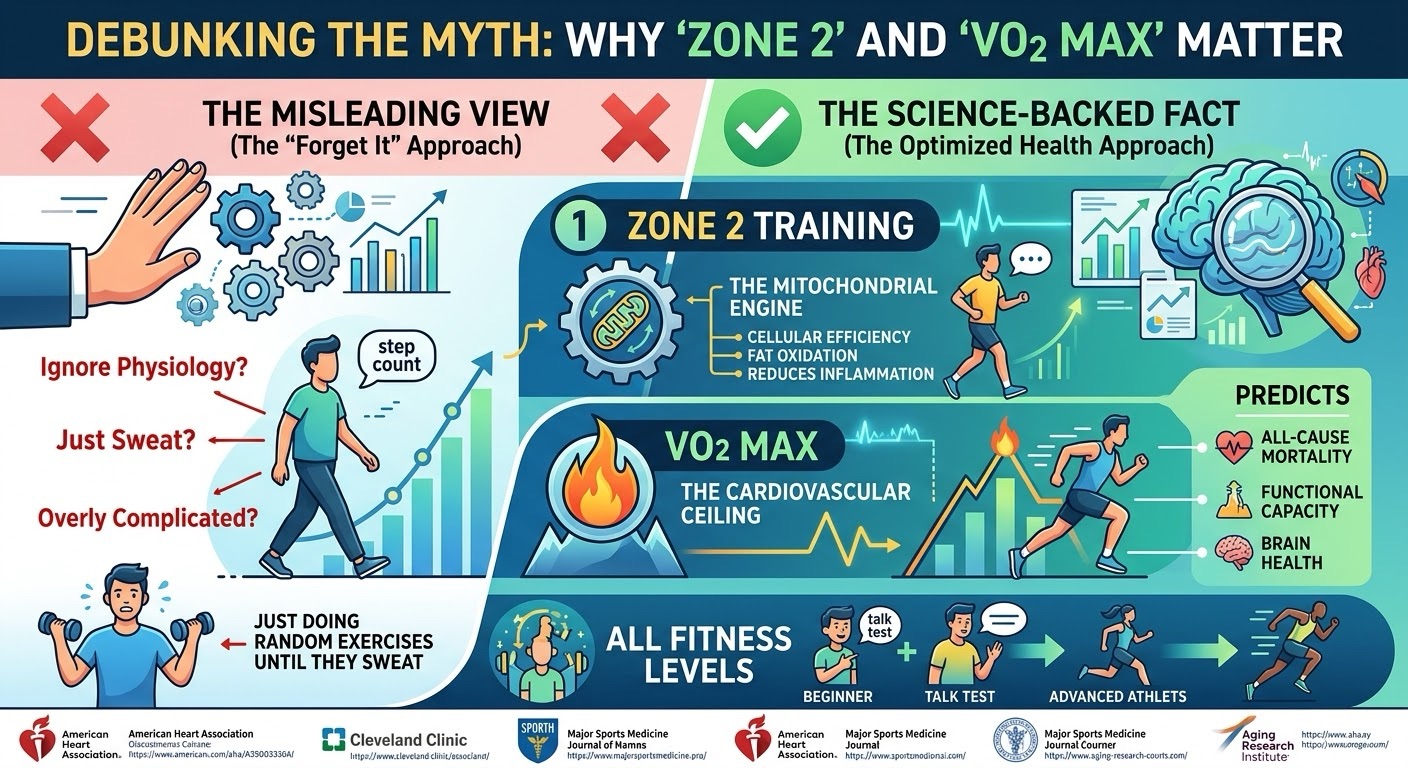
A recent Business Insider article claimed that regular people should “forget longevity buzzwords like Zone 2 and VO2 max” and instead stick to oversimplified, baseline activity metrics like daily step counts or arbitrary sweat sessions.
While simplicity in fitness has its place, dismissing Zone 2 training and VO2 max as mere “buzzwords” throws out decades of gold-standard clinical exercise physiology. These are not biohacking fads reserved for elite Olympians—they are fundamental physiological parameters that dictate metabolic health, chronic disease risk, functional independence, and overall lifespan across every fitness level.

1. \text{VO}_2 Max is One of the Strongest Predictors of All-Cause Mortality
Framing VO2 max (the maximum volume of oxygen your body can transport and utilize during exertion) as an overcomplicated metric ignores one of the most robust findings in modern epidemiology: cardiorespiratory fitness (CRF) is often more predictive of mortality than classic risk factors like smoking, hypertension, or high cholesterol.
- The Cleveland Clinic Cohort Study: In a landmark study published in JAMA Network Open, researchers evaluated 122,007 patients undergoing exercise treadmill testing. The results were stark: cardiorespiratory fitness was inversely associated with all-cause mortality, with no upper limit of benefit. Extremely high aerobic fitness was linked to the greatest survival advantage, while low cardiorespiratory fitness conferred a higher mortality risk than smoking or coronary artery disease.
- The American Heart Association (AHA) Scientific Statement: The AHA released a dedicated clinical statement in Circulation advocating for cardiorespiratory fitness to be routinely assessed as a vital sign in clinical practice, emphasizing that every 1-MET (3.5\text{ mL/kg/min}) improvement in aerobic capacity is associated with a 10–25% reduction in cardiovascular and all-cause mortality.
Regardless of whether someone is a complete beginner or a seasoned runner, knowing and systematically improving cardiorespiratory capacity directly expands their healthy years of life (healthspan).
2. Zone 2 Cardio: The Engine of Mitochondrial Health and Metabolic Flexibility
Zone 2 represents the exercise intensity where mitochondrial lactate clearance matches lactate production, primarily utilizing lipid (fat) oxidation via oxidative phosphorylation. Dismissing Zone 2 as “unnecessary noise” overlooks the cellular power plants that protect against metabolic syndrome and Type 2 diabetes.
- Mitochondrial Biogenesis: Research published in Oxidative Medicine and Cellular Longevity demonstrates that continuous moderate-intensity training stimulates PGC-1$\alpha$ (peroxisome proliferator-activated receptor gamma coactivator 1-alpha), the master regulator that signals the body to build new, healthy mitochondria (mitochondrial biogenesis).
- Metabolic Flexibility & Substrate Utilization: Groundbreaking work by Dr. Iñigo San-Millán and Dr. George Brooks published in Sports Medicine demonstrated that metabolic health can be clearly mapped by lactate clearance capacity and fat oxidation rates during exercise. Individuals with metabolic dysfunction (like insulin resistance or prediabetes) show an inability to efficiently oxidize fat and clear lactate—a deficit that low-to-moderate intensity aerobic training (Zone 2) specifically rehabilitates.
3. Why These Metrics Matter for All Fitness Levels (Especially Beginners)
Critics often argue that Zone 2 and \text{VO}_2 max require expensive metabolic carts or blood lactate testing. This is a false dilemma. You do not need a clinical physiology laboratory to benefit from the science: Metric / ZoneWhat It TrainsHow a Beginner Applies It for Free Zone 2 CardioMitochondrial density, capillarization, fat burning, and cardiac stroke volume.The Talk Test: Exercise at an intensity where you can speak in full, complete sentences, but breathing is slightly elevated (e.g., brisk incline walking, easy cycling). \text{VO}_2 Max TrainingPeak oxygen uptake, cardiac output, lung capacity, and systemic vascular health.Submaximal Intervals: 1–2 weekly sessions incorporating 3–4 minute bouts of hard, sustainable effort (where conversation is impossible), followed by equal rest.
The Takeaway
Walking and hitting a daily step goal is an excellent baseline habit, but it is the floor, not the ceiling.
Telling people to ignore Zone 2 and \text{VO}_2 max ignores the precise physiological adaptations required to prevent chronic illness, sustain independence into old age, and build resilient cardiovascular systems. You don’t need fancy wearables or lab protocols to apply them, but understanding the biological why behind intensity zones turns random exercise into targeted, lifelong preventive medicine.
Referenced Sources & Scientific Literature:
- Mandsager, K., et al. (2018). Association of Cardiorespiratory Fitness With Long-term Mortality Among Adults Undergoing Exercise Treadmill Testing. JAMA Network Open.
- Ross, R., et al. (2016). Importance of Assessing Cardiorespiratory Fitness in Clinical Practice: A Case for Fitness as a Clinical Vital Sign. Circulation / American Heart Association.
- San-Millán, I., & Brooks, G. A. (2018). Assessment of Metabolic Flexibility and Substrate Oxidation: An Approach to Chronic Disease and Performance. Sports Medicine.
- Daussin, F. N., et al. (2017). Exercise and Mitochondrial Health: A Path to Longevity. Oxidative Medicine and Cellular Longevity.
Leave a Reply