
What Happens to Testosterone When You Don’t Get Enough Sleep?
If you are trying to optimize your health, performance, or body composition, sleep might be the most powerful—and most frequently ignored—factor in keeping your hormone levels optimal. Many men turn to supplement stacks, intense workouts, or drastic diet changes, but skipping sleep severely compromises testosterone production.

Here is what actually happens to your body’s primary anabolic hormone when you cut your sleep short, supported by modern medical literature and endocrinology research.
1. Testosterone Levels Tank Rapidly
Testosterone production isn’t constant throughout the day; it operates on a circadian rhythm. Your body produces the vast majority of its daily testosterone while you sleep, particularly during REM (Rapid Eye Movement) and deep sleep stages.
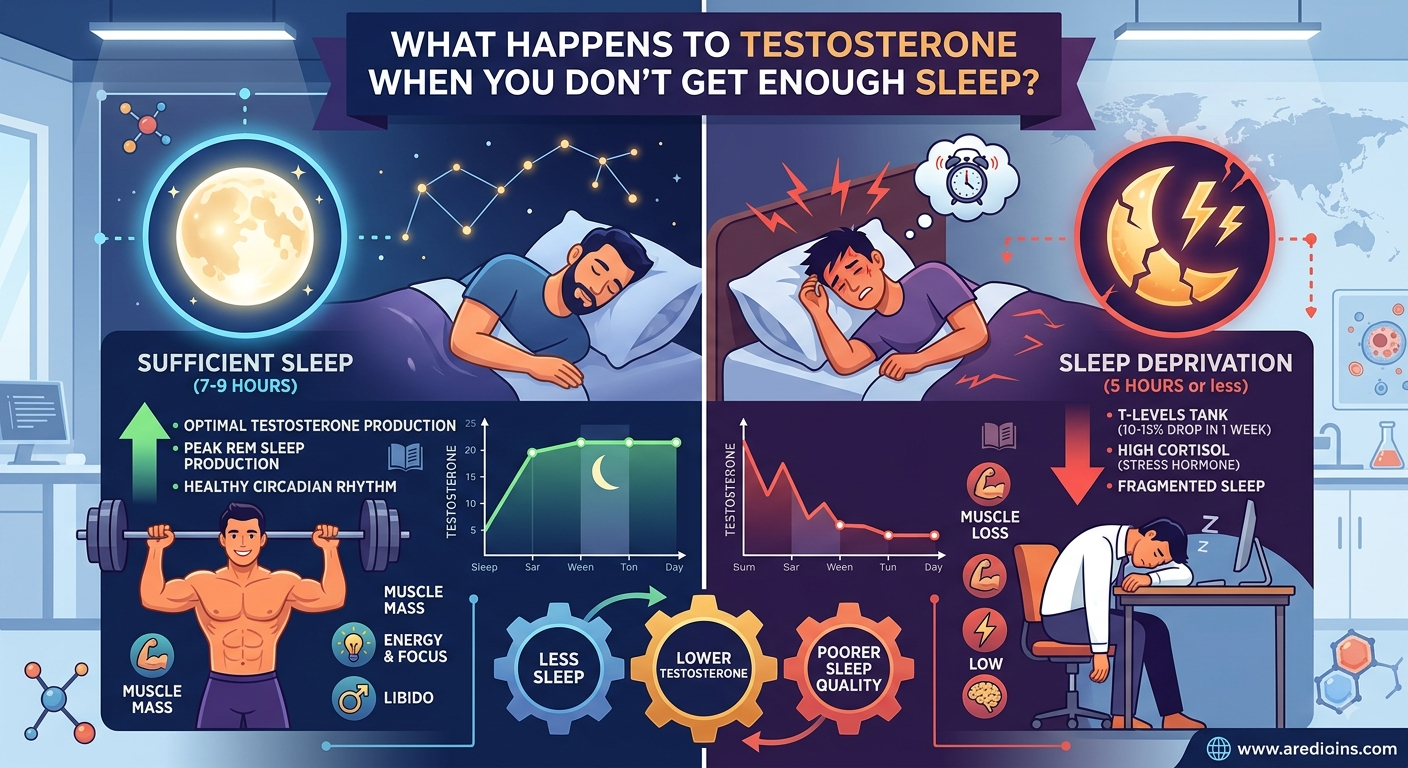
- The 1-Week Drop: In a landmark study published by the Journal of the American Medical Association (JAMA), young, healthy men restricted to 5 hours of sleep per night for just one week experienced a 10% to 15% drop in testosterone levels.
- Equivalent Aging: That sudden 10–15% decline effectively aged their hormonal profile by 10 to 15 years in a matter of days.
- Per-Hour Loss: A broader study on American men published in PubMed / World Journal of Urology found that for every hour of lost sleep, serum testosterone drops by approximately 5.85 ng/dL.
When you skip sleep, you rob your endocrine system of the essential time window it needs to rebuild and release testosterone.
2. Cortisol Spike Creates a Hormonal Tug-of-War
When you are chronically sleep-deprived, your body views sleep restriction as a physical stressor. In response, your adrenal glands flood your system with cortisol—the body’s primary stress hormone.
Cortisol and testosterone operate in a inverse relationship:
- Elevated Cortisol: Increases alertness, elevates heart rate, and keeps your central nervous system on edge.
- Suppressed Testosterone: Cortisol directly impairs the hypothalamic-pituitary-gonadal (HPG) axis, signaling your body to stop prioritizing anabolic processes like testosterone production, muscle repair, and recovery.
3. The “Low T and Poor Sleep” Vicious Cycle
Sleep deprivation lowers your testosterone, but low testosterone also degrades your sleep quality—creating a frustrating, self-reinforcing loop.
┌────────────────────────────────────────────────────────┐
│                   Sleep Restriction                    │
└──────────────────────────┬─────────────────────────────┘
                           │
                           ▼
┌────────────────────────────────────────────────────────┐
│        Testosterone Drops & Cortisol Spikes            │
└──────────────────────────┬─────────────────────────────┘
                           │
                           ▼
┌────────────────────────────────────────────────────────┐
│     Shallow Sleep, Night Awakening & Insomnia          │
└──────────────────────────┬─────────────────────────────┘
                           │
                           ▼
┌────────────────────────────────────────────────────────┐
│         Vicious Cycle Continues / Lowers T Further     │
└────────────────────────────────────────────────────────┘
As noted in clinical breakdowns from Hone Health and Lowcountry Male, low testosterone levels lead to fragmented, shallower sleep, more nighttime awakenings, and a reduction in deep sleep stages.
4. Symptoms You’ll Notice Outside the Bedroom
Because testosterone regulates everything from metabolic rate to cognitive function, sleep-induced low testosterone will manifest in everyday life:
- Reduced Libido and Sexual Health: Lowered desire and potential performance issues due to decreased circulating free testosterone.
- Loss of Lean Muscle and Harder Fat Loss: Less testosterone impairs protein synthesis, making it difficult to build or maintain muscle, while higher cortisol promotes abdominal fat storage.
- Brain Fog and Fatigue: Low vigor, decreased motivation, and difficulty focusing throughout the workday.
How to Protect and Rebound Your Testosterone
To allow your hormones to normalize naturally, prioritize these sleep hygiene protocols:
- Target 7–9 Hours Uninterrupted: You need at least 3 to 4 hours of consecutive, uninterrupted sleep architecture before peak testosterone release occurs.
- Keep Your Bedtime Consistent: Sleeping 12:00 AM to 8:00 AM on weekdays but 3:00 AM to 11:00 AM on weekends disrupts circadian testosterone timing.
- Optimized Sleep Environment: Keep your bedroom dark, quiet, and cool (between 60°F and 67°F / 15°C–19°C) to trigger your core body temperature drop necessary for REM sleep.
- Avoid Evening Disruptors: Limit caffeine past mid-day and restrict alcohol intake—alcohol might help you fall asleep faster, but it severely degrades REM quality and suppresses testosterone production overnight.
Referenced Sources & Further Reading:
- Men’s Health: How Sleep Affects Testosterone Levels
- [Hone Health: Does Testosterone Affect Sleep?](https://honehealth.com/edge/sleep-and-testosterone/)
- [Lowcountry Male: The Role of Sleep in Testosterone Production](https://lowcountrymale.com/the-role-of-sleep-in-testosterone-production-and-mens-health/)
- [PubMed: Impaired Sleep and Low Testosterone in Adult Males (NHANES Data)](https://pubmed.ncbi.nlm.nih.gov/30225799/)
- PMC / NCBI: Effect of 1 Week of Sleep Restriction on Testosterone Levels
- [Baptist Health: Does Insufficient Sleep Affect Testosterone Levels in Men?](https://www.baptisthealth.com/blog/mens-health/does-insufficient-sleep-affect-testosterone-levels-in-men)
Leave a Reply