
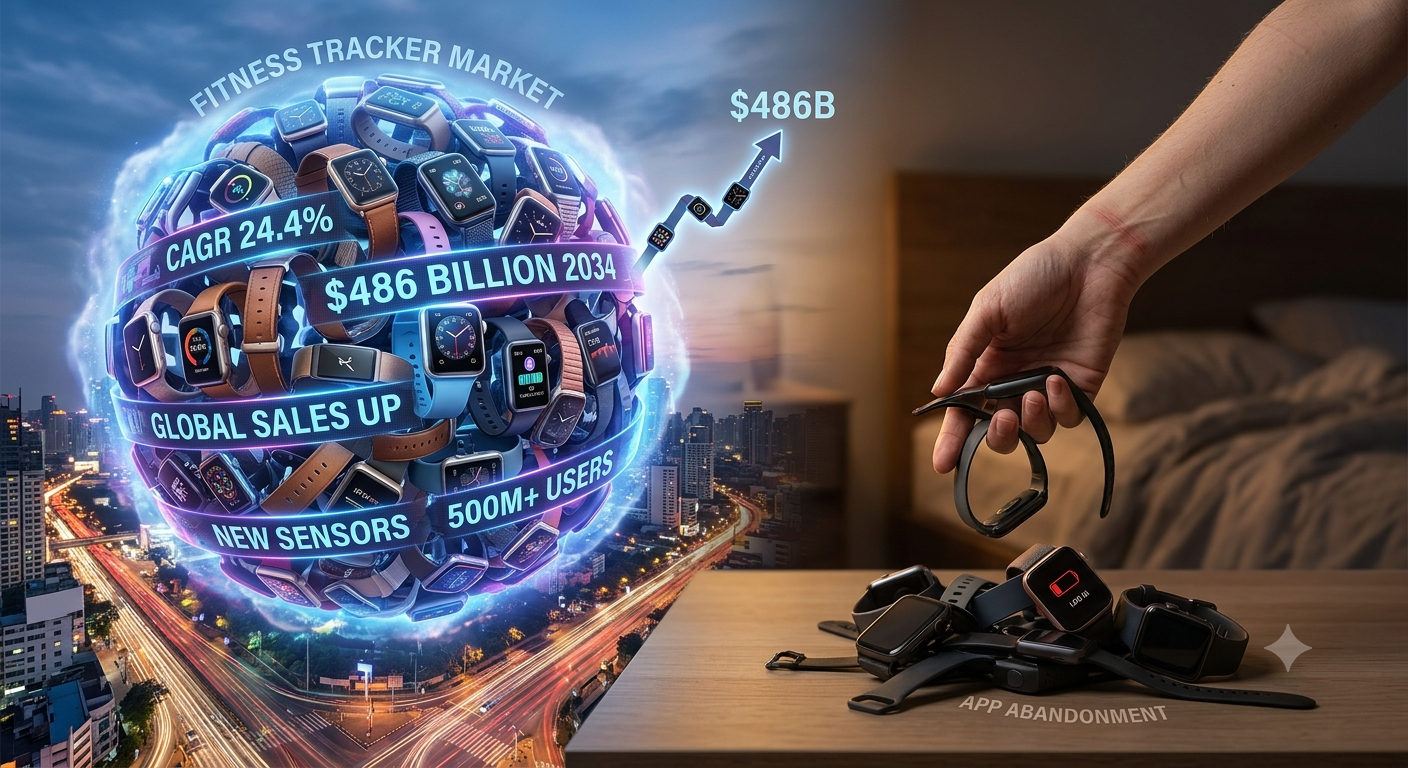
The health technology industry is witnessing a striking paradox: while wearable adoption and sales are breaking global records, users are increasingly ditching their devices due to tracking anxiety, metric fatigue, and mental burnout.

The Booming Wearables Market
According to market research from Fortune Business Insights, the global fitness tracker market was valued at $72.08 billion in 2025 and is projected to expand from $84.68 billion in 2026 to $486.60 billion by 2034, reflecting a compound annual growth rate (CAGR) of 24.43%.
Market expansion is being fueled by several key developments:
- Smartwatch Dominance: Smartwatches account for over 41% of device market share, driven by advanced features like ECG monitoring and sleep readiness scores.
- Preventive Health & Chronic Care: Devices are moving beyond step counts into clinical-grade health tracking, such as blood oxygen levels, heart rhythm irregularities (AFib), and continuous glucose monitoring.
- Widespread Regional Adoption: North America holds the largest share (47% in 2025), but rapid growth in Europe and Asia-Pacific continues to accelerate adoption.
The Dark Side of Optimization: Metric Fatigue and “Orthosomnia”
Despite this surge in adoption, a growing counter-trend reveals that continuous self-quantification is taking a severe mental toll on users.
As highlighted in Men’s Fitness, a survey conducted by Naturepedic and North Star Inbound revealed that while 64% of respondents track at least one health metric daily, 58% feel completely overwhelmed by the sheer volume of health advice and data. Crucially, over a third of users have abandoned a fitness tracker or health app because it made them feel worse mentally.
┌─────────────────────────────────────────────────────────┐
│              Most Commonly Tracked Metrics              │
├─────────────────────────────────────────────────────────┤
│  Weight                                   82%           │
│  Steps & Physical Activity                72%           │
│  Water Intake                             64%           │
│  Sleep Duration                           60%           │
│  Sleep Quality                            47%           │
└─────────────────────────────────────────────────────────┘
Key Psychological Drivers of App Abandonment:
- Orthosomnia: An unhealthy obsession with achieving a “perfect” sleep score. Users frequently report waking up feeling rested, only to check an algorithm’s “poor” sleep score and feel fatigued for the rest of the day—a psychological self-fulfilling prophecy.
- Shame and Guilt: A study published in the British Journal of Health Psychology analyzed thousands of user posts and found that health apps frequently induce shame over missed targets, irritation at aggressive push notifications, and demoralization when progress stalls.
- Data Overload without Context: Real-time data streams without actionable, personalized context transform health tools from empowering gadgets into source material for health anxiety.
What Academic Research Shows About App Churn
The dropout phenomenon isn’t limited to anecdotal survey responses. Systematic reviews and industry analyses highlight high long-term churn:
- The 100-Day Drop-Off: A scoping review available on PubMed Central (PMC) found that a median of 70% of users discontinue health and fitness apps within the first 100 days. Physical activity apps showed abandonment rates ranging between 54% and 75%.
- Tedious Manual Entry: Research published in Emerald Insight points to manual logging fatigue (e.g., searching multi-item food databases or manually logging workouts) as a top trigger for device and app abandonment.
- Perceived Utility Gap: Consumer surveys cited by Wellable indicate that roughly 30% of wearables are eventually abandoned due to boredom, loss of perceived value, or the realization that smartphone apps offer adequate monitoring without an added device.
Finding the Balance: Moving from Tracking to Well-Being
For health tech manufacturers and users alike, sustainable engagement requires shifting away from endless monitoring toward intuitive, supportive health guidance:
- For Users: Treat data as a directional guide rather than a daily report card. If tracking a specific metric (like sleep or calorie intake) causes stress, temporarily disable that metric or take a full tracking break.
- For Developers: Focus on reducing logging friction via automation, shifting away from punitive gamification (e.g., losing a streak), and providing holistic wellness context rather than raw numerical scores.
Outbound Sources Summary
- Fortune Business Insights: Fitness Tracker Market Size & Forecast
- Men’s Fitness: Why Over a Third of People Are Quitting Their Health Apps
- NCBI / PubMed Central: Scoping Review on Lifestyle & Health App Abandonment
- Emerald Insight: Deep Dive into Why Consumers Stick with or Ditch Fitness Trackers
- Powers Health / UCL Study: Fitness Apps Undermine Motivation For Some Users
- Wellable / Gartner: Survey on Fitness Tracker and Smartwatch Abandonment
Leave a Reply