
Have you ever started exercising with guts and gusto… only to burn out within a couple of weeks?
We call it the two-week wonder. And we’ve all been there.
You buy the new gear, set the 5:00 AM alarm, and promise yourself that this time will be different. But by day fourteen, the alarm goes off, your bed feels like a warm cloud, and the thought of hitting the gym makes you want to crawl under the covers.
Too many people blame a lack of willpower, laziness, and their inability to JUST. PUSH. THROUGH.

But willpower is a finite resource. What’s actually lacking isn’t discipline; it’s a simple equation that the fitness industry rarely talks about:
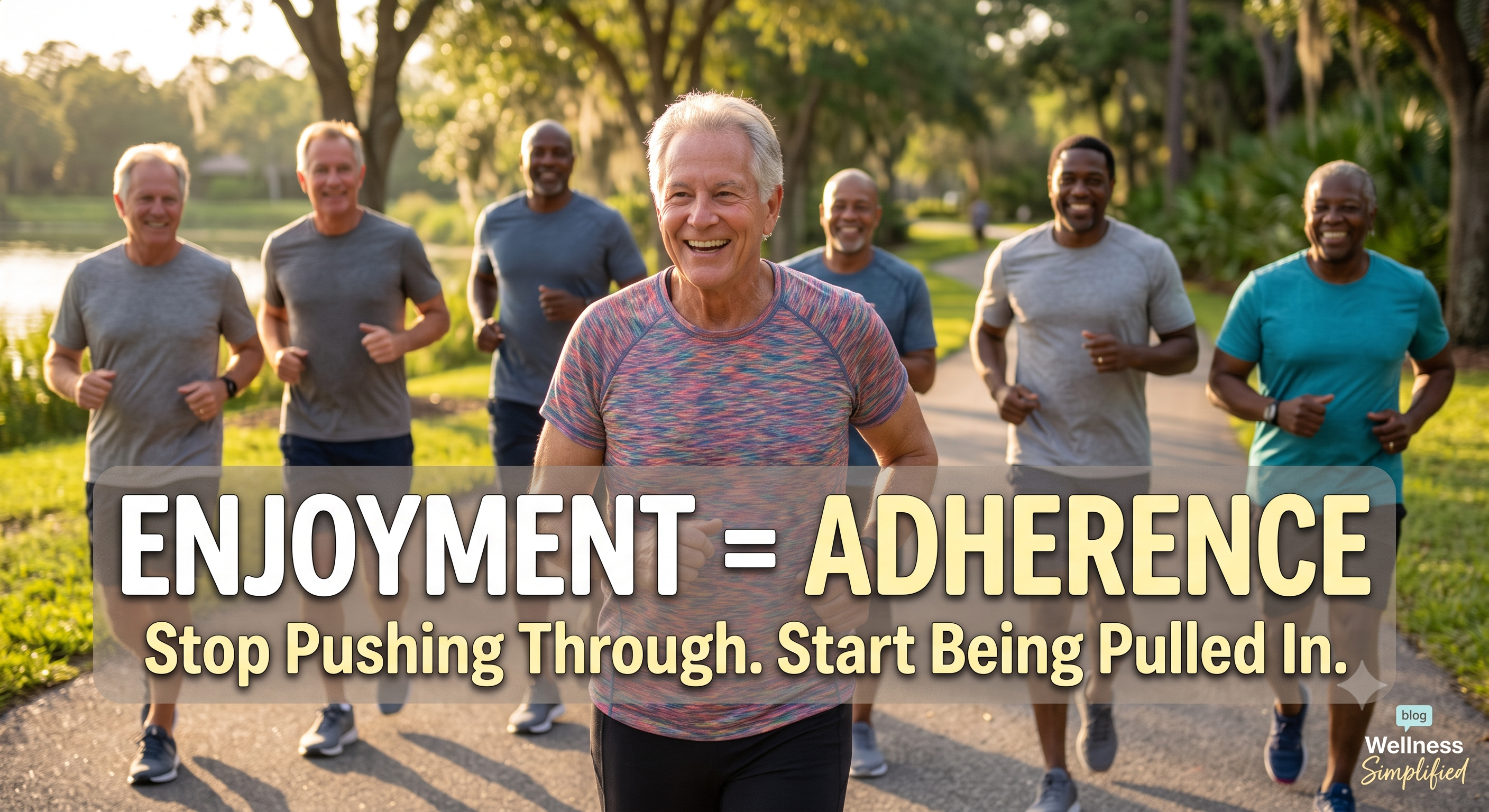
$$\text{Enjoyment} = \text{Adherence}$$
Today, let’s take a few minutes to learn why the best workout is the one you actually want to do, and how to shift from pushing through to being pulled in.
The “No Pain, No Gain” Myth
We’ve been conditioned to believe that if a workout isn’t agonizing, it isn’t working. We look at extreme fitness influencers and think we need to match their intensity to see results.
But here is a dose of reality: Consistency beats intensity every single time.
If you force yourself to do a grueling, high-intensity workout that you hate, your brain logs that experience as a punishment. Human biology is hardwired to avoid pain and seek pleasure. When you rely solely on grit, you are fighting a losing battle against your own psychology.
The Math of Motivation
Think of your fitness journey as a long-term investment.
| The “Grind It Out” Approach | The “Enjoyment First” Approach |
| Focus: Burning maximum calories / extreme fatigue | Focus: Moving in a way that feels good |
| Mantra: “No excuses, just push through.” | Mantra: “What do I feel like doing today?” |
| Lifespan: 2 to 4 weeks before burnout | Lifespan: Months, years, or a lifetime |
| Result: Injury, frustration, and starting over | Result: Sustainable habits and lasting health |
When you find an activity you genuinely enjoy—whether it’s hiking, dance, weightlifting, swimming, or rock climbing—the psychological friction vanishes. You don’t need a motivational speech to do something you like; you just do it.
How to Find Your “Pull”
Shifting your mindset from punishment to pleasure takes a little experimentation. If you’re stuck in the two-week wonder cycle, try these three steps:
- Audit Your Past: Write down the last few times you exercised. Did you actually enjoy the activity, or did you just enjoy being done with it? If it’s the latter, it’s time to swap it out.
- Lower the Barrier: You don’t have to go from 0 to 60. A 20-minute walk you look forward to is infinitely better than a 60-minute gym session you dread and skip.
- Focus on the Feeling: Pay attention to how you feel during the movement. Find the rhythm, the music, or the environment that makes your brain and body want to repeat the experience.
The Golden Rule: The single best exercise on the planet is the one you will actually do again tomorrow.
Stop beating yourself up for failing at a routine that was never designed for your happiness. Give yourself permission to drop the exercises you hate, and start looking for the ones that pull you in.
What’s one activity you’ve tried in the past that actually felt like fun rather than a chore?
Finding your “pull” is about identifying activities where the internal reward is so high that you don’t need external pressure to do them. It requires shifting your mindset from doing what you should do to discovering what you actually want to do.
Outdoor Exploration. Source: Vecteezy / Hiking tourism adventure. Senior couple man woman enjoying outdoor …
Play-Based Fitness. Source: Hydrow / 20 Different Types of Exercise to Try When Starting a Fitness …
Finding that sweet spot relies on three core strategies:
1. Identify Your “Movement Personality”
People enjoy exercise for entirely different psychological reasons. To find what pulls you in, look at your personality traits rather than fitness trends:
- The Problem Solver: If you get bored easily, you need mental engagement. Activities like rock climbing, tennis, or martial arts act as physical puzzles where your brain is too busy figuring out the next move to notice the physical exertion.
- The Escape Artist: If your day is high-stress, you might need a solo, meditative pull. Trail running, swimming, or long cycling sessions allow you to completely disconnect from screens and thoughts.
- The Socializer: If you find working out alone draining, look for community-driven pull. Adult rec leagues, dance classes, or group fitness environments provide built-in accountability through connection.
2. Follow the “Play” Clues from Your Past
Think back to when you were 10 years old. How did you move your body before “exercise” became tied to burning calories or changing your appearance?
- If you loved riding your bike around the neighborhood until the streetlights came on, an adult road or mountain bike might pull you in.
- If you were always climbing trees, look into a local bouldering gym.
- If you loved recess games, look for a local dodgeball or pickleball league.
3. Change Your Metric of Success
When you measure a workout purely by how many calories you burned or how exhausted you feel, you are using a “push” metric. To find your pull, track how you feel afterwards.
Ask yourself: Do I feel more energized? Is my mood better? Did I sleep soundly? When your brain starts pairing a specific movement with an immediate, positive upgrade to your mental health, the pull happens naturally.
Leave a Reply