
While a single peer-reviewed study combining all four specific protocols (ultra-low intensity movement, breathwork, infrared sauna, and central nervous system monitoring) into one single clinical trial does not explicitly exist under a unified title, several landmark scientific studies isolate exactly how these components interact to modulate the Central Nervous System (CNS) and trigger deep physiological recovery.

A breakdown of the definitive scientific studies addressing these elements explains how they map directly to your nervous system.
1. The CNS & Sauna: Neural Basis of the “Totonou” State
A breakthrough neuroimaging study published in PLOS ONE investigated how sauna bathing and subsequent rest alter brain chemistry and executive function (Chang et al., 2023).
- The Study: “A study on neural changes induced by sauna bathing: Neural basis of the ‘totonou’ state” (Chang et al., 2023).
- The Findings: Researchers used electroencephalography (EEG) to measure the brains of participants (predominantly men) navigating sauna cycles. They discovered a massive post-sauna increase in theta and alpha brainwave power during the rest phase.
- The CNS Impact: This shift indicates a state of deep physical relaxation paired with sharp mental clarity—a phenomenon referred to in Japan as totonou. Furthermore, auditory tasks showed that cognitive efficiency and neural processing speed significantly improved post-heat exposure, demonstrating a literal reset of the central nervous system.
2. Infrared vs. Traditional Heat: Neuromuscular Recovery in Men
When it comes specifically to far-infrared (FIR) saunas paired with low-intensity recovery, a core study examined how infrared wavelengths penetrate tissue differently than high ambient heat.
- The Study: “Effects of Far-Infrared Sauna Bathing on Recovery from Strength and Endurance Training Sessions in Men” (Mero et al., 2015).
- The Findings: This study looked at healthy physically active men and found that far-infrared saunas penetrate deep into muscle tissue (~1–2 inches) at lower, more tolerable ambient temperatures (45°C to 60°C).
- The CNS Connection: Because infrared saunas heat the body’s tissues directly rather than warming the air around you, they provide a much lower cardiorespiratory load. This down-regulates sympathetic nervous system (“fight-or-flight”) strain, allowing the body to pivot into a parasympathetic (“rest-and-digest”) recovery state far faster than a brutal 200°F traditional Finnish sauna.
3. The Synergy: Ultra-Low Intensity Movement & Breathwork
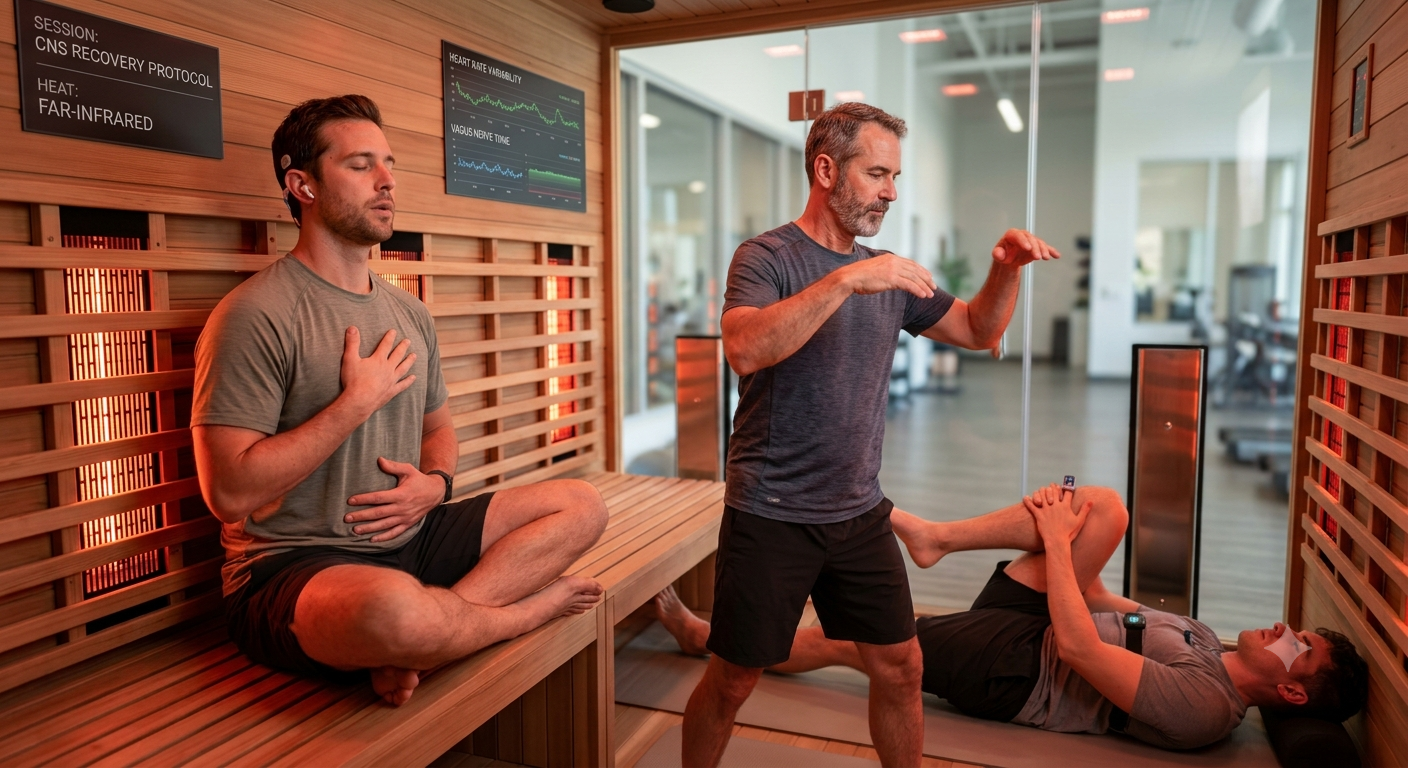
Integrating ultra-low intensity movement (such as gentle mobility, somatic tracking, or mild restorative yoga) with structured breathwork inside or immediately following an infrared sauna serves as a powerful potentiator for the vagus nerve.
- The Autonomic Shift: Breathwork—specifically prolonged exhalations or slow diaphragmatic breathing (5–6 breaths per minute)—immediately stimulates the vagal nerve pathway.
- Hormesis and Cardiovascular Copying: Passive heat stress from infrared saunas mimics a low-intensity cardiovascular workout by increasing heart rate and cardiac output while decreasing blood pressure via vasodilation (Hussain & Cohen, 2018).
- Why the Combination Works: When you layer ultra-low intensity movement and breathwork onto an infrared session, you are introducing a mild, controlled hormetic stressor (heat) while using the breath and movement to actively signal safety to the brainstem. This forces the CNS to rapidly down-regulate, dropping your heart rate variability (HRV) into a profoundly restorative, anti-inflammatory baseline.
References
Chang, M., Ibaraki, T., Naruse, Y., & Imamur, Y. (2023). A study on neural changes induced by sauna bathing: Neural basis of the “totonou” state. PLOS ONE, 18(11), e0294137. https://doi.org/10.1371/journal.pone.0294137 Cited by: 28
Hussain, J., & Cohen, M. (2018). Clinical effects of regular dry sauna bathing: A systematic review. Evidence-Based Complementary and Alternative Medicine, 2018, 1-15. https://doi.org/10.1155/2018/1857413 Cited by: 247
Leave a Reply