
Be honest: when was the last time you dedicated actual time to working on your flexibility? If you are like most guys, stretching is the thing you skip at the end of a workout because you are short on time, or it simply feels like a chore.
But a massive long-term study might make you reconsider pushing your mobility to the back burner.
A team of researchers tracked over 3,000 individuals aged 46 to 65 for an average of nearly 13 years, scoring their flexibility across 20 different joint movements. What they uncovered was a striking connection between your range of motion and your lifespan.
For the guys in the study, the least flexible men had a 1.87-fold higher risk of dying from natural causes during the follow-up period compared to those who were the most flexible. This held true even after the scientists adjusted for age, body mass index (BMI), and overall health status.

Why Flexibility Tracks with Longevity
Flexibility isn’t just about showing off a party trick or touching your toes. In the grand scheme of your health, your joint mobility is a clear indicator of how your body is aging.
- An Indicator of an Active Life: Muscle and joint tightness usually doesn’t happen overnight. It is typically a slow proxy for a sedentary lifestyle, chronic low-grade inflammation, or untreated old injuries.
- The Vascular Connection: Interestingly, some clinical data shows that musculoskeletal stiffness often mirrors vascular stiffness (the hardening of your arteries). Keeping your tissues compliant keeps your cardiovascular system happy.
- Preserving Your Autonomy: As we age, losing the ability to move freely means losing independence. It leads to poor balance, an altered gait, and a much higher risk of falls—which is one of the leading causes of injury-related complications as we get older.
The Good News: You Don’t Have to Just Stretch
If the idea of sitting on a yoga mat for an hour sounds like pulling teeth, there is an alternative. You don’t necessarily have to take up a dedicated static stretching routine to fix this.
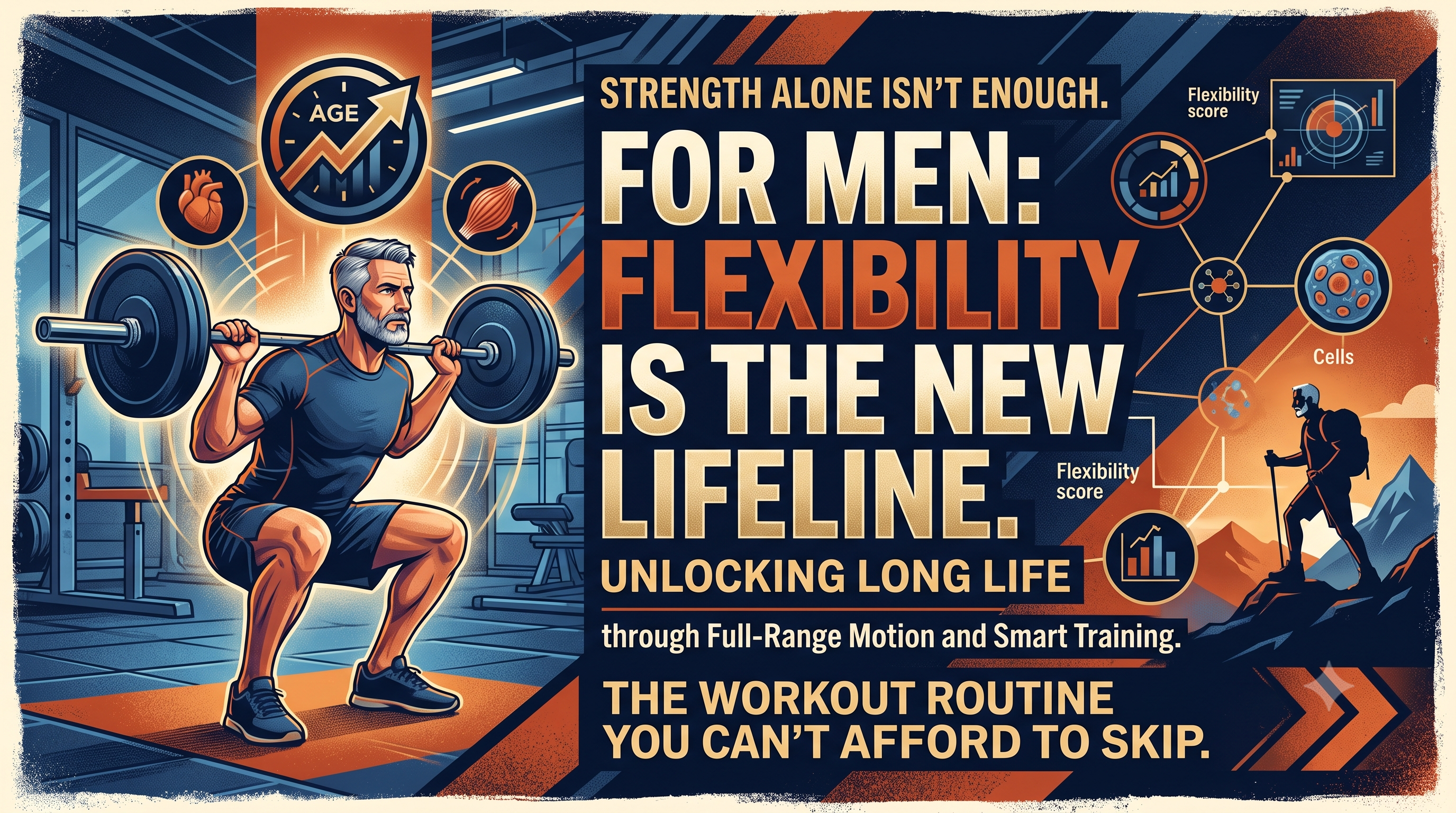
A comprehensive review of 11 different clinical trials revealed that strength training through a full range of motion improves flexibility just as effectively as traditional stretching.
When you load a muscle dynamically and take it all the way through its natural path, you are teaching your nervous system that it is safe to operate in those deep positions. If you want to check the flexibility box while building muscle, focus on these lifting adjustments:
- Sink Your Squats: Stop cutting your reps short. Drop all the way down until your thighs are at least parallel to the floor (or deeper, if your anatomy allows safely) to challenge your hip and ankle mobility.
- Emphasize the Stretch on Pulls: On exercises like dumbbell rows or lat pulldowns, let the weight fully extend your arms and stretch your back at the bottom or top of the movement before pulling.
- Control the Eccentric Phase: Slow down the lowering portion of your lifts. Spending controlled time under tension at the maximum extension of a Romanian deadlift or a chest fly does wonders for lengthening tight tissue.
Ultimately, muscle strength, balance, aerobic fitness, and flexibility are all tied together. By lifting with great form and pushing through your full range of motion, you can protect your joints and your lifespan all at the same time.

Here is a 3-day, full-body workout routine designed specifically to build muscle while forcing your joints through their maximum, safe range of motion (ROM).
By slowing down the “eccentric” (lowering) portion of each lift and pausing briefly in the stretched position, you will teach your nervous system to relax and adapt, building active mobility that translates directly to longevity.
The “Active Range” Routine
Schedule
- Day 1: Full Body A (Focus: Anterior/Quad dominant)
- Day 2: Rest / Active Recovery
- Day 3: Full Body B (Focus: Posterior/Hinge dominant)
- Day 4: Rest
- Day 5: Full Body C (Focus: Unilateral & Hypertrophy)
- Days 6 & 7: Rest
Day 1: Full Body A (Anterior Dominant)
| Exercise | Sets x Reps | Tempo Protocol | Focus & Mobility Benefit |
| 1. Heel-Elevated Goblet Squat | 3 x 8-10 | 3-1-1-0 | Elevating heels reduces ankle restriction. Sit completely bone-on-calf at the bottom. Hold the bottom for 1 second. |
| 2. Romanian Deadlift (RDL) | 3 x 8-10 | 3-2-1-0 | Push hips back until hamstrings are fully stretched. Hold that deep stretch for a 2-second count before driving up. |
| 3. Incline Dumbbell Bench Press | 3 x 10-12 | 3-1-1-0 | Lower the dumbbells wide to get a deep stretch across the chest and anterior shoulders at the bottom. |
| 4. Cable Lat Pulldown | 3 x 10-12 | 2-0-1-1 | At the top, let the weight fully pull your arms up and forward to stretch the lats. Pause for 1 second at the top. |
Day 2: Full Body B (Posterior Dominant)
| Exercise | Sets x Reps | Tempo Protocol | Focus & Mobility Benefit |
| 1. Deficit Reverse Lunge | 3 x 8-10 (per leg) | 2-1-1-0 | Stand on a 2-4 inch step/plate. Step back deeply. The extra depth forces the front hip into deep flexion and stretches the back hip flexor. |
| 2. Chest-Supported Dumbbell Row | 3 x 10-12 | 2-0-1-1 | Let your arms hang completely dead at the bottom, opening up the shoulder blades before pulling. |
| 3. Weighted Dips (or bodyweight) | 3 x 8-10 | 3-1-1-0 | Descend until your biceps touch your forearms (if shoulders allow safely) to build active shoulder extension. |
| 4. Seated Hamstring Curl | 3 x 12-15 | 2-1-1-0 | Sit tall to keep the hamstrings on a pre-stretch. Pause briefly at full leg extension. |
Day 3: Full Body C (Unilateral & Hypertrophy)
| Exercise | Sets x Reps | Tempo Protocol | Focus & Mobility Benefit |
| 1. Bulgarian Split Squat | 3 x 8-10 (per leg) | 3-1-1-0 | Massive stretch for the rear leg’s hip flexor and rectus femoris. Drop the back knee all the way to a soft pad on the floor. |
| 2. Dumbbell Romanian Deadlift | 3 x 10-12 | 3-1-1-0 | Keeps the load closer to your center of gravity, allowing you to sink deeper into hip hinge flexibility than a barbell. |
| 3. Dumbbell Flyes | 3 x 12-15 | 3-2-1-0 | Use light weight. Focus entirely on the 2-second stretch at the bottom of the movement to open up the thoracic spine. |
| 4. Incline Dumbbell Bicep Curl | 3 x 10-12 | 3-1-1-0 | Sitting on an incline places the long head of the bicep into passive insufficiency (maximum stretch) behind your body. |
How to Read the Tempo Code (e.g., 3-1-1-0)
- 3: Spend 3 seconds lowering the weight (eccentric phase).
- 1: Pause for 1 second at the point of maximum muscle stretch. This is where the flexibility magic happens.
- 1: Explode up (concentric phase).
- 0: No rest at the top before starting the next rep.
Leave a Reply