
The concept of the “third place”—originally coined by sociologist Ray Oldenburg in 1989—refers to the social surroundings separate from the two primary environments of home (“first place”) and work (“second place”).
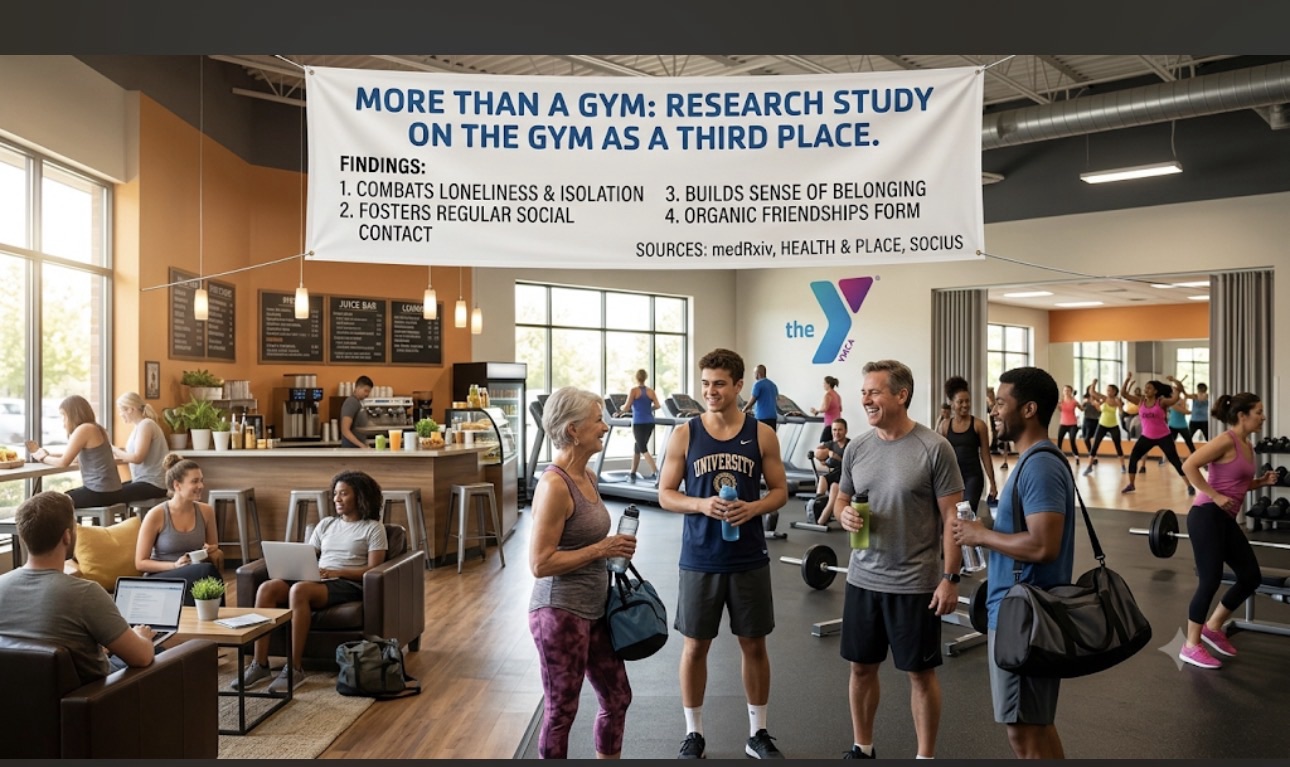
While Oldenburg’s classic examples included taverns, coffee shops, and beauty parlors, modern research across public health and sociology increasingly points to gyms, recreation centers, and fitness clubs as vital contemporary third places.

Below is an overview of the key peer-reviewed studies and academic analyses showing how and why gyms have evolved into these crucial community anchors, now complete with direct source links.
1. The YMCA and Older Adults: “Where Everybody Knows Your Name”
Qualitative research has explored how structured fitness centers function as modern third places, particularly for populations vulnerable to isolation, such as retirees.
In a study observing the social ecosystem of a local YMCA, researcher Emily Stier Adler detailed how members transformed their fitness routines into deep social networks:
- The Study: “Where Everybody Knows Your Name” (Providence College).
- The Finding: While members initially joined for physical health, they gradually integrated into “group exercise classes” (like Zumba or water aerobics). Adler highlights that the gym operates on neutral ground where social differences are leveled, allowing proximity and shared activity to lead directly to organic “conversation, support, laughter,” and friendships that buffer against post-retirement loneliness.
2. Quantitative Proof: Gyms, Mood, and Mental Health
While early research on third places was largely qualitative, modern studies use passive, objective wearable data to prove that visiting these spots physically improves mental health.
A 2026 longitudinal tracking study monitored medical residents across the United States to examine how third-place visits impacted their daily moods:
- The Study: [“Third places visits and well-being: insights from longitudinal passive sensing data” (medRxiv, 2026)](https://www.medrxiv.org/content/10.64898/2026.03.12.26348188v1).
- The Finding: Using Apple Watch and iPhone passive location sensing (SensorKit) to categorize visited locations (including gyms, parks, and cafes), researchers observed a direct, positive correlation. On days when participants spent more time at third places—specifically highlighting gyms—they reported a significantly better mood and reduced depressive symptoms later that same day, partially mediated by increased physical activity and light exposure.
3. Social Infrastructure and Community Resilience
Sociologists view gyms not just as places to sweat, but as “social infrastructure”—the physical places that shape our interactions and combat public health crises like loneliness.
- The Study: [“Closure of ‘third places’? Exploring potential consequences for collective health and wellbeing” (Health & Place, 2019)](https://pubmed.ncbi.nlm.nih.gov/31622919/).
- The Finding: Researchers Jessica Finlay et al. discuss how daily “third place” spaces—specifically referencing gyms, cafes, and libraries—enrich social interaction and a sense of belonging outside the home and workplace. The paper warns that losing access to these fitness and social spaces reduces the community buffers that protect people against loneliness, stress, and alienation.
Why Gyms Fit Oldenburg’s “Third Place” Criteria
Sociologists point out that modern gyms—ranging from local climbing gyms to traditional health clubs—perfectly mirror the core characteristics Ray Oldenburg outlined for a classic third place: Third Place CharacteristicHow the Gym Fits Neutral GroundYou are neither host nor guest. You can come and go as you please without social obligation. A Leveler (No Status)Wealth, occupation, and social status are stripped away. In simple activewear, everyone is on equal footing. Conversation is PrimaryBetween sets, at the water fountain, or after group classes, informal, low-stakes chatting is highly common. Regulars ExistGyms rely heavily on “regulars” who show up at the exact same times (e.g., the morning group fitness crowd), creating a predictable, comforting social presence. A Low ProfileThe environment is informal and comfortable, emphasizing playfulness and stress relief over professional performance.
Leave a Reply