
Is Your Diet Costing You Muscle? The New Science of Healthy Weight Loss
We all know the basic math of weight loss: eat fewer calories than you burn, and the scale goes down.
But there’s a hidden catch that often gets ignored. When you restrict your calories, your body doesn’t just burn fat. It also breaks down fat-free mass (FFM)—including the precious skeletal muscle that powers your metabolism, protects your joints, and keeps you strong as you age.
If you lose weight but lose a mountain of muscle in the process, you risk lowering your metabolic rate, making it much easier to regain the fat later on.

A comprehensive study published in the journal Diabetes, Obesity and Metabolism provides the clearest picture yet on how to prevent this muscle loss during a diet.
The Study: 1,455 Participants, One Clear Answer
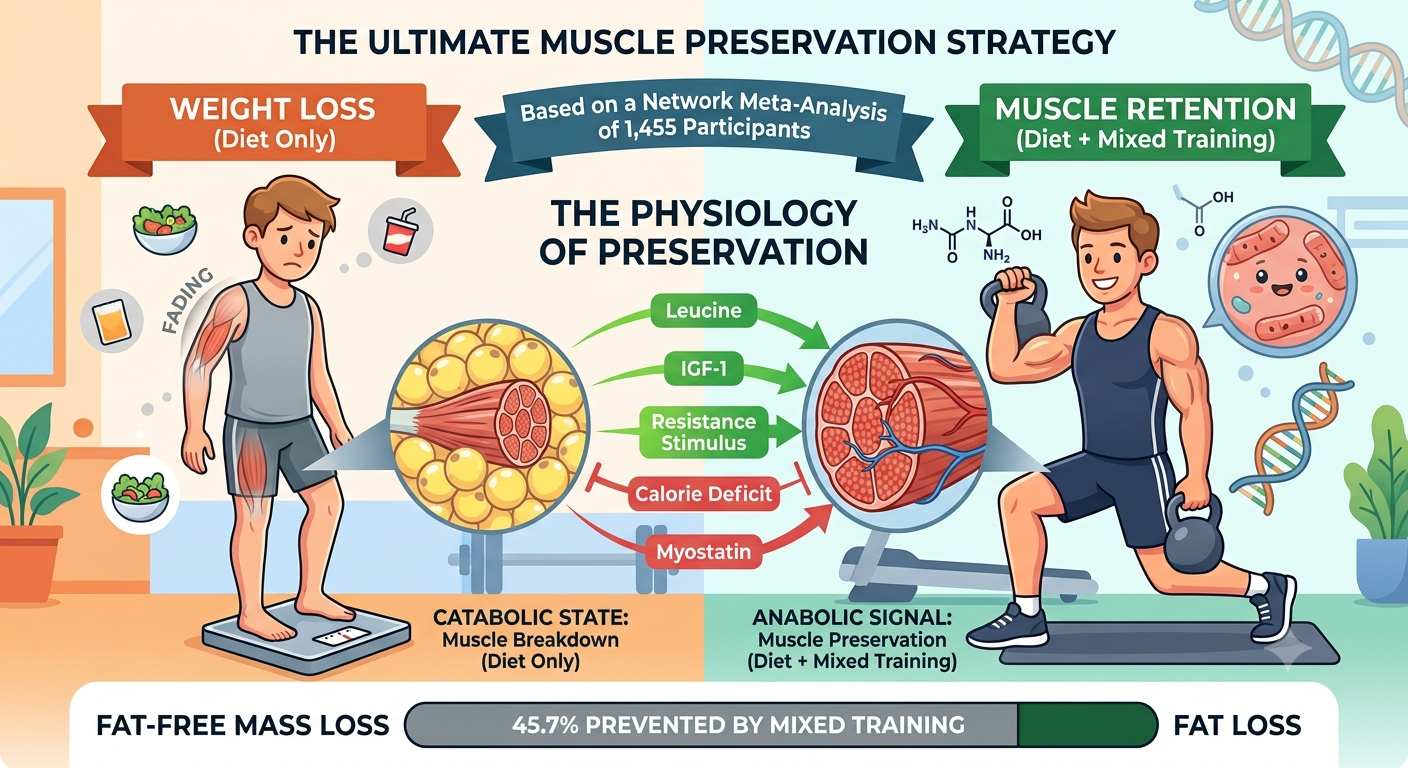
Researchers analyzed 34 randomized controlled trials involving a total of 1,455 overweight or obese participants to see exactly how different types of exercise affect muscle retention during calorie restriction.
The goal was to find out if you can prevent muscle loss during a diet, and if so, which workout style protects your hard-earned muscle the best.
The findings were clear: Exercise is your ultimate insurance policy against muscle loss. On average, adding exercise to a calorie-restricted diet prevented nearly half (45.7%) of all fat-free mass loss compared to dieting alone.
Which Training Style Wins?
The researchers didn’t just look at “exercise” as a single block. They ran a network meta-analysis to break down three major training styles: strength training, endurance (cardio) training, and mixed training (a combination of both).
Here is how each style stacked up at preserving fat-free mass compared to dieting without exercise: Training ModeImpact on Muscle PreservationIs it Statistically Significant? Mixed Training (Strength + Cardio)+1.20 kg of muscle preservedYes, very highly significant Strength Training+0.83 kg of muscle preservedYes, highly significant Endurance Training (Cardio)+0.51 kg of muscle preservedBorderline (fell just short of significance)
While strength training alone is incredibly effective, mixed training (combining both weights and cardiovascular work) yielded the single best result.
Why Endurance Fell Short (But Still Matters)
Pure cardio (endurance) training helped slightly but didn’t reach the statistical threshold needed to guarantee muscle preservation. When you run, cycle, or do steady-state cardio, your body adapts by becoming more energy-efficient, which doesn’t trigger the “hold onto this heavy muscle” signal that a heavy barbell or resistance band does.
Your Action Plan for Smarter Weight Loss
If you are currently cutting calories or planning a diet, you don’t have to sacrifice your strength. You can put this research into action immediately with a simple strategy:
- Establish your moderate deficit
Step 1
Keep your calorie restriction sensible. A drastic deficit causes your body to aggressively burn muscle for energy. Aim for a modest daily deficit of around 300 to 500 calories. - Prioritize protein intake
Step 2
Give your body the building blocks it needs. Aim for roughly 0.7 to 1.0 grams of protein per pound of body weight daily to help repair and maintain muscle tissue. - Lift weights 2-3 times per week
Step 3
Trigger muscle protein synthesis. Challenge your muscles with resistance training (weights, machines, or bodyweight exercises) to signal to your body that this muscle is essential and cannot be burned for fuel. - Add low-to-moderate intensity cardio
Step 4
Combine your lifting with cardio. Adding 150 minutes of moderate aerobic activity weekly supports cardiovascular health and boosts fat loss, creating the ultimate “mixed training” stimulus.
By combining a smart calorie deficit with a mix of lifting and cardio, you ensure that the weight you lose is fat, leaving you leaner, stronger, and healthier on the other side.
Leave a Reply