
The fitness industry is undergoing a massive transformation. We are seeing a distinct shift away from old-school “no pain, no gain” mentalities and hardline member acquisition strategies toward data-backed recovery, longevity, and deepening community retention.

Here are the top five fitness industry news stories and trend reports making waves this week.
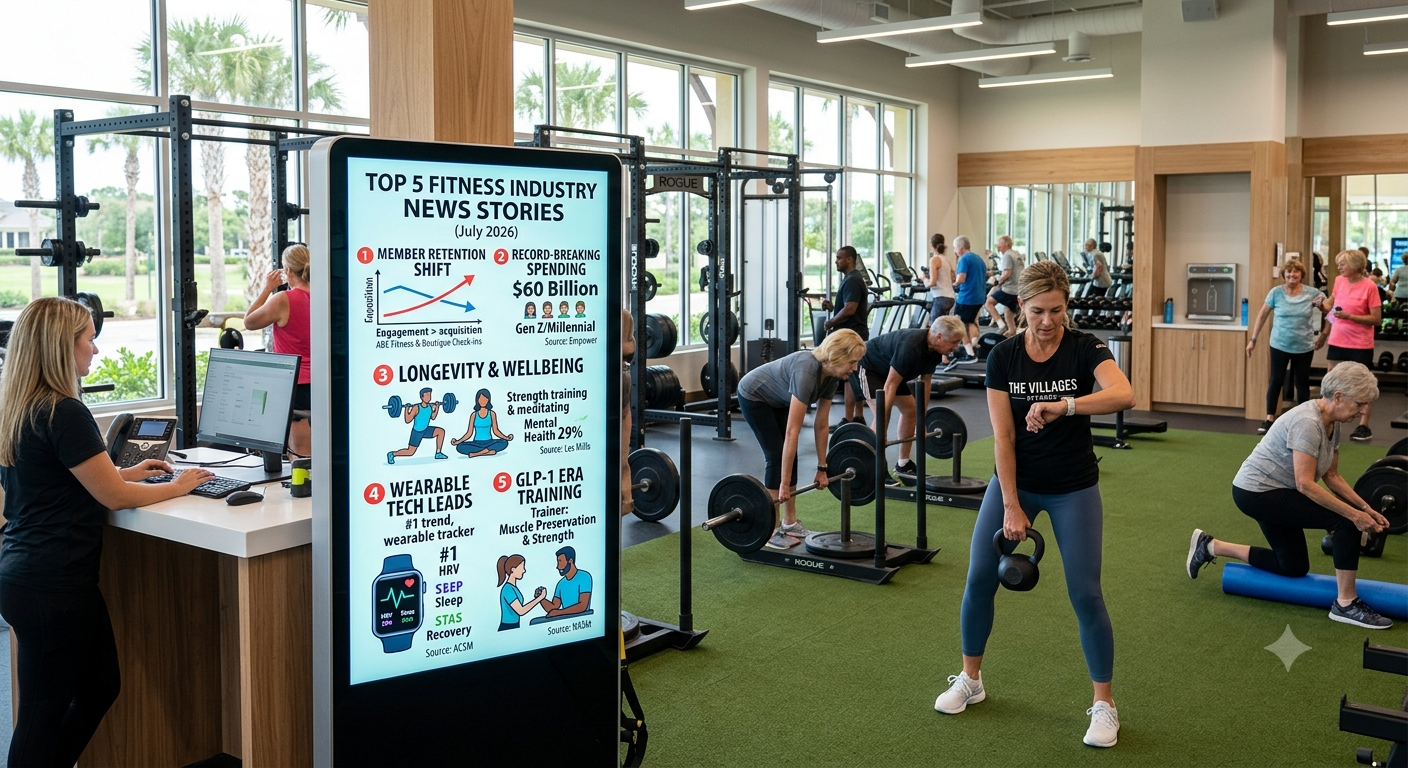
1. The “Reinforcement Shift”: Mid-Year Data Signals a Move from Acquisition to Retention
A major mid-year data drop reveals that the primary driver of growth for fitness operators is no longer chasing new sign-ups, but cultivating extreme consistency among existing members. According to the report, gym sign-ups dipped 9% year-over-year, yet check-ins actually increased. Meanwhile, boutique studios are thriving with a massive 27% surge in member check-ins, proving that hyper-focused community environments are winning the loyalty battle.
- The Takeaway: Gyms are moving away from the “books full of inactive members” model and transitioning into active, high-engagement hubs.
- Source: ABC Fitness Mid-Year 2026 Wellness Watch Report
2. Americans Project a Record-Breaking $60 Billion in Fitness Spending
Despite tightening household budgets and broad economic caution, a nationwide poll found that Americans view fitness as an essential investment rather than a luxury. When asked what expenses they would cut first if facing budget pressures, respondents overwhelmingly prioritized fitness over dining out, travel, and entertainment. Driving this boom are Gen Z and Millennials, who are treating wellness as a core necessity.
- The Takeaway: The fitness sector is proving highly recession-resistant, with younger demographics spending nearly triple what Baby Boomers do on health, longevity, and social fitness spaces.
- Source: Empower Personal Wealth Capital Report
3. The 2026 Global Fitness Report Details the Rise of “Longevity & Mental Wellbeing”
A massive global study surveying over 10,000 fitness consumers highlights a radical shift in why people exercise. Motivation driven by mental health has surged 29% since 2021, and stress reduction is up 17%. Furthermore, strength training has officially become the anchor of modern fitness routines—not for body aesthetics, but for lifelong physical capacity and functional independent aging.
- The Takeaway: The “summer body” goal is dead. Consumers want holistic health, and 88% of gym members now actively demand that mind-body practices like breathwork, yoga, and meditation be added to standard gym timetables.
- Source: Les Mills 2026 Global Fitness Report
4. ACSM Celebrates 20th Anniversary Trends Report, Crowning Wearable Tech #1
The American College of Sports Medicine (ACSM) released its highly anticipated annual forecast. For 2026, Wearable Technology holds the number one spot yet again. However, the conversation has changed: with nearly half of all U.S. adults now owning a fitness tracker, the industry’s focus is pivoting from basic tracking to educating clients on how to interpret advanced biomarkers like Heart Rate Variability (HRV), sleep optimization, and active recovery.
- The Takeaway: Fitness professionals are leveraging wearables not just to track workouts, but to prevent overtraining and build highly customized, reactive recovery schedules.
- Source: ACSM Worldwide Fitness Trends Forecast
5. Training in the GLP-1 Era: NASM Outlines the New Role for Personal Trainers
With the widespread adoption of GLP-1 weight-loss medications, the National Academy of Sports Medicine (NASM) has highlighted a crucial new paradigm for personal trainers. Because rapid weight loss from these medications often leads to concurrent losses in lean muscle mass, trainers are shifting their focus entirely. Instead of acting as “calorie-burning fat-loss coaches,” fitness professionals are re-positioning themselves as clinical partners focused strictly on preserving muscle, metabolic health, and skeletal strength.
- The Takeaway: The medical fitness boom requires a structural pivot in personal training programming, prioritizing heavy progressive resistance work and high-protein guidance to support medical weight management.
- Source: NASM Fitness Business Analysis
Leave a Reply