
Can Fitness Help You Sleep Better as You Age? (And the Trap You Want to Avoid)
We’ve all heard that physical activity is good for our health, but as we get older, sleep can become a frustrating puzzle. If you’re waking up multiple times a night or struggling to get those deep, restorative hours of rest, you might wonder if a solid workout routine is the missing piece.
A landmark study published in the journal Sleep titled “Aerobic fitness, acute exercise and sleep in older men” looked into exactly this. The researchers wanted to know: Does being generally fit give you better sleep? And what happens to an older adult’s sleep after just one heavy day of working out?
The results offer some fantastic news for fitness enthusiasts, but they also come with a crucial warning about working out too hard, too late.

The Setup: Checking in on “Fit” vs. “Sedentary” Sleepers
To find answers, the research team recruited 24 older men (average age in the middle-to-older range) and split them into two groups:
- The Fit Group: 12 men who were regularly active and aerobically fit.
- The Sedentary Group: 12 men who led a mostly inactive lifestyle.
The researchers monitored their sleep using polysomnography (PSG)—a technical sleep study that measures brain waves, oxygen levels, and body movements—across two different nights. One night followed a normal day with no exercise, and the other night followed an intense, exhaustive afternoon workout.
To go even deeper, they used computer programs to measure actual electroencephalographic (EEG) slow waves. Slow-wave sleep is that crucial “deep sleep” phase where your body restores itself, repairs tissue, and consolidates memories.
The Good News: Habitual Fitness is a Sleep Superpower
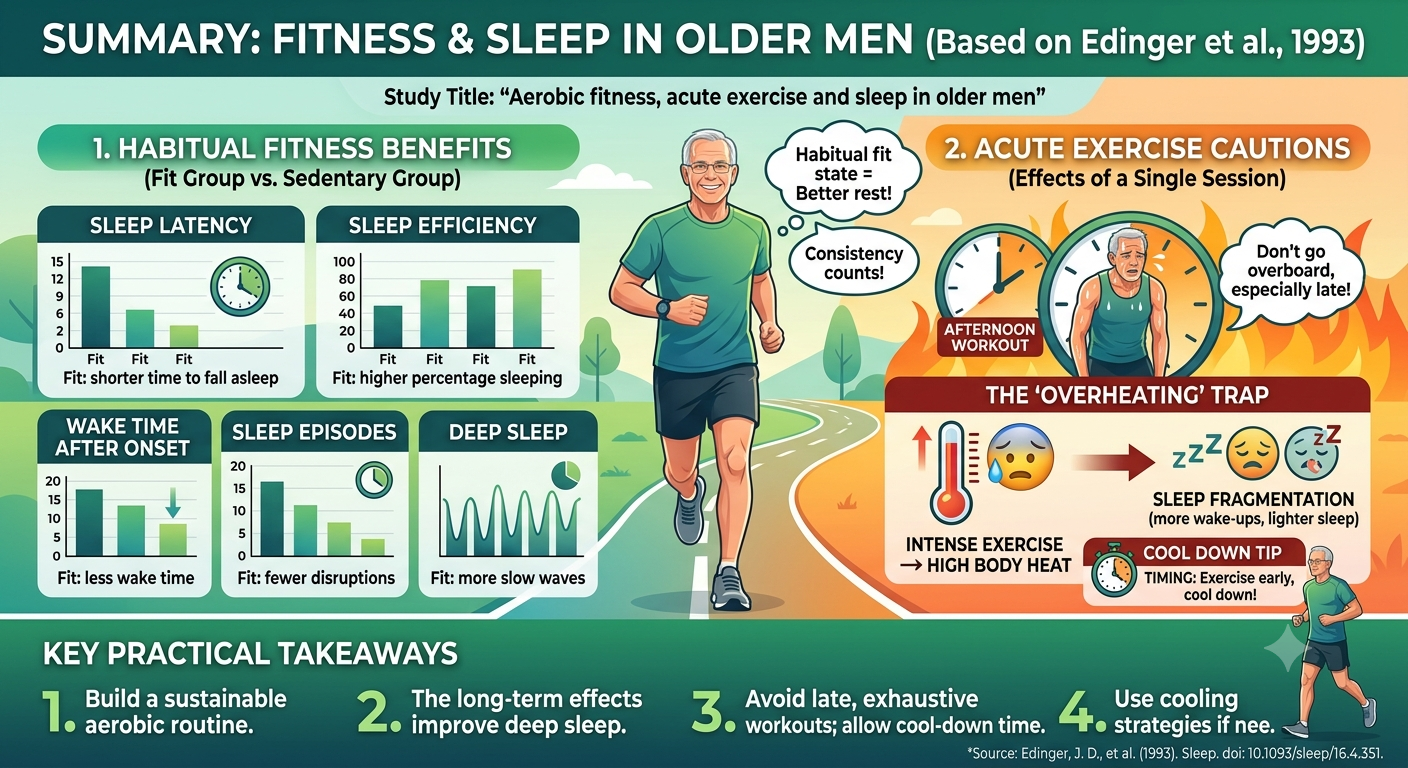
When comparing the baseline sleep of the fit men against the sedentary men, the results were night and day. The aerobically fit men consistently outperformed the sedentary group across almost every metric.
According to the study, the fit individuals had:
- Faster Sleep Onset: They fell asleep much quicker.
- Higher Sleep Efficiency: They spent more of their time in bed actually sleeping, rather than tossing and turning.
- Fewer Wake-Ups: They had less “wake time after sleep onset” and fewer distinct disruptions or “stage shifts” during the first half of the night.
- Deeper Sleep: Their brains produced a significantly higher total number of slow waves, meaning they achieved a deeper quality of rest.
In short, being a regularly active person pays massive dividends for your sleep quality as you age.
The Warning: Watch Out for Post-Exercise Overheating
You might think that if being fit is good, executing an extra hard workout right before bed would make you sleep like a baby. However, the study threw a fascinating curveball when looking at the effects of “acute” (a single bout of) exhaustive exercise.
The researchers found that a single session of exhaustive afternoon exercise didn’t automatically guarantee a better night’s rest. In fact, for many participants, it did the opposite.
When analyzing why, the researchers found a key predictor: Body heating. Participants who experienced high levels of body heating during their intense workout actually suffered from increased sleep fragmentation (more disrupted, broken sleep) that night. This held true for both the fit and the sedentary men.
The Science Behind the Sweat
Our bodies rely on a natural drop in core body temperature to signal to the brain that it is time to sleep. When you engage in heavy, exhaustive aerobic exercise, your core temperature spikes. If your body doesn’t have enough time to cool back down before your head hits the pillow, it can throw off your circadian rhythm, keeping your nervous system overly stimulated and fracturing your sleep.
Key Takeaways for Older Adults
If you want to use exercise to conquer your sleep issues, this study provides an excellent roadmap:
- Play the Long Game: Focus on building a regular, sustainable aerobic fitness routine (like brisk walking, cycling, or swimming). The long-term benefits of general physical fitness are what truly unlock deep, continuous slow-wave sleep.
- Timing is Everything: Avoid exhaustive, high-intensity workouts late in the afternoon or evening. Give your body several hours to cool down and return to its baseline temperature before bedtime.
- Keep it Cool: If you do find yourself working out later in the day, consider strategies to help lower your core temperature afterward, such as a lukewarm shower, staying hydrated with cool water, and keeping your bedroom environment comfortably chilled.
The Bottom Line: Staying fit is one of the best choices you can make for your sleep health as you age. Just remember to train smart, give your body time to cool down, and let your internal thermostat do its job!
*** Source: Edinger, J. D., et al. (1993). Aerobic fitness, acute exercise and sleep in older men. Sleep, 16(4), 351-359. DOI: 10.1093/sleep/16.4.351
Leave a Reply