
The Great Squat Debate: Should You Squat Barefoot or in Shoes?
If you’ve spent any amount of time in a weight room, you’ve probably noticed two distinct camps when it comes to the barbell back squat. There are those who strictly use standard athletic or weightlifting shoes, and there is a growing legion of lifters who kick their shoes off to squat completely barefoot (or in minimalist, barefoot-style footwear).
Fans of the barefoot approach often claim it gives them better ground contact, stability, and biomechanics. But what does the science actually say?
A fascinating study published in the European Journal of Sport Science by Jonathan Sinclair and colleagues (2015) sought to put this debate to the test. Let’s break down their research and see if science backs up the barefoot hype.

The Study: Putting Footwear Under the Microscope
The study, titled “The influence of different footwear on 3-D kinematics and muscle activation during the barbell back squat in males,” aimed to find out exactly how our choice of footwear impacts our body mechanics and muscle recruitment during a squat.
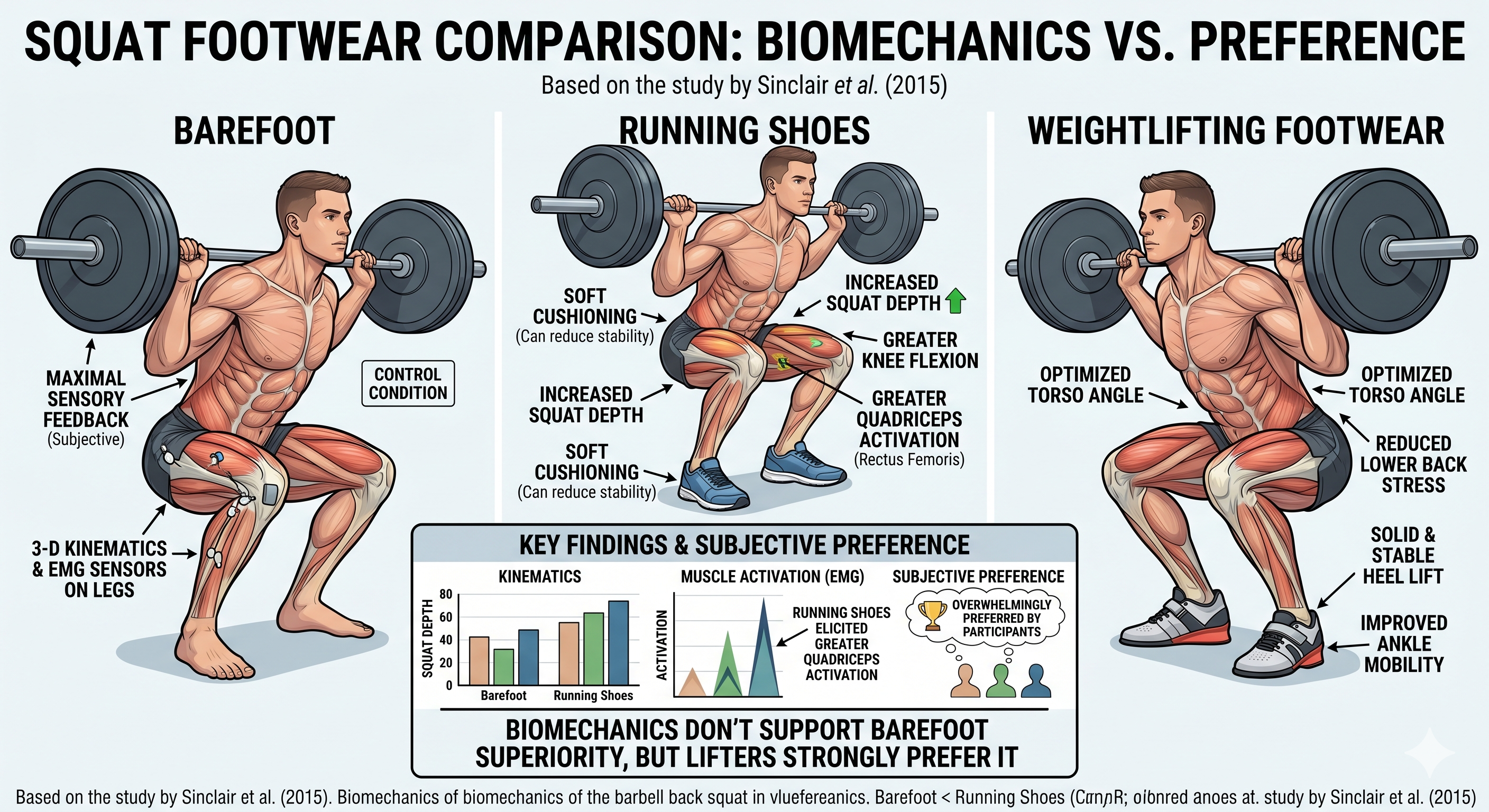
The researchers gathered 14 experienced male lifters and had them perform barbell back squats at 70% of their 1-rep max. They tested different conditions, including standard running shoes, weightlifting footwear, and barefoot.
To get the full picture, the scientists didn’t just ask the lifters how they felt. They used an eight-camera motion analysis system to measure 3-D kinematics (the movement of the torso, hips, knees, and ankles) and electromyography (EMG) to measure the electrical activation of key muscles: the rectus femoris (quadriceps), tibialis anterior, gastrocnemius (calves), erector spinae (lower back), and biceps femoris (hamstrings).
The Surprising Findings
If you are a die-hard barefoot squatter, brace yourself: the biomechanical data didn’t exactly prove the superiority of lifting without shoes.
Here is what the researchers found:
- Squat Depth & Knee Flexion: Compared to lifting barefoot, wearing a standard running shoe was actually associated with an increased squat depth and greater knee flexion.
- Muscle Activation: Squatting in the running shoe led to greater activation in the rectus femoris (one of the primary muscles in your quadriceps).
From a purely biomechanical standpoint, the running shoes allowed the lifters to get deeper into the squat and recruit slightly more quad muscle than the barefoot condition.
The Plot Twist: What Did the Lifters Actually Want?
Despite the biomechanical advantages of the running shoe in depth and quad activation, the researchers also asked the participants a simple question: Which footwear condition did you actually prefer?
The results of this subjective rating were statistically significant. Overwhelmingly, the participants preferred to squat barefoot.
The Verdict: Comfort vs. Biomechanics
So, what should we make of this study?
First, it validates the anecdotal evidence we see in gyms every day: experienced lifters genuinely prefer the feeling of squatting barefoot. Whether it’s the psychological feeling of being grounded, the sensation of sensory feedback from the floor, or perceived stability, the preference is real.
However, the study importantly notes that there is no biomechanical evidence (at least in this specific scope) to support the notion that going barefoot improves your lifting mechanics. In fact, if your goal is strictly to maximize your squat depth and hit your quads a bit harder, standard athletic shoes might actually give you a slight edge.
Takeaway for your next leg day: If you love squatting barefoot because it feels right to you, keep doing it! Comfort and confidence under the bar are massive components of a successful lift. But if you are struggling with hitting depth or want to target your quads, you might want to lace up those sneakers or invest in a solid pair of lifting shoes.
Reference: Sinclair, J., McCarthy, D., Bentley, I., Hurst, H. T., & Atkins, S. (2015). The influence of different footwear on 3-D kinematics and muscle activation during the barbell back squat in males. European Journal of Sport Science, 15(7), 583-590.
Leave a Reply