
Want to Boost Your Memory? An Evening HIIT Workout Might Be the Secret
We all know that a good night’s sleep is essential for a sharp mind. Science has long told us that sleep plays a massive role in memory consolidation—the process where our brains take the information we learned during the day and lock it into long-term storage.
But what if you could hack your sleep to improve your brain’s capacity to learn new things the following day?
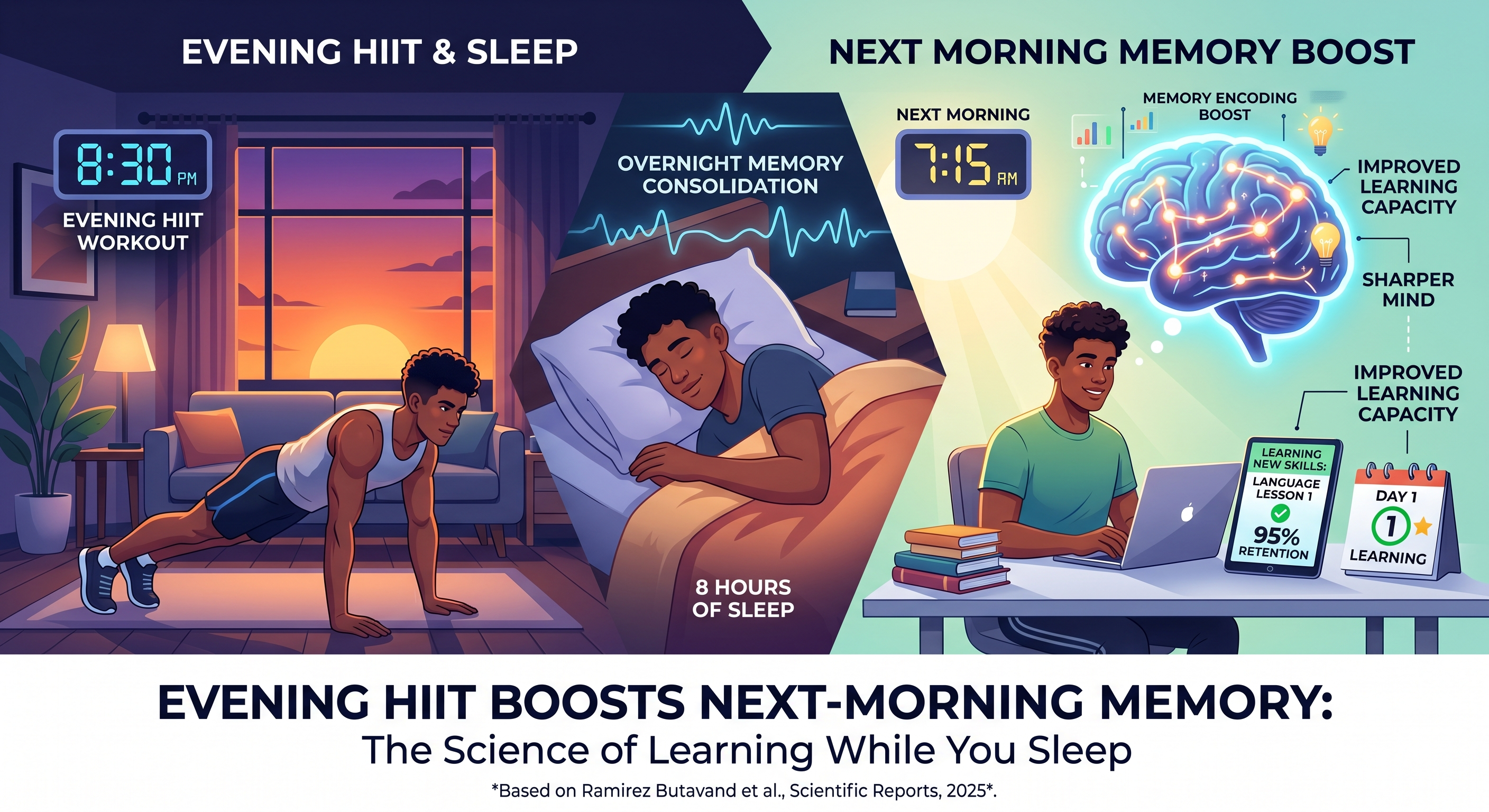
A fascinating 2025 study published in Nature’s Scientific Reports by researchers Daniela Ramirez Butavand, Juliane Nagel, Gordon B. Feld, and Simon Steib suggests that the secret to better memory encoding the next morning might just be an intense evening workout.

The Study: Hacking Sleep for Better Learning
While researchers know sleep helps us retain information, it has been harder to prove exactly how sleep frees up our brain’s capacity to absorb new data (a process called memory encoding). The research team wanted to see if they could use exercise—a low-cost, low-tech intervention—to alter sleep architecture and effectively “supercharge” the brain’s ability to learn the next day.
The researchers tested participants under different conditions:
- HIIT (High-Intensity Interval Training): Short, intense bursts of exercise followed by recovery.
- MICT (Moderate-Intensity Continuous Training): A steady, moderately paced workout.
- Control: No exercise.
After completing their assigned condition in the evening, the participants slept for eight hours. Thirty minutes after waking up the next morning, they were put through rigorous memory and vigilance tasks. They were tested again 24 hours later to see how well the new information stuck.
The Results: High-Intensity Wins the Day
The results were incredibly compelling for the high-intensity crowd.
The study found that engaging in an evening HIIT session significantly improved post-sleep memory performance. When participants did the intense interval training before bed, their brains were better primed to encode new information the next morning—and the positive effects lasted up to 24 hours after the initial learning session!
Interestingly, the study noted that the early parts of the memory tasks were especially affected by the HIIT intervention. Even more promising? Participants who naturally had lower memory encoding abilities seemed to benefit the most from the HIIT workouts.
Why Does This Happen?
On a cellular level, learning creates connections (synapses) in the brain. During sleep, our brain undergoes a process called “synaptic homeostasis,” where it prunes and recalibrates these connections so our neural networks aren’t overloaded. The researchers suggest that the physical stress and subsequent recovery demanded by high-intensity exercise might optimize this overnight recalibration, leaving the brain’s “sponge” perfectly wrung out and ready to soak up new facts the next day.
What This Means for You
If you have a big presentation, a difficult exam, or a day where you need to learn a lot of new material, your evening routine the night before could be your secret weapon.
Instead of just passively winding down, try squeezing in a quick, high-intensity interval workout. You don’t need a fancy gym or heavy weights; simple bodyweight intervals (like burpees, jump squats, or high knees) might be enough to trigger the neurophysiological benefits.
Not only will the workout support your cardiovascular health, but it might just be the ultimate “smart drug” to prep your brain for a highly productive tomorrow.
Reference: Ramirez Butavand, D., Nagel, J., Feld, G. B., & Steib, S. (2025). High intensity exercise before sleep boosts memory encoding the next morning. Scientific Reports, 15(1), 20388. https://doi.org/10.1038/s41598-025-07880-z
Leave a Reply