
Title: Why Do We Stop Moving? Inside the HABITAT Study on Mid-Life Physical Activity
We all know the mantra: to stay healthy, we need to stay active. Guidelines recommend at least 30 minutes of moderate activity five days a week, or 20 minutes of vigorous activity three times a week. Yet, as we hit our middle years, a noticeable shift happens. Studies show that adults aged 40 to 65 are among the least likely to meet these recommendations.
But why? Is it a lack of time? A lack of motivation? Or does the neighborhood we live in play a bigger role than we realize?
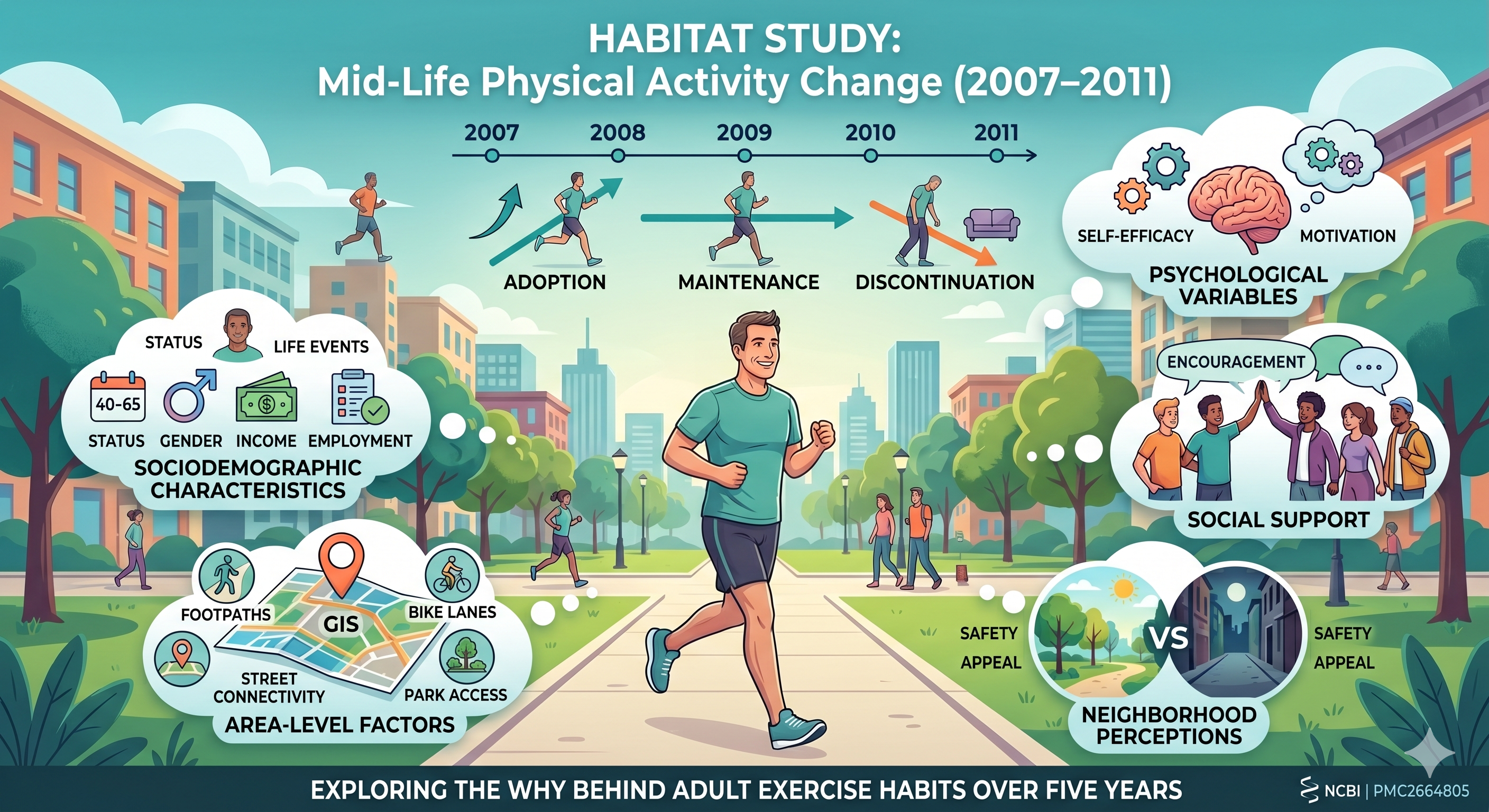
To answer these questions, researchers launched the HABITAT (How Areas in Brisbane Influence HealTh and AcTivity) study. Detailed in a foundational paper published in BMC Public Health, HABITAT is an innovative, five-year longitudinal study (2007–2011) designed to track the physical activity patterns of mid-aged adults in Brisbane, Australia.
Here is a closer look at what the study set out to discover and why its multi-level approach changes how we view exercise.

The Two Main Goals of HABITAT
Unlike a simple survey that takes a snapshot of a single moment in time, HABITAT was designed to follow roughly 17,000 adults over five years. The study had two primary aims:
- To map physical activity change: Track the patterns of adoption, maintenance, and discontinuation of physical activity over five years (2007–2011) in adults aged 40–65 years at baseline.
- To weigh the contributing factors: Determine the relative contribution of psychological variables, social support, neighborhood perceptions, area-level factors, and sociodemographic characteristics to those physical activity changes.
The Five Pillars of Physical Activity
Historically, failure to exercise was often chalked up to a lack of individual willpower. But human behavior is incredibly complex. Relying on the Social Ecological Model, the HABITAT study aimed to prove that our habits are shaped by multiple layers of influence.
Here is how the researchers broke down the factors that influence our daily movement:
1. Psychological Variables
This is the internal layer. It looks at a person’s attitudes toward exercise, their self-efficacy (belief in their own ability to stay active), and their internal motivation. It also considers perceived personal barriers, such as fatigue, work commitments, or a general disinterest in working out.
2. Social Support
We don’t live in a vacuum. This factor examines the social cohesion of a person’s environment and the encouragement they receive from their network. Having an active partner, supportive peers, or guidance from health professionals can significantly impact whether someone laces up their walking shoes or stays on the couch.
3. Neighborhood Perceptions
How do you feel about your neighborhood? If you perceive your local streets as unsafe due to crime or heavy traffic, you are far less likely to go for an evening jog. This variable measures subjective experiences: Are the surroundings pleasant? Are there accessible footpaths? Do the streets feel safe?
4. Area-Level Factors (The Physical Environment)
This is where the study gets incredibly objective. Using Geographic Information System (GIS) mapping, researchers looked at the hard data of the neighborhoods participants lived in. This includes:
- Distance to facilities: How far is the closest public park, bus stop, gym, or grocery store?
- Street connectivity: How many intersections are there? (Highly connected streets make walking for transport easier).
- Infrastructure: The actual measurements of bike paths, footpaths, pedestrian crossings, and the density of streetlights.
5. Sociodemographic Characteristics
Finally, foundational elements like gender, socioeconomic status, health status, and life events (like retirement or children moving out) were tracked to see how demographic shifts influence long-term activity levels.
Why This Study Matters
Before HABITAT, many studies treated physical activity as a single, homogenous behavior and relied heavily on cross-sectional data (which cannot prove cause and effect). By tracking adults over five years and differentiating between types of activity—such as recreational walking, cycling for transport, and vigorous exercise—HABITAT provides a roadmap of how and why our habits change.
More importantly, it forces us to look beyond individual blame. If the study shows that people in areas with poor street lighting and no parks experience the steepest declines in physical activity, the solution isn’t just to tell them to “work out more.” The solution is better urban planning.
https://pmc.ncbi.nlm.nih.gov/articles/PMC2664805
By measuring the relative contribution of our minds, our social circles, and our built environments, the HABITAT study offers vital insights to help policymakers, urban planners, and health professionals build a world that naturally keeps us moving, no matter our age.
Leave a Reply