
Title: Why Your Muscles Might Be Turning Into “Marbled Steaks” (And Why That’s Not a Good Thing)
Hey there, health enthusiasts! We all know that adding more candles to our birthday cakes comes with a few fun surprises—maybe some gray hairs, a new appreciation for early bedtimes, or joints that pop like bubble wrap. But did you know your muscles could be secretly turning into something resembling a marbled ribeye steak?
Yep, you read that right. In a fascinating recent review published in Physiological Reports (you can check out the full sciencey version right here), researchers took a deep dive into a sneaky, age-related condition called myosteatosis.
So grab your favorite healthy snack, and let’s break down what this paper discovered, why it happens, and what it does to our bodies—in plain, easy-to-understand English!

What on Earth is Myosteatosis?
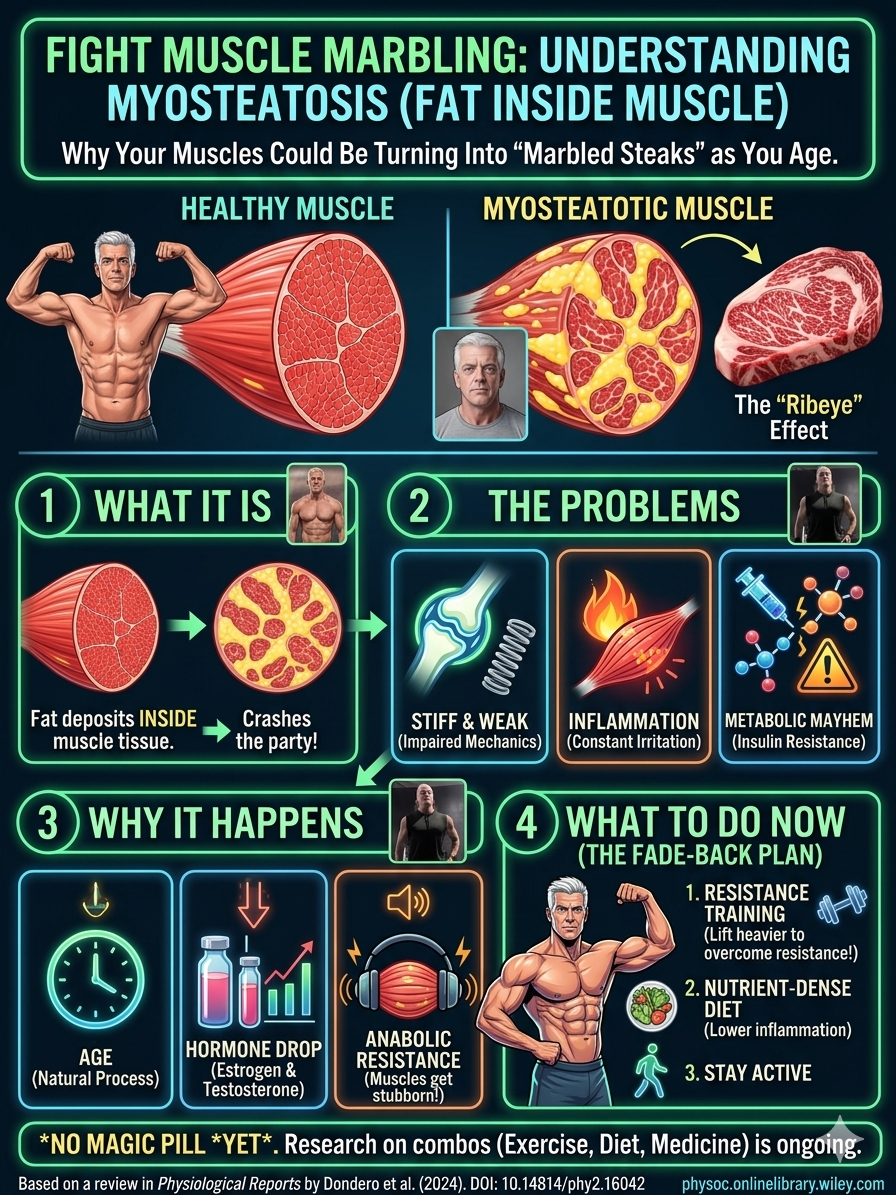
Simply put, myosteatosis is the infiltration of fat into your skeletal muscles. Instead of sitting nicely around your muscles (where fat usually hangs out), little fatty deposits start setting up camp inside the muscle tissue itself.
While marbling might make a steak delicious and tender, it’s the absolute last thing you want for your own biceps and quads. Healthy muscles are dense, strong, and highly responsive. When fat crashes the party, it brings a host of unwanted guests.
The Problem with “Marbled” Muscles
The paper, authored by Kathleen Dondero and her colleagues, highlights exactly how this sneaky fat messes with our day-to-day physical function:
- Stiff and Weak Muscles: Imagine trying to stretch a rubber band that has little bits of hard clay stuck inside it. It doesn’t stretch smoothly, right? Myosteatosis increases “passive muscle stiffness” and literally impairs muscle mechanics, meaning you lose the ability to produce strong, forceful movements.
- Inflammation Station: This isn’t just innocent, lazy fat. The fat cells inside your muscles constantly spit out inflammatory signals that irritate the surrounding muscle fibers and make them dysfunctional.
- Metabolic Mayhem: Having fat inside the muscle directly contributes to insulin resistance. This means your muscles stop responding well to insulin, making it harder for your body to pull sugar out of your blood for energy. Over time, this can pave the way for chronic diseases like type 2 diabetes.
Why Does This Happen?
Why do our bodies suddenly decide to store fat in our hard-earned muscle? The researchers point to a “perfect storm” that happens as we get older:
- Hormone Drops: Natural age-related declines in sex hormones (like estrogen and testosterone) make it harder for the body to maintain pure, lean muscle mass.
- Anabolic Resistance: This is a fancy way of saying your muscles become stubborn. When you’re young, eating a chicken breast or lifting a dumbbell sends a loud “BUILD MUSCLE!” signal to your body. As you age, your muscles put on earmuffs, requiring a much stronger signal (like heavier lifting or more protein) to get the same muscle-building result.
What’s the Fix?
Here is where the scientists give us a reality check. Thus far, there isn’t a magical pill to completely reverse myosteatosis. The paper notes that many current treatments just don’t have the horsepower to fully rescue the muscle tissue once the fat has moved in.
But don’t throw in the towel! The researchers emphasize that the scientific community is heavily focused on finding solutions. The ultimate goal is to figure out the exact combination of exercise, nutritional interventions, and pharmacology (medicines) to kick that fat out of our muscles for good.
The Takeaway:
While scientists work in the lab to find a targeted cure for myosteatosis, the best thing you can do is keep fighting the good fight. Stay active, challenge your muscles with resistance training (to overcome that stubborn anabolic resistance!), and eat a nutrient-dense diet to keep inflammation low.
Keep your steaks marbled, but your muscles lean!
Leave a Reply