
The Power of the Step: How a Simple Walk Can Save Your Life
We’ve all heard it a thousand times: “You need to exercise more.” But when life gets busy, the thought of buying expensive gym memberships, mastering complex workout routines, or waking up at 5:00 AM to crush a high-intensity interval training (HIIT) session can feel completely overwhelming. It’s easy to get stuck in a cycle of wanting to get healthier, but feeling too tired or unmotivated to start.
What if the ultimate weapon for your health was already waiting for you right outside your front door? What if you didn’t need to sprint, lift heavy weights, or change into fancy gear to transform your body?
Science has a beautiful truth for you: You just need to walk.
A groundbreaking systematic review and meta-analysis published in Preventive Medicine (PMID: 25579505) looked at decades of clinical data to find out exactly what happens when people go from doing nothing to simply incorporating a walking routine into their lives.
The results were absolutely undeniable. The simple act of putting one foot in front of the other is a total game-changer. Here is what science says happens to your body when you commit to a walking routine:

1. You Supercharge Your Engine (Aerobic Capacity)
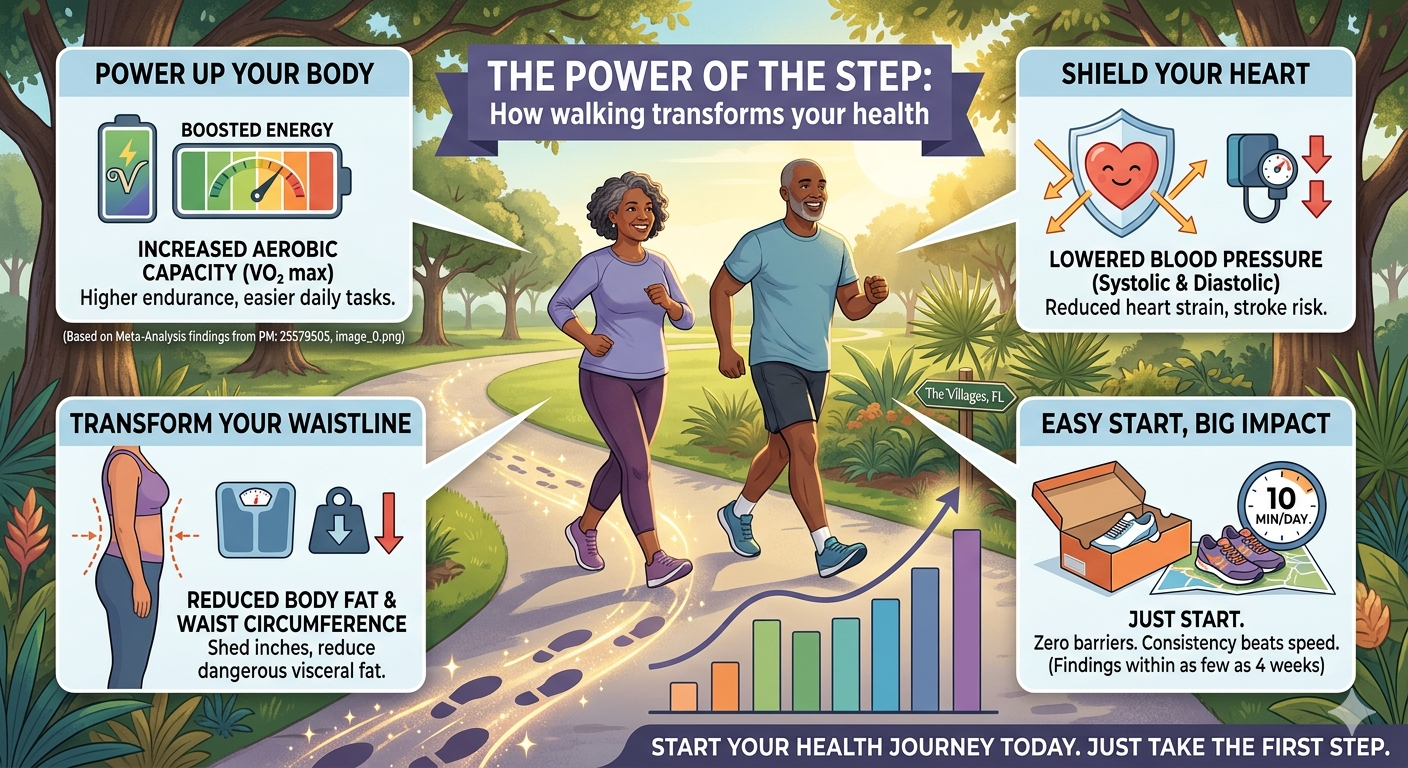
The study found that regular walking significantly increases your aerobic capacity—your body’s ability to take in and use oxygen efficiently. Think of it as upgrading your body’s battery. When your aerobic capacity goes up, everyday tasks feel easier. You’ll have more energy to get through the workday, play with your kids, and enjoy your weekends without feeling constantly wiped out.
2. You Protect Your Heart (Lower Blood Pressure)
Heart disease is a silent threat, but walking is your personal shield. The research showed that walking interventions successfully reduced both systolic and diastolic blood pressure. By dropping those numbers, you are actively taking the strain off your heart, cleaning out the pipes, and dramatically lowering your risk of heart attacks and strokes.
3. You Shed the Inches (Weight and Body Fat Loss)
You don’t need to punish yourself with grueling workouts to see changes in the mirror. The data proved that walking as a standalone treatment leads to significant reductions in body weight, percentage of body fat, and—crucially—waist circumference. Trimming down your waistline isn’t just about fitting into your favorite jeans; it’s about reducing visceral fat, the dangerous fat that wraps around your vital organs.
The Best Part? The Barrier to Entry is Zero.
The participants in these clinical trials weren’t elite athletes. At the baseline, they were completely inactive. They didn’t start with marathon training; they just started walking. And in as little as 4 weeks, their bodies began to heal, strengthen, and transform.
Walking requires no subscription, no special skills, and no ego. It doesn’t care how out of shape you think you are. It only requires your willingness to step outside.
How to Start Today:
- The 10-Minute Rule: Don’t worry about hitting 10,000 steps right away. Start with just 10 minutes a day. Walk down your street and walk back.
- Make it an Experience: Put on your favorite podcast, call a friend, or use the time to unplug and disconnect from screens.
- Be Consistent: The magic isn’t in how fast you walk; it’s in how often you do it.
Your journey to a healthier, happier, and longer life doesn’t start with a leap of faith—it starts with a single step. Put on your shoes, open your door, and go claim your health. You’ve got this!
Source: Murtagh, E. M., et al. “The effect of walking on risk factors for cardiovascular disease: an updated systematic review and meta-analysis of randomised control trials.” Preventive Medicine.
Leave a Reply